Get Full Government Meeting Transcripts, Videos, & Alerts Forever!
Get email alerts on the Confrontation Clause Cjis Printout topic
No spam. Unsubscribe anytime.
Appeals court hears arguments over admission of 'no record found' CJIS printout in firearms case
Summary
In oral arguments, defense counsel urged that a CJIS "no record" printout is testimonial hearsay violating the Confrontation Clause; the Commonwealth argued the result was nonhearsay or admissible as absence of a public record. The court took the matter under advisement and noted related Supreme Judicial Court guidance may be forthcoming.
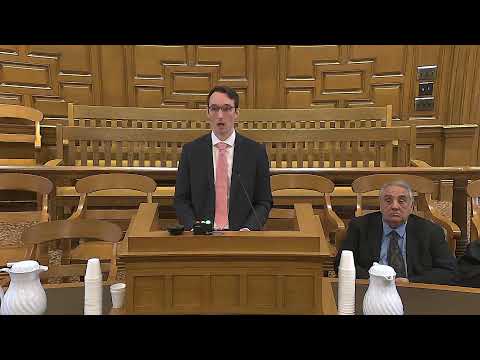
Defense counsel for the defendant argued at oral argument that a CJIS/BOPFI printout reading “no record found” is the functional equivalent of testimony that the defendant had no license to carry a firearm and therefore is testimonial hearsay barred by the Confrontation Clause.
The prosecutor, Jesse Crane, told the panel the printout and Dowd’s testimony were admissible because the result was computer-generated and, alternatively, qualified as the recorded absence of a public record under Massachusetts evidence law. The court took the matter under advisement.
At issue was whether a printout indicating no firearms-license record in the centralized database could be admitted to prove that the defendant did not hold a license. Defense counsel argued that the entry was prepared in anticipation of litigation and “was testimonial hearsay in violation of the confrontation clause,” adding that “no record... is the functional equivalent of stating you don't have a license.”
Jesse Crane, prosecutor for the Commonwealth, countered that the operative evidence — the “no records found” result — was nonhearsay for two reasons. “The first [reason] being that it was computer generated,” Crane said, and he also argued the result fit the exception for the absence of a public record under the Massachusetts Guide to Evidence, section 803(10).
The parties disputed whether the printout was truly computer-generated or a paper record produced from a database that local police officers populate. Defense counsel emphasized that other cases — including Commonwealth v. Royal and older precedents cited at argument — treat entries by human agents differently than records produced entirely without human input. Crane said Trooper Phil Dowd, a CJIS employee and retired state trooper, testified about how the database is populated and that a diligent search produced no results; Crane also noted Dowd independently confirmed the defendant’s name and date of birth via motor vehicle records.
Counsel discussed procedural options. Defense counsel suggested pausing the matter to await a decision in a related Supreme Judicial Court case, Commonwealth v. Quentin Smith, which the panel noted had been argued and might provide guidance. Crane acknowledged Smith might be helpful but urged the record here contained sufficient foundational testimony to admit the evidence.
The panel also heard argument on a related factual element: whether the Commonwealth had proved the defendant knew a firearm was loaded. The prosecutor relied in part on Resende-related authority and facts alleging an altercation at a bar and that the defendant carried a gun in his front pants pocket. The panel noted the evidence of the altercation was thin — largely testimony that an officer had been told an altercation involving a firearm occurred and that a complainant later reported an incident at the police station.
After hearing argument, the court said it would consider the briefs and oral argument before ruling. “We’ll take under advisement,” a judge told counsel.