Get Full Government Meeting Transcripts, Videos, & Alerts Forever!
Get email alerts on the Mpers Experience Study topic
No spam. Unsubscribe anytime.
Actuaries recommend lowering long‑term return assumption to 6.75% and phasing it in over four years
Summary
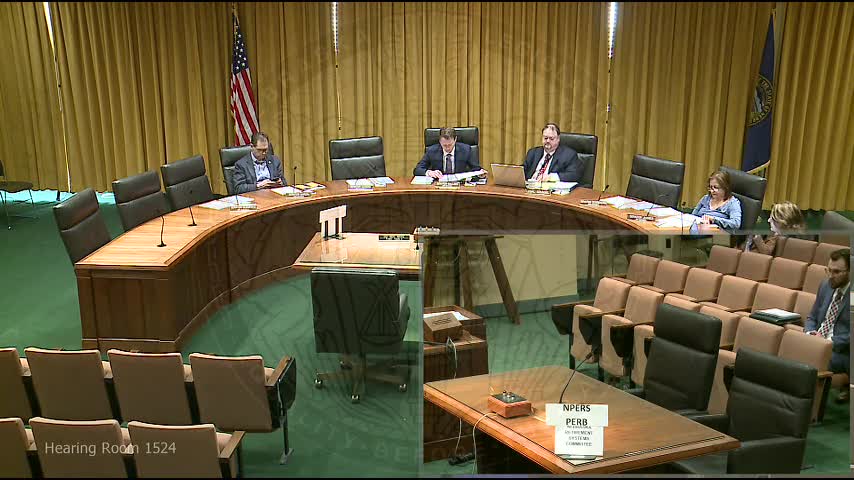
Actuaries for the Nebraska Public Employees Retirement Systems presented the system's experience study to the Legislature's Retirement Systems Committee and recommended lowering NPERS' long‑term investment return assumption to 6.75%, to be phased in over four years.
Actuaries for the Nebraska Public Employees Retirement Systems presented the system's experience study to the Legislature's Retirement Systems Committee and recommended lowering NPERS' long‑term investment return assumption to 6.75%, to be phased in over four years.
The recommendation, delivered by Brent Bannister of Cap Knott MacDonald, comes as the actuaries reviewed economic and demographic assumptions that underlie NPERS' actuarial valuations. Bannister told the committee, “Assumptions do not affect what a plan costs; they may affect what the contributions are in a given year.” He said the recommended 6.75% long‑term return reflects the system's current asset allocation and a 2.35% inflation assumption the actuaries proposed keeping unchanged.
Why it matters: the assumed investment return is a primary driver of actuarial contribution rates. Lowering the assumed return means the actuarial rate generally rises, which can reduce the contribution margin between what statutes or employers currently require and what actuaries recommend as necessary to fund benefits over time.
Key recommendations and numbers from the presentation: - Long‑term investment return: recommended 6.75% (the actuaries recommended phasing this change in over four years to lessen year‑to‑year budgetary impact). Bannister: “Our suggestion was, let’s move it down to 6.75%.” The Public Employees Retirement Board (PERB) had decided to phase the change in over four years, the actuaries said. - Inflation: retain at 2.35%. - Real return assumption implied by asset mix: actuaries estimated a real return of roughly 4.4% given NPERS’ asset allocation and recommended the lower assumed nominal return to match that mix. - Cash‑balance crediting rate: retain at 6% for state and county cash‑balance plans (the rate is based on a federal midterm rate with a margin, not below 5%). - General wage inflation: increase modestly from 2.85% to 2.95% to reflect near‑term wage pressures and a tighter labor market. - Individual salary‑increase patterns: small adjustments to the salary‑scale assumptions, including modest increases for years 3+ of service in certain groups (state patrol, school groups), rather than major structural changes. - Annuity election (cash‑balance plans): actuaries recommended moving the state plan's annuity‑election assumption from 50% to 55% (county to remain near 50%) based on account‑weighted experience.
Demographic assumptions: Pat Beckham, also of Cap Knott MacDonald, said the actuaries made only minor adjustments to demographic assumptions overall, and specifically recommended no change to mortality assumptions because the mortality experience during the study period — which included COVID years — did not warrant a different long‑term mortality table. Beckham said, “We are not recommending a change to mortality.”
Committee discussion and context: senators asked about COVID's lingering effects, the role of artificial intelligence and tariffs on future productivity, and why NPERS' assumed return differs modestly from other systems. The actuaries explained that the Nebraska portfolio is slightly more conservative than some peers — roughly 30% in fixed income — and that asset allocation is the primary driver of expected returns. On the topic of unfunded liabilities, the actuaries said Nebraska's funds are generally well funded compared with national medians, and noted the state's funding policy aims to amortize unfunded liabilities over 25 years.
Next steps: the actuaries said the phase‑in will be reflected in upcoming valuations; the first step of the phase‑in (6.95% in their example) will appear in the 2025 valuation and future valuations will incorporate subsequent steps. They emphasized annual valuations will continue to track experience and adjust contributions as warranted.
The committee did not take a formal vote during the hearing; the presentation was an informational session on actuaries' findings and the PERB's decision to phase the new assumption.