Get Full Government Meeting Transcripts, Videos, & Alerts Forever!
Get email alerts on the Municipal Code Amendments topic
No spam. Unsubscribe anytime.
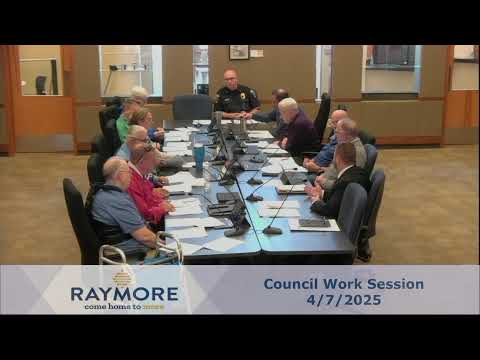
Raymore staff present omnibus criminal and traffic code amendments including golf-cart enforcement and domestic-violence language
Summary
City staff presented an omnibus package of proposed amendments to Raymore's criminal and traffic codes at a council meeting, seeking changes to how the municipal court and police enforce domestic violence, hindering-prosecution offenses, golf-cart registration and traffic violations, sidewalk-blocking parking and vehicle lighting/equipment rules.
City staff presented an omnibus package of proposed amendments to Raymore's criminal and traffic codes at a city council meeting, asking the council to consider revisions that would change how the municipal court and police enforce domestic-violence offenses, hindering-prosecution cases, golf-cart operation and registration, sidewalk-blocking parking and vehicle lighting/equipment violations.
Jonathan Fairborn, a city staff presenter, said the set of proposals "affectionately" could be called an "omnibus crime bill" and that the changes respond to items raised by the city prosecuting attorney, the municipal judge and the police department. "Over the course of the last several months, there have been a number of items ... that we feel the code needs to be updated and addressed relative to new conditions that have arisen," Fairborn said.
The most detailed elements described by staff include:
- Domestic-violence language: Staff proposed replacing references to civil adult-abuse statutes with criminal-code provisions so municipal court penalties—jail time, fines and required classes—can be applied at the local level. Fairborn said the current code cited Revised Statutes of Missouri sections that emphasize civil remedies (protective orders and child-support modifications) rather than criminal enforcement and that the draft would substitute the criminal sections and add criminal definitions for "domestic victim," "family" and "household members." He said victims could still pursue civil remedies in circuit court under the civil statutes.
- Hindering prosecution: The draft would add language to permit charges when a person gives a false name or date of birth to officers. Fairborn said police had identified this gap after the city adopted a later version of state law that omitted the provision. The proposed change would classify providing a false name or date of birth as a Class A misdemeanor under the municipal code.
- Neighborhood vehicles (golf carts): Staff described proposed enforcement changes to chapter 341 governing neighborhood vehicles. The ordinance would explicitly allow traffic-code citations for golf-cart operation and give the city clerk authority to administratively revoke a city-issued neighborhood-vehicle registration for 12 months when individuals under age 16 violate traffic laws while operating the vehicle. Fairborn said registrations are currently issued for two-year periods and that the city has about 77 registered neighborhood vehicles. He framed the revocation as a tool to hold owners and parents responsible when underage or unlicensed operators commit traffic violations; the council discussed insurance coverage, juvenile referrals to the juvenile office and, in serious cases, charging parents with child-endangerment when injuries occur.
- Stopping/standing/parking and sidewalk blocking: Staff proposed incorporating Revised Statutes of Missouri section 300.44 into the municipal code with clarifying language to prevent vehicles or trailers from blocking sidewalks or pedestrian crossings (the so-called "Burke rule" example was discussed). Enforcement would generally start with a notice and 30 days to correct the condition and could proceed as property-maintenance citations; staff said either code enforcement or police could issue citations depending on the circumstance. Councilmembers asked whether temporary obstructions such as trash cans would be included; staff said routine, temporary trash cans would not be the target and that enforcement is complaint-driven.
- Lighting and defective-equipment rules: Staff proposed removing or replacing direct references to state Chapter 307 provisions (and related statutory notification and warrant/notice requirements) from the municipal code so the city can rely on its own, detailed code language for lights and equipment violations. Fairborn and staff said the change would avoid additional state-imposed procedural steps that local prosecutors and the judge found burdensome; Fairborn said conversations with the municipal judge and the city prosecutor indicated the draft trims language to give the local judge clearer enforcement authority.
Council members asked clarifying questions about enforcement mechanics, juvenile reporting, insurance coverage for unlicensed drivers on neighborhood vehicles and how the city would notify current registrants of new rules. Fairborn said the city clerk administers neighborhood-vehicle registrations and suggested adding the revised enforcement language to the inspection and registration paperwork; he also said staff would probably send updated notices to the 77 registered vehicles.
No formal vote on the proposed ordinances was recorded in the transcript. Staff answered council questions and indicated support from the municipal judge and city prosecutor for the proposed wording changes; the council asked for clarifications but did not adopt the package during the meeting.
Additional meeting notes: multiple presenters and staff referenced Missouri statutory sections by number and discussed how existing cross-references in the code had, in some cases, produced unintended civil-only pathways that limited municipal criminal enforcement. Staff repeatedly described the package as a consolidation intended to avoid piecemeal updates and to restore local enforcement options.