Get Full Government Meeting Transcripts, Videos, & Alerts Forever!
Get email alerts on the Climate Superfund topic
No spam. Unsubscribe anytime.
Make Polluters Pay Act draws broad testimony as committee opens hearing; bill carried forward
Summary
The Senate Committee on Energy and Environment heard extensive testimony on Senate Bill 1187, the Make Polluters Pay Act, on April 7, with experts, community members, faith leaders and business groups testifying for and against establishing a Climate Superfund Recovery Program to recover climate damages tied to 1995–2024 emissions.
The Senate Committee on Energy and Environment opened a public hearing on Senate Bill 1187 on April 7, hearing extensive testimony both for and against establishing a Climate Superfund Recovery Program to assess and recover costs from large fossil‑fuel suppliers for climate‑driven damages.
Senator Khan Pham (Senate District 23) introduced the bill, describing it as the Make Polluters Pay Act. He said the measure would establish an interagency Climate Superfund Recovery Program to adapt to and mitigate climate impacts and to hold responsible parties strictly liable for the cost of covered greenhouse‑gas emissions from 1995 to 2024. Pham told the committee the approach draws on models in Vermont and New York and would assign an interagency role to account for Oregon’s multiple agencies; the bill includes a 30% set‑aside for fire resilience and adaptation to be managed by the Oregon State Fire Marshal and directs DEQ to identify responsible parties and issue cost‑recovery notices under sections 9–12.
Academic and technical witnesses described the scientific and legal basis for the bill. Rachel Rothschild, assistant professor at the University of Michigan Law School, said state climate superfund laws can be designed to comply with the U.S. Constitution and federal law, including the Clean Air Act’s savings clauses, and pointed to precedent in hazardous‑waste and state tort litigation. John Perona, professor of environmental biochemistry and law at Portland State University, described source‑attribution methods that use historical production records and emissions factors to identify companies responsible for large cumulative greenhouse‑gas outputs and allocate damages in proportion to emissions. Larry O’Neill, Oregon State Climatologist, summarized Oregon climate observations and projections, including a recent doubling of 90°‑plus days in Salem during the past five years and projections that extreme heat days and temperatures like those experienced in the 2021 heat dome will become more frequent.
Supporters described tangible local harm and recovery costs. Mark Gabbah, former mayor and state representative, cited NOAA data noting multi‑billion‑dollar statewide events in recent years and urged the committee to hold large polluters accountable. Testimony from community members and faith leaders described personal losses in the 2020 Almeda and Holiday Farm fires and asked the Legislature to ensure polluters help pay recovery and resilience costs. Economic testimony from Ernie Nimi and others estimated large ongoing economic costs from wildfire smoke, heat mortality and impacts to productivity and insurance markets.
Opponents, including Oregon Business and Industry, Northwest Pulp and Paper Association, and the Oregon Liability Reform Coalition, urged the committee to oppose or substantially revise the bill. Their testimony cited existing state climate programs, concerns about retroactive liability back to 1995, potential double regulation or costs for in‑state businesses, and the need for more time to vet a sweeping, first‑heard bill before committee deadlines.
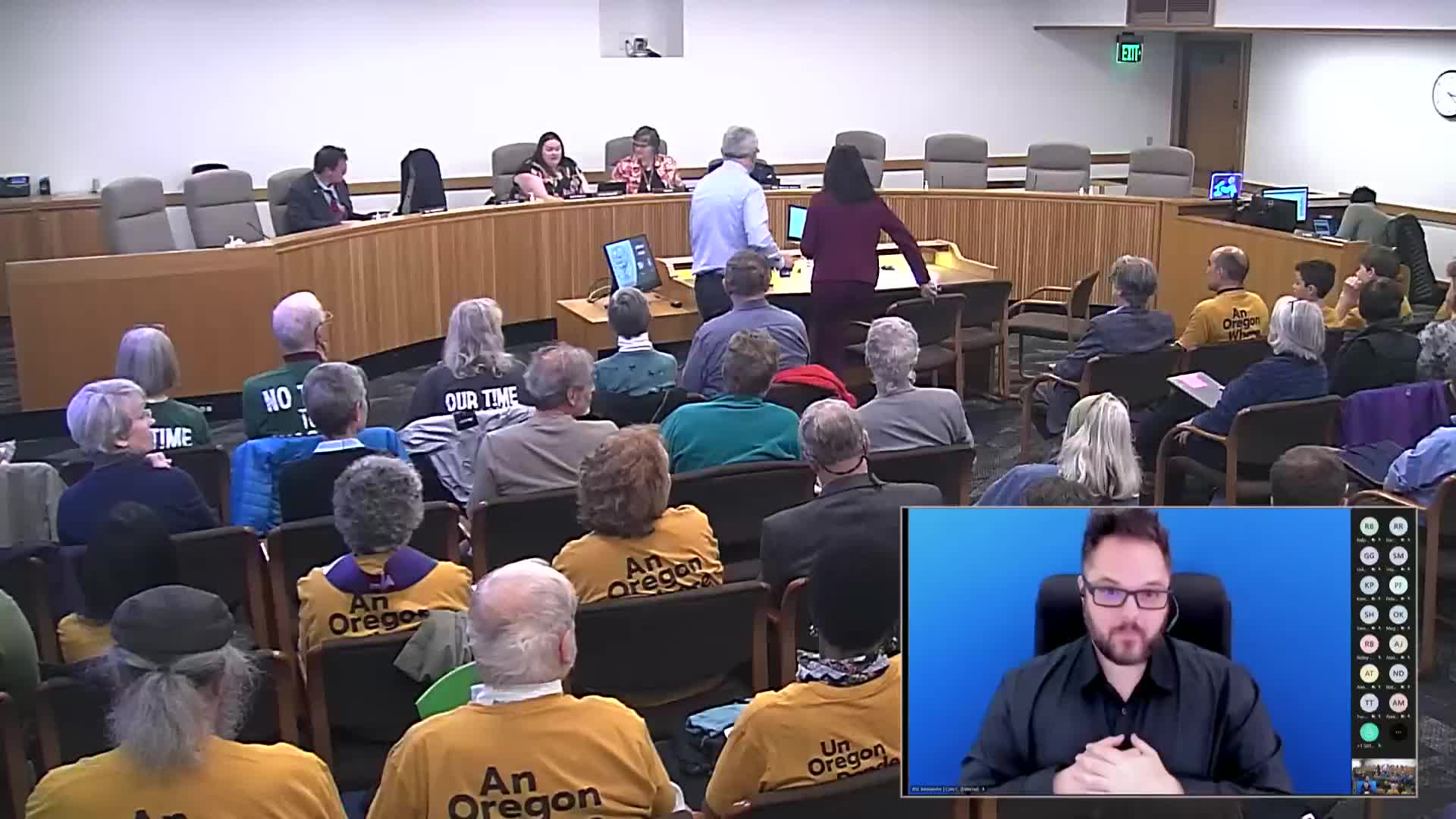
Committee members allowed a large public panel; the chair noted approximately 36 people testified before the committee recessed the hearing. Committee leadership said the bill would be carried forward to Wednesday for additional testimony and directed those who had traveled to submit written testimony. The chair closed the public hearing and said a small number of opponents remained on the sign‑in list but the majority of in‑person testimony was in support.
The hearing record includes testimony from sponsors, scientists, economists, frontline community members, faith leaders, and business groups. Committee action at the hearing was limited to receiving testimony; the chair carried the bill forward for further deliberation.