Get Full Government Meeting Transcripts, Videos, & Alerts Forever!
Get email alerts on the Land Use Development topic
No spam. Unsubscribe anytime.
Fort Myers Beach council approves CPD boundary expansion and clears mobile vendor park with strict conditions after contentious public debate
Summary
After lengthy public testimony and detailed staff review, the town council unanimously approved expanding a commercial planned development (CPD) boundary on Estero Boulevard and separately adopted a second ordinance permitting a mobile vendor/food truck park with conditions limiting hours, amplified music and special events.
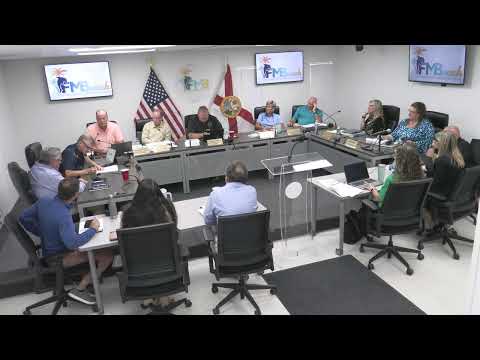
The Fort Myers Beach Town Council voted unanimously April 7 to expand the commercially planned development (CPD) boundary on Estero Boulevard and to approve a companion CPD ordinance allowing a mobile vendor (food truck) park, after hours of testimony from residents, property owners and attorneys on both sides.
The council’s actions authorize an expanded CPD boundary that adds two parcels to an existing CPD; councilors also approved a separate ordinance that sets the allowed uses, performance conditions and operational limits for a proposed mobile vendor park on parcels including 2510 and 2518 Estero Boulevard and 2543 Cottage Avenue.
Why it mattered: The two votes together enable the developer’s plan to operate a permanent, managed site for mobile vendors and a permanent support structure (service building and restrooms) near long-standing residential buildings. Neighbors and the Pelican Watch condominium association argued the use is incompatible with adjacent homes and will harm property values, while the applicant and staff argued the proposal complies with the comprehensive plan and land‑development code when implemented with conditions.
Council and staff said the effort to separate the boundary-expansion vote from the use/conditions vote was meant to ensure the council considered the footprint of the CPD and the allowed uses as distinct decisions. Community Development Director Judith Frankel and town planning staff presented findings that the expanded boundary met the criteria in the land development code and comprehensive plan; she told the council the Local Planning Agency unanimously recommended approval at its January hearing.
Public testimony: More than a dozen residents, property owners and attorneys spoke at the two quasi‑judicial hearings. Opponents pressed several points: they called the proposed open‑air food truck park with on-site alcohol and amplified entertainment an intrusive commercial use for lots that were formerly single‑family parcels; they raised traffic and pedestrian safety concerns for the narrow neighborhood streets; and they cited property‑value, noise and parking impacts.
Tom Brady, identified in public comment as president of Protect FNB, told the council that opponents have “raised over $70,000 in two months and have hundreds of supporters.” He said neighbors felt misled about public input and that a resident’s window could face a 255‑foot building near Denaro Boulevard. Randy Bryceth, Pelican Watch HOA president (participating by Zoom), said the proposed plan “squeezes” adjacent lots and could create pressure on neighboring homeowners, possibly encouraging future lot sales that would enlarge commercial footprint.
Applicant and staff response: The applicant’s attorney, Noel Davies, and project representative Ken Golander said the application has been revised since first reading and that the developer has added buffering, relocated certain site elements and reduced impacts in response to comments. The project team said the permanent support structure was increased modestly in size to better enclose and buffer live entertainment, and that the site plan includes additional landscaping, a stabilized parking surface option, a gated parking kiosk and short‑term parking measures.
Council action and conditions: Councilor Mary Allers moved to approve the CPD boundary expansion; the motion carried unanimously (see Votes at a glance below). After extensive negotiation on operational limits, council approved the CPD ordinance authorizing the mobile vendor park and associated deviations subject to a series of staff- and applicant‑proposed conditions. Key operational restrictions adopted by the council include: - Hours of general operation limited in the ordinance; the council adopted a provision that the site close earlier outside daylight‑saving months and may operate to 10 p.m. during daylight‑saving time in season; the comfort station (public restrooms) is limited to the hours of operation. - Amplified/live entertainment limits: the council adopted a compromise limiting amplified live entertainment to four days per week, four hours per day (between noon and 8 p.m.), with no more than three of those days used for live/duo performances (solo/duo performers only; larger bands require special-event permitting). One of the four days may be used for non‑musical amplified programming (for example, trivia, a radio broadcast or community events) rather than live music. - Ambient (recorded/background) music: permitted but limited to 60 dB at the property line and must comply with the town noise ordinance; where the ordinance condition is more restrictive it controls. - Special events: rather than automatically granting a fixed number of special-event permits per year, council required that any special-event permit applications be processed through the town’s normal permitting process so council and public notice can occur. - Buffers and site design: applicant commitments adopted in the ordinance include an enlarged landscaped buffer along Pelican Watch, a 4‑foot decorative fence along certain property lines, upgraded tree sizes at planting, and a redesigned support structure sited to act as a sound and visual buffer between seating/truck pads and adjacent homes. The ordinance allows certain deviations from code (driveway spacing, buffer widths, parking location and surface) tied to the approved master concept plan.
Enforcement and next steps: The ordinance requires a development order and subsequent site‑plan review by staff to confirm that the final construction documents match the conditions adopted by council. Staff said a parking operations plan (including a gated kiosk with free first 20‑minute turnover) and a traffic trip‑generation study at development‑order time are required; if the trip‑generation review shows higher impacts, a full traffic impact statement will be required. The applicant committed to additional on‑site controls including directional signage, a right‑exit-only configuration for the Chapel Street driveway and a “pork‑chop” geometry to discourage cut‑throughs into nearby neighborhoods.
Opposition persisted: Pelican Watch and nearby homeowners said the conditions do not fully mitigate property‑value and noise concerns; their attorneys signaled they may continue to press civil challenges. Several residents also asked the council to review whether an appointed member of the town’s Local Planning Agency, who has publicly supported Protect FNB, should remain on the LPA while litigation or quasi‑judicial items are pending (that matter was discussed separately by council; see related article on local ethics and public comment).
Ending: Council members said they were satisfied with the concluded negotiations and the additional buffering and operational limits; the two CPD votes passed unanimously. The applicant will now prepare final development order materials and site plans so staff can verify the conditions adopted by council before construction permits are issued.