Get Full Government Meeting Transcripts, Videos, & Alerts Forever!
Get email alerts on the Municipal Budget topic
No spam. Unsubscribe anytime.
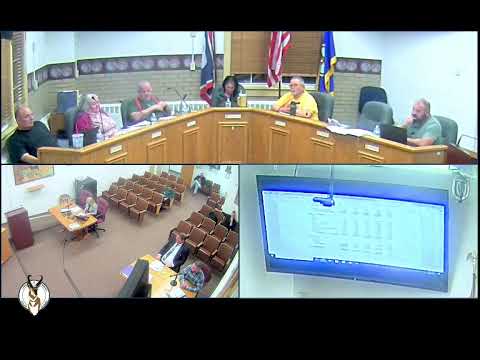
Rawlins council reviews preliminary FY2026 budget, flags $562,000 shortfall and major capital needs
Summary
The Rawlins City Council on April 7 heard a wide-ranging presentation from City Manager Tom Sarvey on the preliminary fiscal year 2026 budget, including a roughly $562,000 shortfall after proposed restorations of frozen positions and capital requests.
The Rawlins City Council on April 7 heard a wide-ranging presentation from City Manager Tom Sarvey on the preliminary fiscal year 2026 budget, including a roughly $562,000 shortfall after proposed restorations of frozen positions and capital requests.
Sarvey told the council the city is currently looking at potential expenditures of about $13,258,000 and projected revenues of $12,800,000. He said prior years’ hiring freezes account for about $438,000 in “frozen positions” that, if unfrozen, increase expenditures. The packet also lists capital requests of roughly $777,000 and a city capital-spending goal tied to depreciation of $1.5 million. "We have about 4 new positions that we would like to propose to, council throughout the organization," Sarvey said.
Why it matters: the budget discussion identifies a gap between operating needs, capital replacement shortfalls and the city’s revenue outlook. Councilors were asked to weigh restoring staffing, funding capital replacements such as a replacement fire engine, and maintaining a streets mill-and-overlay program.
Key numbers and context - Preliminary potential expenditures: $13,258,000; preliminary revenues: $12,800,000. - Frozen positions (past hiring freezes) total about $438,000. - After removing frozen positions, proposed new positions and additional capital requests, Sarvey said the net shortfall is about $562,000; when factoring in depreciation and a streets program estimated at $1 million annually the longer-term shortfall grows (he cited about $2.1 million when those are included). - General-fund payroll and benefits together account for roughly $9.1 million (salaries about $6.2 million; benefits about $2.9 million). - Full-time equivalents in the general fund are listed at 77.5; recreation has 12.5 FTEs; total general-fund FTEs were described as "just under 93."
Department-level proposals and reorganizations Sarvey walked the council through departmental pages and several staff leaders explained proposed changes. - Community development: staff said the city is restructuring to let the community development director focus full time on planning, zoning and project work. That includes moving oversight of the landfill, recycling and central garage to Public Works and adding a community development assistant to handle reporting and administrative tasks. "We would get somebody that could write reports and take notes and all those different things," Lou said of the proposed assistant. - Code enforcement: staff said they plan to transfer the code enforcement officer from the police department to community development to consolidate enforcement and data collection. - Public Works consolidation: Public Works Director Cody described bringing multiple operational departments (central warehouse, buildings and grounds, green spaces and others) under one umbrella and proposing an office manager (0.5 GF/0.5 enterprise allocation) and a shop superintendent to reduce multiple direct reports to the director. "The Public Works Administration's Office... handles quite a lot of Administration," Cody said. - Parks/Green Spaces and cemetery: staff proposed creating a separate cemetery budget and adding two part-time cemetery positions for seasonal mowing/watering; they also discussed phased investments to repair irrigation and add programmable controllers to reduce manual watering and long-term costs.
Public safety and capital requests - Fire apparatus and gear: Chief Robinson reviewed operational needs and capital asks, including replacement of Engine 2, which staff estimated at about $1,100,000. He said industry lead times run 32–34 months for a custom build (up to 48 months for more complex specs). "A lot of my stuff is geared towards maintaining and keeping the equipment that we have operational, usable," Chief Robinson said. He also asked for additional self-contained breathing apparatus (SCBA), noting new packs run roughly $7,000–$8,000 apiece. - Ambulance and hospital MOU: Robinson said the city functions as a next-out ambulance often and maintains an MOU with the local hospital for out-of-town runs; the hospital bills patients and the city charges a flat rate back to the hospital for those transfers.
Streets, equipment and facilities - Street sweeper and asphalt plant: streets staff requested a heavy-duty street sweeper (budgeted at approximately $375,000) and reported that the city’s asphalt plant is aging and near end of life. Councilors and staff discussed whether private contractors could perform patch work and how street-cut permits and timing affect pavement programs. - Central warehouse and equipment charging: staff recommended allocating heavy-equipment repair costs back to originating departments (including enterprise funds) instead of charging them centrally to better reflect true costs.
Finance, court, IT and personnel items - Municipal court: Sarvey and staff reported court revenue does not cover operating costs and discussed passing credit-card convenience fees on to users once systems allow it. Sarvey: the county currently applies card fees; Rollins does not yet have the accounting technology to pass those fees on citywide. - Finance and hiring: the budget proposes a purchasing agent to centralize procurement and to reallocate an accounting clerk position into enterprise funds while adding the purchasing agent in the general fund. The finance director role remains open. - City Attorney office: the city attorney described the office as staffed by an attorney and paralegal; a frozen deputy attorney position was noted. The attorney outlined typical market salaries for deputy-level positions and said a deputy would help with prosecutions, community development and code enforcement workflow. The attorney also described seeking an intern program as a low-cost staffing supplement. - IT: staff said they moved many software charges to departments and budgeted about $50,000 to begin replacing end-of-life servers. - Human Resources: staff reported unfreezing and refilling an HR manager position (3/4 previously) and flagged background-check and recruitment improvements as early assignments for new HR leadership.
Other operational points - CATS (city transit): staff noted the fare was raised from $0.50 to $2 in FY2025 and ridership has remained steady; the service largely covers approximately 10% of operating costs through fares.
Formal action recorded The meeting opened by approving the special meeting agenda for April 7, 2025. Council member Terry Pattison made the motion to accept the agenda; the motion was seconded and approved by voice vote. The motion passed with five "yea" votes recorded (no detailed roll-call record appears in the transcript excerpt). No budget ordinance or appropriation was adopted at this meeting.
What’s next Sarvey said this was the second of three budget sessions; enterprise funds (water, sewer, wastewater) were scheduled for the next meeting. Staff will return updated reconciliations as councilors direct and will bring additional detail on capital timing and personnel costs. The meeting adjourned at 8:36 p.m.
Ending note: Councilors asked staff to produce more granular cost estimates for major capital purchases (fire engine, sweepers, SCBAs), to propose options for phasing irrigation improvements at the cemetery, and to return with enterprise-fund allocations for shared positions and proposed hiring timelines.