Get Full Government Meeting Transcripts, Videos, & Alerts Forever!
Get email alerts on the Payment Processing Interchange Fees topic
No spam. Unsubscribe anytime.
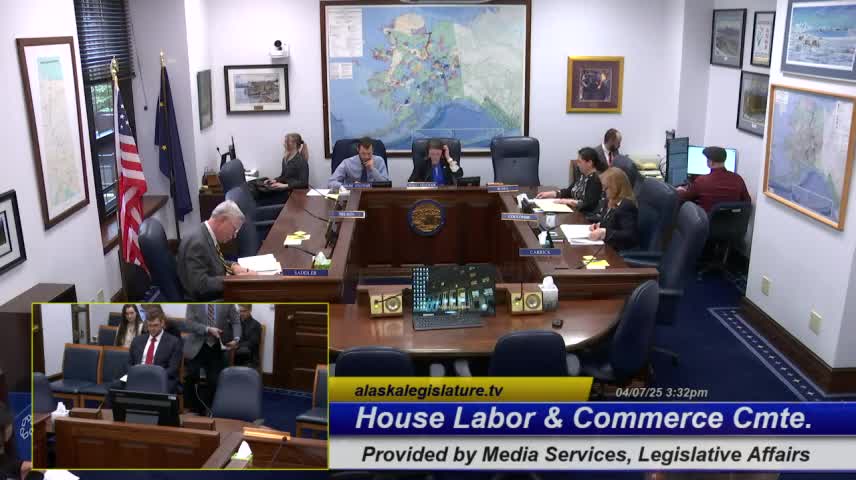
House Bill 171 would bar interchange fees on tax and gratuity portions of card transactions, sponsors say
Summary
Representative Bill Elam introduced HB 171 to prevent interchange fees on tax and gratuity portions of card transactions when merchants provide required documentation, with a 180-day documentation window and a required refund within 30 days.
Representative Bill Elam introduced House Bill 171 on April 7, proposing that payment networks and related entities be prohibited from charging interchange fees on the tax and gratuity portions of electronic payment transactions when merchants provide proper documentation.
"House bill 171 addresses how interchange fees, commonly known as swipe fees, are applied to electronic transactions," Representative Bill Elam said. He told the committee the bill is intended to reduce costs for Alaska small businesses by excluding taxes and tips from the base on which interchange fees are charged.
Kendra Broussard, staff to Representative Elam, walked the committee through the bill’s sections. The proposal would (1) prohibit issuers, payment card networks, acquirer banks, or processors from charging interchange fees on tax or gratuity amounts when documentation is provided during authorization or settlement; (2) allow merchants to submit documentation up to 180 days after a transaction with a required refund to the merchant within 30 days of receipt; (3) prohibit networks from raising fees on the remaining portion of a transaction to compensate; and (4) define terms and prohibit misuse of transaction data. The bill also adds a violation to AS 45.50.471(b) and establishes a civil penalty of $1,000 per violating electronic payment transaction.
Sarah Oates Harlow, president and CEO of the Alaska Cabaret Hotel, Restaurant and Retailers Association (Alaska Char), provided invited testimony supporting the bill. "Restaurants alone in Alaska are paying over $6,200,000 in credit card swipe fees annually just to carry out their role in collecting taxes on behalf of localities," Oates Harlow said, and told the committee those fees come out of tight restaurant margins. She said the bill could keep millions in Alaska and recommended narrowing the bill’s targets to payment card networks only, noting similar laws in other states have faced litigation.
Division of Banking and Securities representatives were on the line for questions but told the committee they lacked comprehensive state-level data on overall interchange-fee volumes. Committee members questioned logistics for merchants and whether existing point-of-sale systems and processor software can distinguish tax and tip portions; witnesses said processors and networks are developing software solutions and many merchants already track tax and tip amounts for reconciliation.
Members also raised preemption and litigation concerns. Committee discussion referenced ongoing litigation in other states (for example Illinois) where similar laws are being contested; witnesses and the sponsor said the language may need refinement to address federal preemption and to limit the entities covered if that reduces litigation risk.
The committee took no vote and set HB 171 aside for further study and future hearings, with additional invited testimony expected from national industry partners and local merchants.