Get Full Government Meeting Transcripts, Videos, & Alerts Forever!
Get email alerts on the Emergency Medical Services topic
No spam. Unsubscribe anytime.
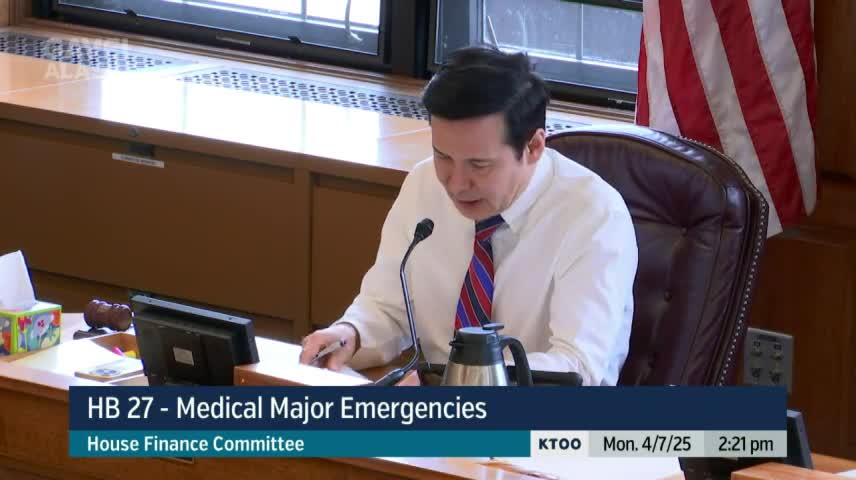
House Finance hears bill to expand Alaska’s EMS 'system of care' to include strokes and heart attacks; fiscal note seeks one staffer and data system
Summary
Representative Genevieve Mina introduced House Bill 27 to expand Alaska’s EMS system of care to include stroke and severe heart‑attack (STEMI) protocols, voluntary facility designation and a statewide registry.
Representative Genevieve Mina introduced House Bill 27, a measure to expand Alaska’s emergency medical services (EMS) system of care so it covers time‑sensitive medical emergencies beyond trauma, specifically strokes and severe heart attacks (STEMI). Mina told the House Finance Committee the bill would replicate the state’s trauma designation and registry model — which the committee established in 2010 — so that hospitals, EMS providers and other stakeholders can coordinate transfers, data collection and clinical protocols for stroke and STEMI care.
Mina and invited witnesses described gaps in Alaska’s current system. Neurosurgeon Dr. Lucy He (Providence/Alaska Regional) and longtime paramedic and EMS educator Bridal Webb said the state lacks a consistent statewide registry and voluntary facility‑designation process for stroke and STEMI; they argued those tools are necessary to measure outcomes, identify system gaps and improve triage and transfer decisions.
The Department of Health provided a fiscal note estimating a first‑year cost of about $240,000 (FY2026). The DOH proposal funds one new staff position to manage registries and convene subject‑matter committees and includes purchase of a data system to manage stroke and cardiac event records. DOH said funding for FY2026 would be primarily general fund (UGF) match ($211,700) with federal receipts of approximately $28,900.
Committee members asked detailed operational and policy questions. Representatives raised the realities of rural medevac and village clinical capacity, the voluntary nature of facility designation, how prehospital personnel would make diversion decisions in the field, and whether the state could repurpose an existing vacancy instead of adding a new position. Department and stakeholder witnesses said the trauma unit currently runs a statewide trauma registry and that replicating registries and a voluntary certification process for stroke/STEMI would require dedicated staff time and site visits.
Committee next steps: with roughly 18 minutes left in the scheduled hearing the committee set HB27 aside for further work and directed staff to include the fiscal note in the record. Members asked for additional information about current hospital participation in national stroke/STEMI accreditation programs, details about medevac and Coast Guard coordination for transfers, and options for staffing the DOH function (vacancy repurposing vs new position).
Why it matters: advocates said timely recognition and routing of stroke and severe heart‑attack patients can dramatically reduce death and long‑term disability by getting patients to the right facility and intervention quickly. DOH and providers said a registry and voluntary facility designation are foundations for quality improvement and federal grant eligibility; the fiscal note seeks modest initial investment to create that infrastructure.
The bill was set aside for additional follow‑up and will return to committee once staff and sponsors provide requested information.