Get Full Government Meeting Transcripts, Videos, & Alerts Forever!
Get email alerts on the Telehealth Reimbursement topic
No spam. Unsubscribe anytime.
Senate committee hears bill to require private insurers to pay telehealth at same rates as in-person care
Summary
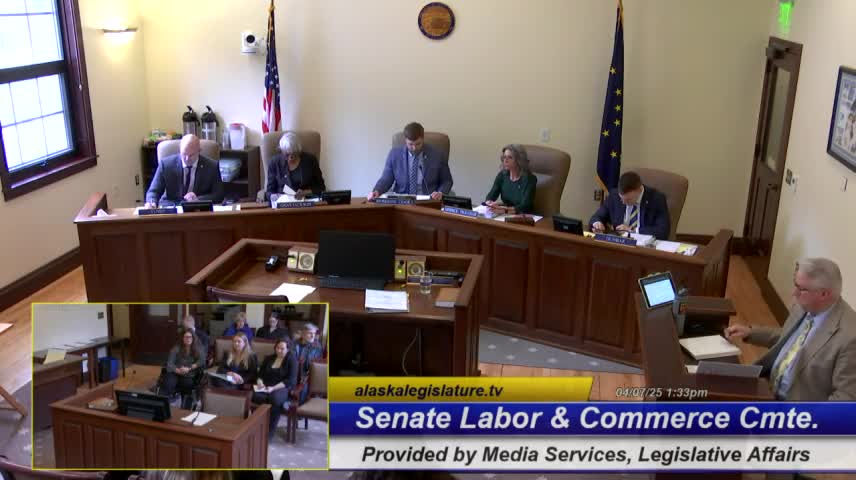
Senate Labor and Commerce on Monday heard its first testimony on Senate Bill 83, a bill that would require private health insurers to reimburse telehealth services at the same rate as comparable in-person services.
Senate Labor and Commerce on Monday heard its first testimony on Senate Bill 83, a bill that would require private health insurers to reimburse telehealth services at the same rate as comparable in-person services.
Senator Matt Klayman, sponsor of the bill, told the committee the measure “will ensure pay parity for telehealth requiring health care insurers to reimburse the same payment rate for telehealth services as in person care.” He said parity would expand access for Alaskans who face long distances, limited transportation and disability-related barriers.
The bill’s sponsor and staff described the bill’s structure and scope. Serena Hackenmiller, staff to Senator Klayman, summarized the committee substitute: it adds a new subsection under the cited Alaska statutes to require parity, explicitly includes behavioral health services, conforms several code sections to the new requirement, requires municipal group plans to follow the same standard, repeals a session-law sunset related to Medicaid telehealth parity, and sets an effective date of Jan. 1, 2026.
Economist James Rebitzer, testifying remotely, urged support on economic grounds. “Mandating equal payment can help solve a couple of economic problems that private parties can’t solve on their own,” he said, arguing parity reduces incentives for insurers to “free ride” on other payers’ investments in telehealth capacity. Rebitzer added Alaska’s geography makes underinvestment in telehealth “especially severe.”
Anchorage psychiatrist Dr. Howard Deltweiler said telehealth is essential to continuity of care in Alaska. Citing a recent snowstorm that kept patients from his office, he said telehealth allowed him to manage prescriptions and monitor side effects remotely. “Continuity of care and telecommunication, especially here in Alaska due to the distances and the climate and the problems that we have, are absolutely essential,” he said.
Committee members asked no questions of the witnesses during this hearing. No formal committee action was taken on SB 83 at this meeting; the item was presented and heard as a first hearing.
The bill text and sectional summary presented to the committee reference multiple Alaska statutory sections (as recited by staff during the hearing) and remove a temporary sunset in session law that previously applied to Medicaid telehealth parity. The sponsor’s office and staff said the bill is intended to align private-insurer reimbursement with an existing Medicaid parity framework already in state law.
The committee recessed after the presentation and testimony; members indicated they will take further questions through the sponsor’s office if needed. If the committee advances the bill in subsequent meetings it will be through additional committee action and a future report-out vote.