Get Full Government Meeting Transcripts, Videos, & Alerts Forever!
Get email alerts on the Land Use Minimum Lot Size topic
No spam. Unsubscribe anytime.
Council reopens discussion on minimum lot sizes, ADUs and subdivision rules
Summary
Councilmembers and planning staff discussed changes to minimum lot sizes, accessory dwelling units (ADUs), infill subdivision impacts and engineering constraints such as impervious coverage and alley access; staff said revisions will be considered as part of future zoning and subdivision code updates and no ordinance was proposed or adopted.
The Norman City Council discussed potential changes to minimum lot-size rules for residential development and the implications for accessory dwelling units (ADUs) and infill subdivisions during the same meeting; Jane Hudson, a staff member, presented the item and answered council questions.
Jane Hudson said the council's earlier conversations about ADUs prompted a broader look at minimum lot sizes for both greenfield subdivisions and infill parcel splits. "Once you sell off that back lot, it's no longer an ADU. It becomes the primary structure for that new lot," Hudson said, summarizing a recurring issue that can change setbacks, coverage and utility connections when an ADU is converted into a separate lot.
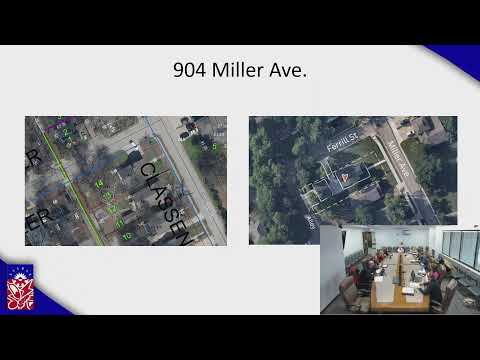
Staff walked the council through two primary scenarios: new greenfield subdivisions where minimum lot-size standards set the number of lots that can be created, and infill subdivisions where existing lots are divided to create smaller parcels or flag lots. Hudson and staff showed recent local examples — flag-lot configurations and short-form plats used in Fountain View North and other recent subdivisions — and explained common technical constraints including setbacks, required street frontage or access easements, water and sewer connection locations, and stormwater runoff calculations tied to the city's 65% impervious-coverage standard.
Engineering staff raised concerns about alley access, addressing and emergency-vehicle access when lots rely on alleys rather than conventional street frontages. One staff speaker said engineering is "not in favor" of designating alleys as primary addresses at this time because of emergency access and addressing challenges; the transcript records a council discussion of naming or numbering solutions but no policy change was adopted.
Council members asked whether minimum-lot rules would apply only in the core downtown area or citywide. Hudson said the rules could be applied broadly where public utilities and required services are available, and that homeowners associations or covenants could limit subdivision outcomes on private property. She noted the policy work would be part of the broader zoning and subdivision code updates the city plans to undertake as part of the pro-housing grant process.
Councilors and staff discussed trade-offs and potential unintended consequences, including: - Loss of existing smaller housing stock if lots are systematically redeveloped into larger, higher-end homes. - Increased impervious coverage and localized drainage concerns if lot coverage and setback rules permit very small lots without coordinated drainage plans. - The limits of variances: staff reminded the council that variances are adjudicated case-by-case by the Board of Adjustment under the legal standard of undue hardship and are not a reliable substitute for citywide code changes.
No votes were taken. Council members asked staff to gather additional examples from other cities (including those that have removed or reduced minimum-lot-size requirements), to examine utilities and drainage capacities, and to return with draft code language and targeted recommendations — potentially including a new zoning subcategory for smaller-lot neighborhoods or standards that apply only where engineering and addressing requirements can be met.
The council agreed to continue the discussion at a future meeting as part of the zoning and subdivision code rewrite; staff said some of the technical provisions (stormwater, alley access, addressing and emergency access) will require engineering review before any code changes are proposed.