Get Full Government Meeting Transcripts, Videos, & Alerts Forever!
Get email alerts on the Elections Administration topic
No spam. Unsubscribe anytime.
Senate passes election‑law changes including new citizenship declaration; ranked‑choice amendment defeated
Summary
House File 954 passed after hours of debate over a provision allowing on‑the‑spot challenges to a voter’s citizenship. An amendment to authorize ranked‑choice voting at the local level was defeated 13–34.
The Iowa Senate on April 7, 2025, passed House File 954, a package of election‑law changes that includes a signed declaration of U.S. citizenship on ballot affidavits and new procedures to challenge a voter’s citizenship at the polling place. The bill passed after a roll call in which 32 senators voted aye and 15 voted nay.
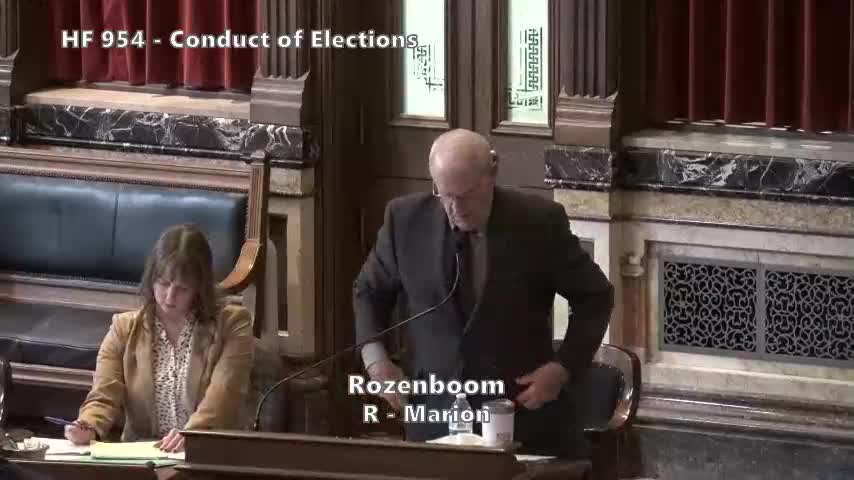
Debate centered on a provision that allows precinct election officials and third parties to challenge a person’s citizenship when the voter appears at the polls. Sponsor Senator Chris Rosenboom (R‑Marion) said the change is intended to give election officials additional tools after the Secretary of State identified what the office described as a small number of noncitizen registrations in the last cycle. “Only 40 noncitizens voted in last year's election in Iowa, and only 35 of those were counted,” Rosenboom said on the floor as he pressed the bill forward.
Opponents — including Senator Joe Weiner (D‑Johnson), Senator Matt Winkler (D‑Johnson) and Senator Tom Trone Garriott (D‑Dallas) — warned the provision lacked clear guidance on what documents prove citizenship at the polls and could produce inconsistent, county‑by‑county practices or even be used to target voters. “This opens the door to suppression of the vote throughout the state,” Senator Weiner said. Senator Winkler described the existing registration and verification process: voters supply a citizenship attestation on the registration form and the auditor matches records with DOT and other databases; he urged that administrative processes, rather than new on‑the‑spot challenges, are the correct means to address errors. “This process works,” Winkler said, outlining the current registration checks and the Secretary of State's match procedures.
The Senate also considered and rejected an amendment — Senate Amendment 3077 — that would have allowed local jurisdictions to elect ranked‑choice voting for municipal and school board contests. The amendment’s sponsor, Senator Trone Garriott, argued for letting communities choose; opponents raised concerns about cost, delayed results and ballot exhaustion. The amendment failed on a record roll call, 13 ayes to 34 nays.
Procedure and votes: The amendment to permit ranked‑choice voting was defeated 13–34. The overall bill passed by a roll call of 32 ayes and 15 nays, and the sponsor asked that the bill be immediately messaged following passage.