Citizen Portal
Sign In

Mesa outlines $800,000 Parks & Recreation reductions; Fremont Pool to close after this summer

2892655 · April 8, 2025

Loading...

AI-Generated Content: All content on this page was generated by AI to highlight key points from the meeting. For complete details and context, we recommend watching the full video. so we can fix them.

Summary

Parks and Recreation Director Andrea Moore told councilmembers the department must cut $800,000 from its operating budget, including closing Fremont Pool after summer, reducing event subsidies and trimming basin maintenance, while adding 24.7 part‑time FTEs to match current staffing needs and proposing fee increases to offset costs.

Andrea Moore, director of Mesa’s Parks, Recreation and Community Facilities Department, presented a proposed fiscal 2026 budget on April 7 that she said will require a net $800,000 reduction to city resources and a mix of program cuts, fee increases and staffing adjustments to balance service levels.

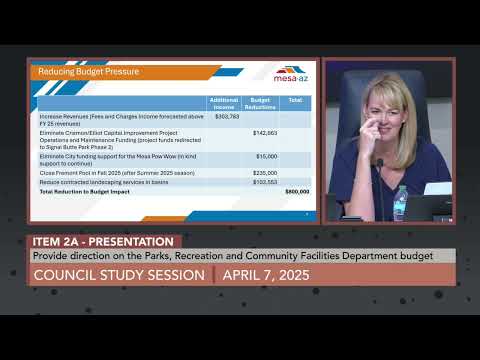
Moore said the department will seek about $300,000 in new revenue from recent fee adjustments and achieve the remainder of the $800,000 reduction through program eliminations, cuts to contracted services, and by eliminating operations-and-maintenance funding for a planned Elliot and Chrisman park development that was redirected to Signal Butte Park Phase 2. "We are pleased to present to you our budget proposed for fiscal year 26," Moore said in the study session.

The proposal includes closing Fremont Pool after this summer. Moore said Fremont Pool, built in the 1970s, has reached the point where continuing to keep it open would require major capital work — replastering, new filtration equipment and decking repairs — and the department recommends decommissioning it until a voter-approved replacement can be brought online near Red Mountain Center. Moore told the council the replacement pool is a bond-funded project planned for the Red Mountain site; she said the new pool is not expected to be in service for several years, and later in the presentation she referenced 2031 as the anticipated timeframe for the replacement.

Councilmember Spilsbury said the multi‑year gap worries parents. "Six years is a really long time," she said, adding that she was concerned about neighborhood access to pools, swim lessons and teen programming. Moore replied that Shepherd Pool to the west would be the nearest existing facility and that the department is also designing the Eastmark pool and another regional site; design work for the two voter-approved pools is already under way and a single design contract covers both projects.

On the cost side of the replacement, Moore gave a total project estimate for the Red Mountain pool at about $34 million and said combined design costs for the two pools are expected to be roughly 7–8% of that total (about $3.43 million). She emphasized that design work is funded by capital dollars and does not immediately add to general‑fund operating costs but warned that construction and opening the new pools would create ongoing operations-and-maintenance obligations the city must be ready to fund.

The department also proposes program and service reductions to help balance budgets while keeping current service levels where possible. Proposed cuts or eliminations include: cancellation of recreation‑center special events at Webster, Jefferson and Eagles community centers; holiday closures at Red Mountain Center, the Tennis Center and all pools; elimination of Sunday open hours at the Tennis and Pickleball Center (except for tournaments); ending fall, winter and spring school‑break camps at the tri centers while retaining after‑school programs and full summer camps; ending Friday open‑gym hours at Eagles Community Center; eliminating a $15,000 annual direct payment to support the Mesa Powwow while continuing in‑kind services; and reducing contracted basin maintenance frequency in winter months under the environmental compliance fund.

Moore said the department is proposing a 24.7 FTE increase in part‑time, non‑benefited positions to reflect actual staffing the department already uses but has been funding through vacancy savings and other one‑time lines. The additional part‑time staffing is estimated at about $1.3 million in personnel costs; Moore characterized the request as a correction to reflect the department’s current staffing rather than an expansion of new services.

To raise revenue, the department plans a second round of fee adjustments after Parks Board review in May. Moore said those changes would be implemented in the fall and include raising certain private‑rental, field, room and pool fees toward 100% cost recovery, charging affiliated youth groups for site supervision and field preparation where they currently are not charged, and an across‑the‑board increase of about 9–10% that the department estimates could yield roughly $1.2 million in additional revenue if implemented.

Moore outlined the department’s cost‑recovery framework: drop‑in public access (parks, open gyms) generally targets 20–30% cost recovery for direct program expenses; youth and introductory recreation sits in a 30–50% target range; more advanced or specialized classes and adult sports target higher recovery (some adult sports already exceed 100%). She said the department’s overall cost recovery currently runs about 32%.

Moore warned that if the department cannot realize the proposed fee increases and other savings, staff would have to move to more severe cuts such as making Kino and Skyline aquatic centers seasonal rather than year‑round, eliminating the city’s Celebrate Mesa spring event at Pioneer Park, and cutting the community fishing program — changes she estimated could amount to roughly $500,000 in program reductions.

Councilmembers raised questions about prioritization and equity. Councilmember Spilsbury urged attention to neighborhood playgrounds and argued those assets are broadly accessible to families. Moore said the department follows a parks master plan adopted in 2022 that incorporated community surveys and prioritization; she also noted a backlog in maintenance needs: she cited an estimated $14 million backlog in irrigation projects and about $6 million in playground renovations across the city’s roughly 75 playgrounds, many installed in the 1980s.

Moore also described an agreement with Mesa Public Schools governing decommissioned school pools: "Our agreement with Mesa Public Schools says that we return it to flat ground," she said, meaning the city would demolish and restore the Fremont Pool site if the council approves closure.

No formal motions or votes were taken during the study session on the Parks and Recreation budget. Moore and staff said they will present fee changes to the Parks Board in May and bring final budget recommendations back through the council budget process. The council also was told staff will continue design work on the two voter‑approved pools while deferring construction timing until the city confirms it can support ongoing operations and maintenance costs.

What’s next: staff will present the Parks Board with proposed fee changes in May, continue design work on the two bond‑funded pools and return to council as part of the city’s formal budget process. The council’s next study session will begin with public safety budgets on Thursday, according to meeting staff.