Get Full Government Meeting Transcripts, Videos, & Alerts Forever!
Get email alerts on the Behavioral Health Defense Counsel topic
No spam. Unsubscribe anytime.
Committee advances bill clarifying appointment process for defense counsel in involuntary-commitment cases
Summary
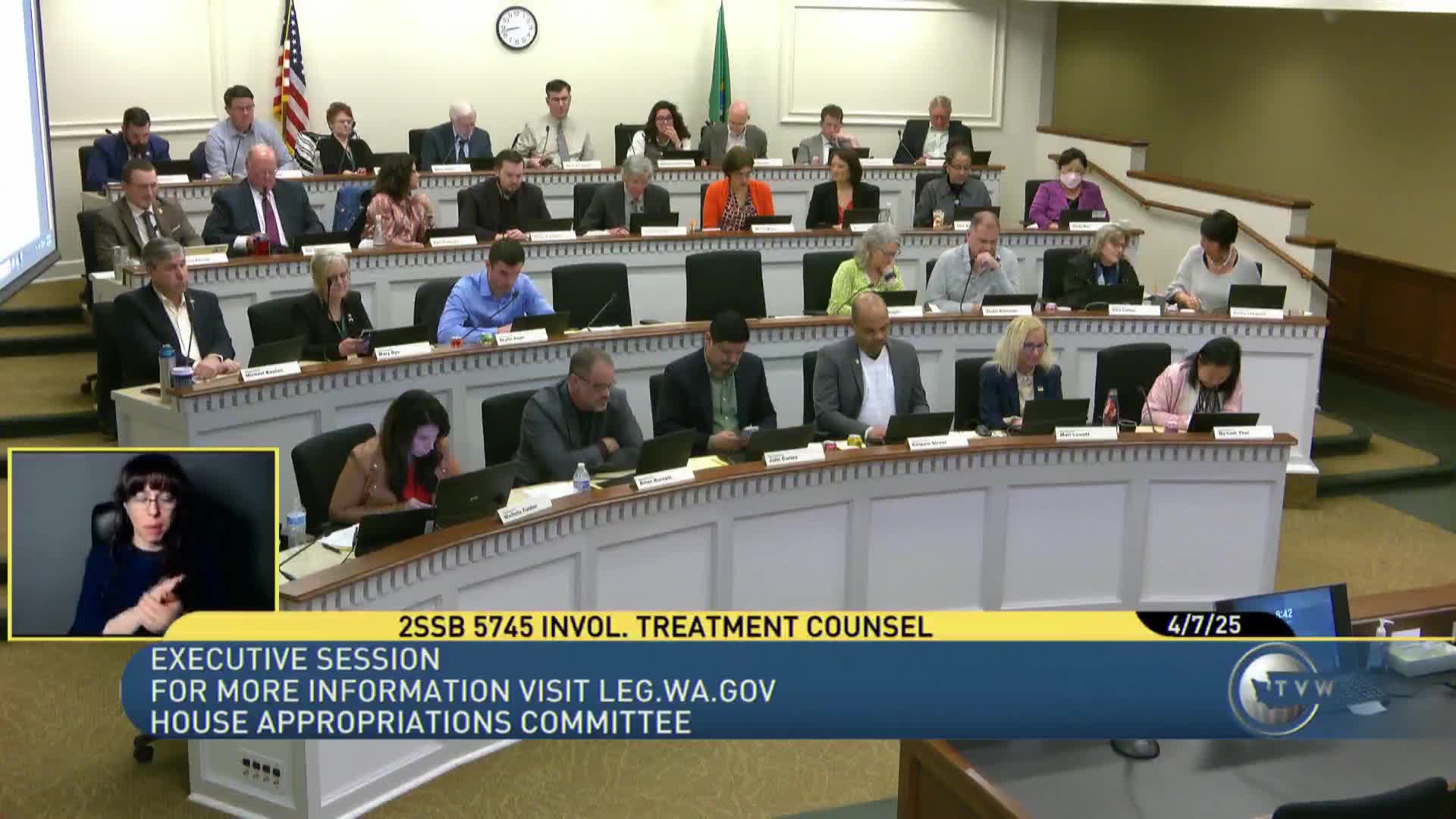
The Washington House Appropriations Committee on Oct. 12 reported Engrossed Second Substitute Senate Bill 5745 out of committee with a do-pass recommendation by a 19-12 vote.
The Washington House Appropriations Committee on Oct. 12 reported Engrossed Second Substitute Senate Bill 5745 out of committee with a do-pass recommendation, 19-12.
Vice Chair Macri said the bill seeks to address emerging challenges in providing appropriate defense counsel for people subject to involuntary-treatment or commitment proceedings after the state opened or acquired new behavioral-health facilities in several counties. He credited work with the Office of Public Defense (OPD), the Health Care Authority and the University of Washington's new Behavioral Health Teaching Hospital in creating a process that could allow OPD to help ensure consistent defense counsel while maintaining counties' central role in the ITA (involuntary treatment act) judicial process.
"It still requires that counties play the central role, in the ITA judicial process," Vice Chair Macri said. "But it is equally as important for the state to play a bigger role to ensure appropriate defense for folks." Representative Khoury raised concerns about cost-shifting to counties, saying, "We're concerned about the additional cost shift to the counties after next year," and said she would vote no for that reason.
The committee recorded a roll call tally of 19 ayes and 12 nays and reported the bill out of committee with a do-pass recommendation. The transcript shows committee-level debate about cost and county capacity but does not include details of fiscal allocations, nor specific implementation timelines in the hearing record.
The committee adjourned after reporting the bill; the record does not show subsequent floor scheduling or a final enactment date.