Get Full Government Meeting Transcripts, Videos, & Alerts Forever!
Get email alerts on the Dei Legislation Education Healthcare topic
No spam. Unsubscribe anytime.
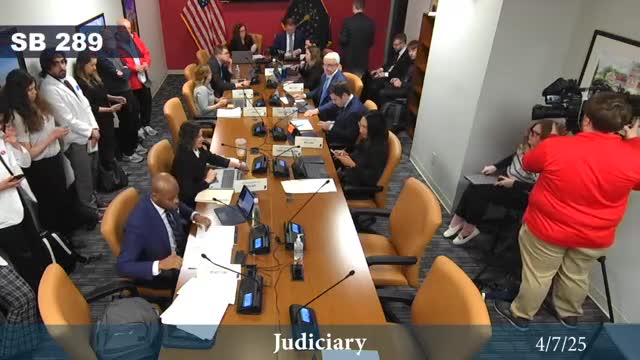
House panel advances amended SB 289 limiting some DEI practices; debate produces lengthy testimony from educators, students and advocacy groups
Summary
The Indiana House Judiciary Committee passed Senate Bill 289 on April 7 after adopting an amendment that sponsors say focuses the bill on government actions regarding diversity, equity and inclusion; the measure drew extended testimony from university faculty, medical students, civil-rights groups and community organizations.
The Indiana House Judiciary Committee on April 7 passed Senate Bill 289, an anti–diversity, equity and inclusion (DEI) measure, after adopting a set of amendments intended to narrow the bill’s scope. The committee vote was 7-3.
The measure grew from Senate language that sponsors described as intended to ensure equal treatment by public entities. Senator Chris Byrne and other supporters said the committee amendment (Amendment 11) focuses the bill on government actions and clarifies that agencies and institutions should not treat people differently based on a list of "personal characteristics," cross-referencing the Civil Rights Act and recent U.S. Supreme Court guidance. Supporters said the change makes existing executive orders and guidance more durable.
Opponents — a broad mix of university faculty, medical students, civil-rights organizations, education advocates and local nonprofits — warned the measure could chill classroom instruction, academic programming and campus support services. Dozens of witnesses spoke over two hours, including medical students, university professors and representatives of Indianapolis-area youth and civil-rights groups.
Key provisions and changes - Amendment 11 (adopted 9-3 on a roll call to the amendment) narrowed the bill’s original language, focusing enforcement on certain "actions" by public entities rather than curriculum content, and adding cross-references to federal civil-rights standards and to recent court decisions. Sponsor language referenced Students for Fair Admissions v. Harvard as a motivating event. - The bill creates a private cause of action in Chapter 7 with civil penalties that witnesses and advocates repeatedly criticized as disproportionate; committee testimony referenced penalty amounts in the range of $50,000 to $100,000 for violations, far above typical penalties for misdemeanors under Indiana law. - The amendment preserved certain institutional activities, such as allowing private donor funds for programming, while restricting compelled reporting or requirements that individuals adopt specified viewpoints.
What supporters said Senator Byrne described the bill as an effort to ensure "equal treatment under the law," saying he sought to confine the measure to government actions and to focus on actions rather than discourse. Laura D'Agostino, an attorney with Pacific Legal Foundation, testified in support and called the bill "a step in the right direction" to eliminate race- or gender-based governmental preferences.
What opponents said Speakers opposing the bill included students and faculty from Indiana University School of Medicine, representatives of the Indianapolis Urban League, the ACLU of Indiana, and community organizations. Their testimony focused on practical impacts in medical education, workforce recruitment, campus support and student mental health.
Medical students and educators testified that DEI offices and programming facilitate access and retention for underrepresented students, help with clinical readiness (for example, preparing clinicians for culturally specific presentations of disease), and support recruitment into the state’s health workforce. Many said they would be personally less likely to remain in Indiana if the bill or similarly restrictive policies took effect. Several witnesses asked the committee to delete Chapter 7’s civil-penalty provisions or sharply reduce the proposed amounts.
Administrative and implementation questions Committee members and witnesses raised questions about how the bill would interact with nationally required accreditation standards and licensure exams (for medicine, social work and other professions) that include content about cultural and social determinants of health; witnesses warned that the bill’s language, if read broadly, could conflict with those national standards.
Committee action and next steps Amendment 11 passed 9-3 on the roll call for the amendment; the final committee vote to pass SB 289 as amended was 7-3. Multiple members said the amendment substantially improved the bill, while others said significant ambiguity and risk remain — particularly around the private cause of action and the magnitude of civil penalties in Chapter 7.
Speakers and groups who testified included university faculty and medical students (many from Indiana University School of Medicine and Marian University), the Indianapolis Urban League, the ACLU of Indiana, the Marion County Commission on Youth, the Children’s Policy and Law Initiative of Indiana and several individual clinicians, many of whom described concrete classroom or clinical experiences. Testimony included calls both to retain robust DEI programming and to guard against any compelled ideological litmus tests.
Why it matters: Supporters say the bill codifies equal treatment and limits government use of "personal characteristics" in decision-making; opponents say the bill risks undermining instruction, accreditation compliance, campus supports and the state’s ability to recruit and retain a diverse health workforce. The committee left questions about Chapter 7’s penalty structure and about interactions with licensing and accreditation for further consideration as the bill proceeds in the session.