Get Full Government Meeting Transcripts, Videos, & Alerts Forever!
Get email alerts on the Public Pensions topic
No spam. Unsubscribe anytime.
Senate finance committee hears analysis showing defined‑benefit pensions' value exceeds projected defined‑contribution balances under panel assumptions
Summary
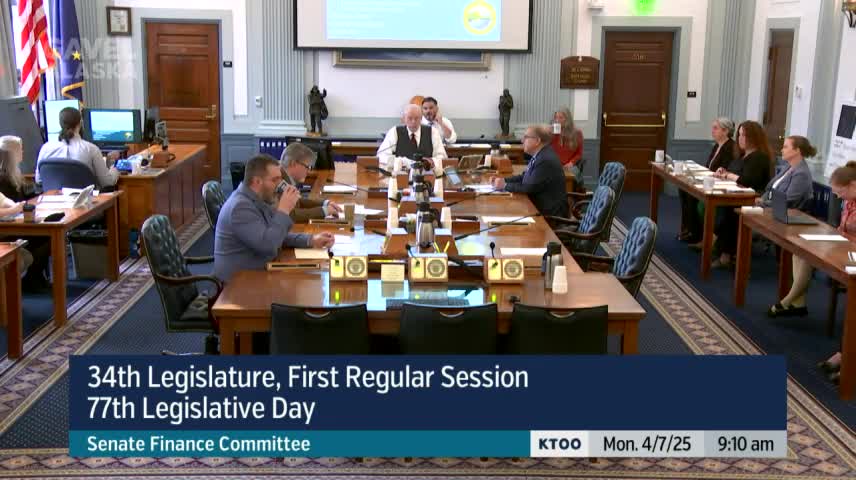
At an April 7, 2025 hearing, the Senate Finance Committee heard a detailed comparison of Alaska's defined‑benefit retirement plans (PERS and TERS) and proposed defined‑contribution alternatives from Kathy Lee of the Division of Retirement and Benefits and state actuary David Kershner.
At an April 7, 2025 hearing, the Senate Finance Committee heard a detailed comparison of Alaska's defined‑benefit retirement plans (PERS and TERS) and proposed defined‑contribution alternatives from Kathy Lee, director of the Division of Retirement and Benefits, and David Kershner, the state's actuary affiliated with Gallagher.
The department presented illustrations showing that, under the assumptions used by the presenters, the actuarial present value of the defined‑benefit (DB) promises — which includes statutory post‑retirement pension adjustments (PRPAs) — exceeded the projected accumulated balances for defined‑contribution (DC) accounts in every retirement age and return scenario the staff showed. The committee members pressed staff for additional breakdowns of tenure, unfunded liability contributions and how the Supplemental Benefits System (SBS) affects total retirement outcomes for employees not covered by Social Security.
Kathy Lee opened the presentation with her background and the purpose of the comparison. "My name is Kathy Lee. I'm the Director of the Division of Retirement and Benefits. I have worked in retirement and benefits for 34 years," she told the committee. David Kershner then walked members through the modeling choices and key assumptions and cautioned that comparisons require multiple assumptions. "DC members are basically subject to two interest rate risks," Kershner said, referring to investment returns during accumulation and the interest rate used if a participant annuitizes a DC balance.
Why it matters: Alaska's retirement systems and any change to benefit design affect the state's balance sheet, employer contribution requirements, and the retirement income available to public workers and retirees. Much of the committee's questioning focused on how modeling choices (hire age, salary growth, return rates, annuity conversion assumptions and PRPA indexing) change the comparison and on the budgetary consequences of the state's existing unfunded liabilities.
Key assumptions and features shown to the committee
- Assumed hire age and pay: illustrations used a notional hire age of 25 and a starting salary of $60,000, with annual salary growth of 2.75%. - Inflation and PRPA: the Anchorage consumer price index was assumed to rise 2.5% annually; PRPAs were illustrated at 50% of CPI before age 65 and 75% of CPI after age 65. The presenters noted the 10% Alaska residency COLA was excluded from the illustrations because not every retiree qualifies. - DC return scenarios and annuity conversion: DC accumulation scenarios used 5% and 7% annual returns. To convert DC balances to annuities for comparison, presenters used a 3.74% annuity conversion basis derived from a 30‑year average of 10‑year Treasury yields through March 2024 and a unisex mortality table. - Vesting and contribution rates: DC plans were shown with employer and employee contribution splits (example: DC employee contribution 8%; employer DC contribution 7%). Statutory DB employee rates shown included 7.5% for peace officers and firefighters and 6.75% for most PERS members; TERS (teachers) DB members were shown at 8.65% employee contribution. Employer DB statutory contribution rates cited in the presentation included about 22% for PERS and 12.56% for TERS; the presenters explained any excess actuarial cost is borne by the state.
Examples cited by presenters
- PERS police/fire example: a hypothetical employee hired at 25 with the starting pay used in the examples who retires at 50 had an illustrated DB starting annual benefit of $64,403. The comparable DC annuitized starting benefits under the department's assumptions were about $25,007 (5% DC return) and $33,531 (7% DC return); projected DC account balances at that retirement age were roughly $503,000 (5%) and $656,000 (7%) in the slide set. Present‑value calculations shown by staff included the present value of future PRPAs for DB members; DC present values reflected only accumulated DC balances under the chosen return assumptions.
- Across multiple retirement ages and for both PERS and TERS illustrations, presenters showed the DB present value (including PRPAs) exceeding the DC present value under the assumptions used in the department's slides.
Committee questions and follow‑up requests
Committee members asked about how representative the hire‑age and starting‑salary assumptions are of actual new hires (Kershner and Lee said age 25 was used for consistency with prior comparisons but acknowledged average new‑hire age is higher). Members also probed the meaning of the 10‑ and 20‑year post‑retirement illustrations (Kershner noted those were illustrative and that life expectancy is reflected in present‑value calculations). Senators asked for more granular data on average tenure and benefit outcomes for shorter career lengths (for example five‑, 10‑ and 15‑year employees), an update or inclusion of the state's scheduled unfunded liability contributions by fiscal year, and clarification about how tier structure affects costs. The committee asked the department to return with the SBS (Alaska Supplemental Benefits System) performance and comparative materials showing how inclusion in SBS changes TERS outcomes.
Department and staff actions
No formal committee votes occurred. The committee adjourned after directing staff to provide additional data: updated tables on unfunded liability payments and projected contributions, a breakdown illustrating how outcomes change for workers with shorter state service, and a follow‑up presentation on SBS performance and a comparative analysis that shows combined DB/SBS or DC/SBS outcomes where applicable. The committee scheduled to reconvene at 1:30 p.m. for a separate capital‑budget agenda item.
What the presenters emphasized
Kershner emphasized the two sources of risk for DC participants — accumulation returns and interest rates used for annuitization — and that DC annuity outcomes are sensitive to the prevailing interest rate at the time of purchase. Lee and Kershner repeatedly cautioned that the numbers shown were dependent on the illustrative assumptions and that different assumptions would change the comparison.
Quotes
"I have worked in retirement and benefits for 34 years," Kathy Lee said when introducing herself to the committee. David Kershner summarized a key modeling point: "DC members are basically subject to two interest rate risks."
Next steps
The Division of Retirement and Benefits will return to the committee with additional analyses requested by members, including SBS performance data and more granular career‑length comparisons. No votes or policy changes were adopted at the April 7 hearing.