Get Full Government Meeting Transcripts, Videos, & Alerts Forever!
Get email alerts on the Secretary Of State Budget topic
No spam. Unsubscribe anytime.
Secretary LaRose stresses cybersecurity, local election support and Safe at Home funding in budget testimony
Summary
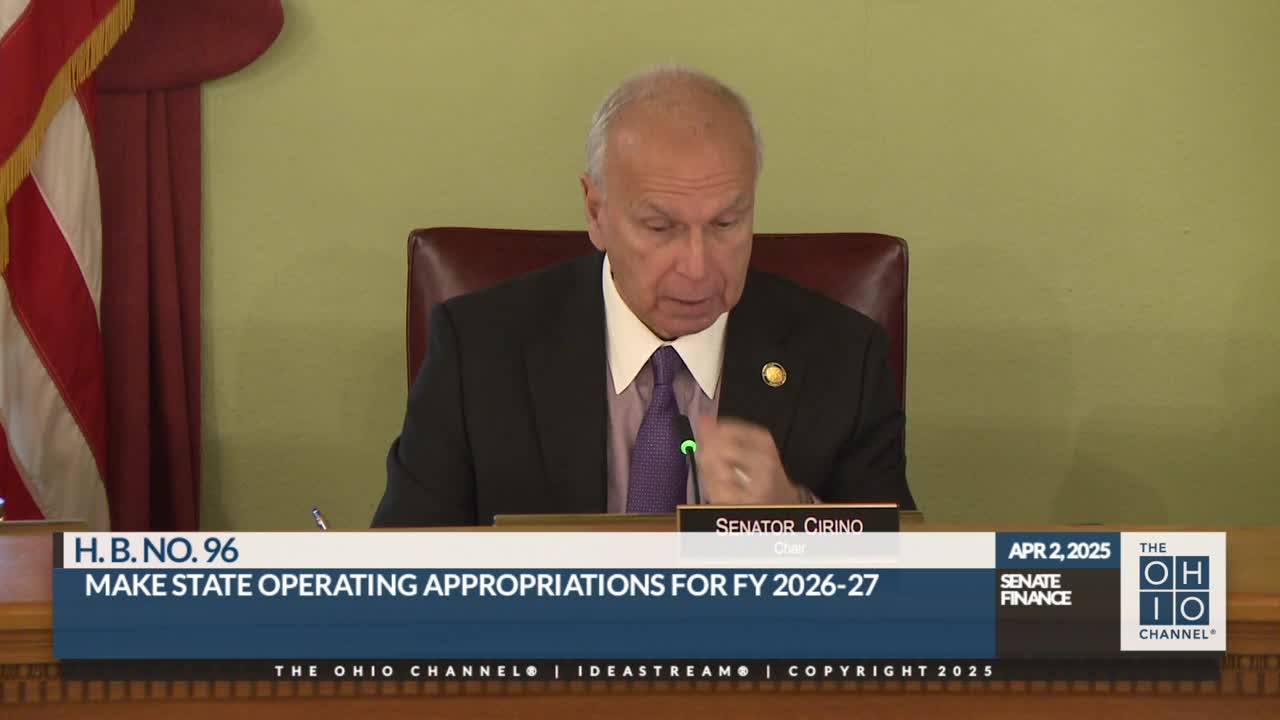
Secretary of State Frank LaRose told the Senate Finance Committee the office prioritized cybersecurity, county board grants and voter confidence; he warned that relying on business‑filing fees leaves the office exposed and asked senators to restore a $375,000 Safe at Home increase cut in the House sub bill.
Secretary of State Frank LaRose told the Senate Finance Committee the secretary’s office is focused on cybersecurity for elections, grants to county boards of elections, and maintaining low business‑filing fees while warning that the office’s fee‑reliant funding model creates a future deficit risk.
LaRose said his office’s mission is “we're the office that helps people vote and helps people start businesses,” and he told senators that Ohio ran “the smoothest election that Ohio has ever had” in 2024, citing record early turnout and post‑election reporting of results. He said the office led on cyber and physical security and stood up multiple operations to track and respond to election‑related social media concerns.
LaRose described several quantitative items: more than 5.8 million Ohioans participated in the 2024 election, and his office recorded 172,000 new businesses created in the prior year. He highlighted tools and transparency initiatives including an elections data portal at ohiosos.gov/data and voter‑tracking features at voteohio.gov/track.
LaRose urged senators to restore funding the House sub bill removed for the Safe at Home program, which provides confidential addresses for voters who are domestic‑violence survivors; he described the cut as $375,000 over the biennium and said the amount is modest relative to the program’s public‑safety purpose. “Nobody should have to choose between their personal safety and their precious right to vote,” he said.
On business filings and fees, LaRose said the office has held the standard business‑filing fee at $99 and intends to keep it to preserve Ohio’s competitiveness. He warned that relying primarily on business‑filing fees to fund the office makes the agency vulnerable to revenue swings; the office’s introduced budget tried to blend some GRF support with fees to avoid deficit spending in future years, he said.
Committee members asked about mailed absentee ballots and postal delays in some regions; LaRose said the office has worked with the U.S. Postal Service, maintains weekly election‑season meetings, and has encouraged county election officials to coordinate with local postmasters. He noted the deadline rule that absentee ballots postmarked by the day before the election should be counted and encouraged voters to use the online ballot tracking tool.
LaRose concluded by asking support for cybersecurity and county grants and for restoring the Safe at Home increase in the overall budget negotiations.