Lifetime Citizen Portal Access — AI Briefings, Alerts & Unlimited Follows
Laconia High officials report rising graduation rate, falling discipline referrals and continued academic recovery
Loading...
Summary
School leaders told the Laconia School Board that graduation rates and many academic measures have edged up since COVID while behavior referrals and chronic absenteeism have declined after a package of student-support changes.
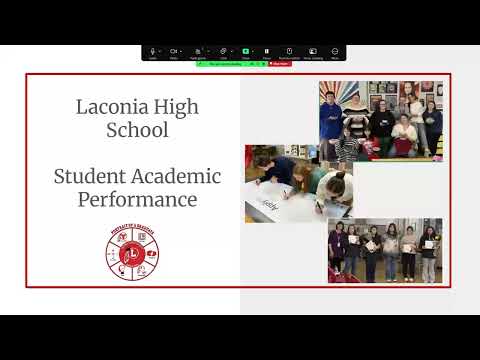
Laconia High School Principal Hines told the Laconia School Board on April 1 that the high school's graduation rate and several measures of student success have improved as the school implements targeted academic recovery and expanded behavioral supports.
In a presentation to the board, Principal Hines and members of the Laconia High administrative team said about 90% of course classes are being passed at the high school and that last year's graduation total rose to 117 of 140 students (about 84%), with this year's expected graduates at about 120 of 132 (about 91%). "We can say with certainty that 90% of our student population at Laconia High School, 90 percent of those classes are being passed, and so we're very proud of that total," Principal Hines said.
The update framed that academic progress alongside a sharp decline in discipline referrals and improvements in attendance. Assistant Principal Mike Boyle and Student Services Administrator Jen Sautak outlined a reorganization of student supports — consolidating counselors, mental‑health clinicians and restorative-practices staff into a common suite and expanding tiered interventions under the MTSSB (Multi-Tiered System of Supports for Behavior) framework. "We put them all together, got them some professional development, had them start to develop some systems. They collect data, and they took off," Sautak said, attributing the drop in referrals to those coordinated supports.
Why it matters: Board members said the combination of stabilized staffing, newly configured student‑support teams and building upgrades appears to be translating into better climate and improved outcomes, a priority as the district implements K–12 curricular alignments and earlier intervention strategies.
Key academic data and supports - I‑Ready at the high school is used by teachers as class-level pre/post assessment rather than a schoolwide growth metric; the administration said it is useful for planning targeted instruction rather than producing a single growth score. - Math and English diagnostic results show room for improvement: the presentation noted roughly 30–42% of students in math are at or approaching grade-level skills on the I‑Ready snapshot the school presented; English measures were stronger but still reflected students needing remediation. - SAT (state accountability) and PSAT participation and scores were reviewed. Principal Hines noted that Laconia's SAT measures have been roughly consistent and in some cases rising while state and national averages have slightly decreased over the same multi-year window. - Advanced Placement participation rose to 43 students taking 52 AP exams; the school counts a score of 3+ as a marker of proficiency for reporting purposes. - Alternatives and pathways highlighted: early-college (E-Start / Running Start), online classes, industry certifications (ServSafe, OSHA, cybersecurity), and Hewitt Technical Center partnerships.
Behavior, attendance and student supports - Daily referrals have fallen significantly since 2021; the presenters said repeat offenders remain a small share of the population and that the percentage of students with six or more referrals dropped markedly. - Attendance and tardiness data were described as improved; presenters said gains in school climate and staff stability have helped. - The school reorganized counseling and mental‑health services into a suite that supports classroom lessons (social-emotional curricula), suicide awareness (Connor's Climb), targeted group work (girls' groups, barbershop group), and external referrals to DCYF and regional mental‑health partners.
Staffing and operations - Presenters noted stable department leadership, new professional-learning structures (PLCs), and teachers participating in AP question‑reading and other external professional development. One physics teacher will serve as an AP question reader in June. - Building upgrades (electronic hall pass, secured single‑use restrooms, locker-room renovations) were credited with improving school climate; the administration flagged an April 11 anticipated opening of upgraded locker-room facilities.
What the board asked and next steps Board members pressed the administration on middle-to-high-school transition work and how the district is aligning seventh and eighth grade interventions to reduce incoming freshman deficits. Principal Hines said the district is rolling transition work back into the second half of seventh grade and strengthening a year‑long freshman seminar (freshman English) focused on transition skills, accountability and social-emotional learning.
The administration said it will continue to refine common assessments, portfolios and vertical curriculum alignment and to monitor interventions and staffing as the district expands early-college course offerings and career pathways.
Ending note: Board members and the administration emphasized that improvements reflected coordinated systems work rather than any single change and said they plan to return with additional assessment and enrollment detail as pathway expansions proceed.