Get Full Government Meeting Transcripts, Videos, & Alerts Forever!
Get email alerts on the General Obligation Bond topic
No spam. Unsubscribe anytime.
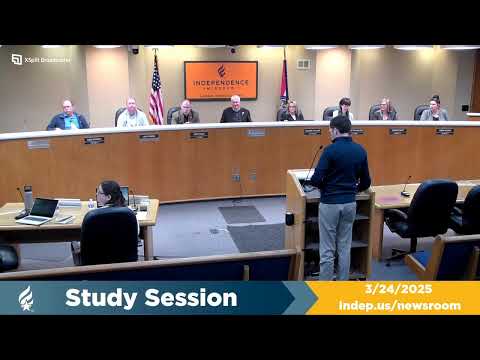
City manager presents $197 million general‑obligation bond package and tax impact ahead of April 8 vote
Summary
City Manager Zack Walker told the council the proposed three‑question general obligation bond package totals $197 million and described project lists and the estimated tax levy if voters approve all questions in full.
Zack Walker, city manager for the City of Independence, presented an overview of a three‑question general obligation (GO) bond proposal that will appear on the April 8 ballot if approved by the council. Walker described the proposals, explained how GO bonds function under Missouri law and detailed estimated costs, project lists and the tax impact if voters approve all three questions in full.
Walker said the three questions total $197,000,000: a public‑safety question ($130,000,000) that includes $123,000,000 for a new justice center, $4,000,000 to address the current police station site and $3,000,000 for the animal shelter; an infrastructure question ($55,000,000) that includes $30,000,000 for street reconstruction/overlay, $10,000,000 for sidewalks targeted to school corridors, and $15,000,000 for bridge repair or replacement; and a facilities question ($12,000,000) with $7,000,000 for historic sites (Truman Memorial Building, Vail Mansion, Bingham‑Wagner Estate) and $5,000,000 for the athletic complex.
Why it matters: Walker said the city faces roughly $430,000,000 in deferred maintenance across streets and other capital assets, maintains about 1,200 lane miles of streets, and has multiple bridges with restricted lanes or closures. Walker described the police headquarters, built in the early 1970s, as functionally obsolete and cited recurring maintenance costs averaging about $225,000 per year in recent years. He said comparable stations in neighboring cities were built or renovated more recently and that consolidation of police, court and specialized units onto a secured campus would improve safety and operations.
Tax impact and timing
Walker said, if all three questions pass in full, the city estimates a combined maximum levy of $0.82 per $100 of assessed valuation. He presented an example: using a county market value of $211,090 (assessed at 19% under state law yields $40,107 in assessed value), the annual tax liability at $0.82 per $100 assessed value would be approximately $328.88 for that illustrative property. Walker said the city expects a phased implementation of borrowing and project delivery over several years — his example timeline showed an aggressive six‑year phase in — and emphasized that not all of the levy would “hit” taxpayers at once.
Walker noted exemptions and rules: Jackson County’s property tax credit for seniors age 62 and older can exempt qualifying seniors from the bond levy; Walker said his financial estimate accounted for that exemption. He also explained that GO bonds must be repaid within 20 years of issuance and that issuance schedules will be tied to project needs.
Project details and alternatives
- Public safety: Walker described recurring building problems at the 1972 police headquarters (water infiltration, ADA issues, unreliable elevator) and space constraints for evidence and modern equipment. The proposal includes a new justice center and consolidation of related police units, plus demolition of the old police site to create a shovel‑ready downtown parcel.
- Infrastructure: Walker described the current street sales‑tax shortfall relative to $430M of need and said the bond would provide $6,000,000 per year over five years for accelerated street work, $10,000,000 for school‑area sidewalks (seven elementary schools prioritized with district input), and $15,000,000 to address 13 bridges that need repair or replacement.
- Historic sites and athletic complex: Walker said $7,000,000 would be allocated to maintain and repair the Truman Memorial Building, the Vail Mansion and the Bingham‑Wagner Estate and $5,000,000 would support reinvestment at the city’s 65‑acre athletic complex to attract regional youth sports events.
Oversight and next steps
Walker described three layers of oversight: quarterly reports to the council’s audit and finance committee, an annual public report to the full council and reporting to related sales‑tax oversight committees to show how bond dollars and sales tax maintenance funds are used together. He reminded the council the ballot question requires a 57% approval under state law, not a simple majority. Walker encouraged voters to use absentee voting and offered his email for groups seeking presentations.
Council interest and public engagement
Council members thanked staff for extensive outreach and presentations and asked about public tours of the police department; Deputy Chief Peterson confirmed two public tours (one weeknight evening and one weekend afternoon). No formal vote on the bond was taken at the study session; Walker’s presentation was an informational briefing ahead of the April 8 election.