Get Full Government Meeting Transcripts, Videos, & Alerts Forever!
Get email alerts on the Camp Ripley topic
No spam. Unsubscribe anytime.
Camp Ripley leaders brief Morrison County commissioners on training, construction and environmental work
Summary
Colonel Fink, speaking for Camp Ripley, gave a community briefing to the Morrison County Board of Commissioners covering training activity, economic impact, construction and environmental programs at the state training center.
Colonel Fink, speaking for Camp Ripley, gave a community briefing to the Morrison County Board of Commissioners covering training activity, construction and environmental programs at the state training center.
Camp Ripley, Fink said, aims to “provide the best customer service” while its primary mission remains military training. He told the board the installation had nearly $83,000,000 in annual economic impact and was the nation’s third busiest training center in 2024 with “nearly 558,000 man days” and almost “72,000 state and local agencies” participating in training.
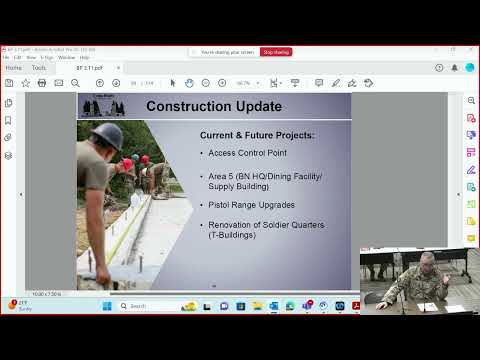
The briefing highlighted several infrastructure projects. “It’s going to cost right around about $17,000,000 to put in that access control point,” Fink said of a new main‑gate access control point that will remain on Highway 115 but be sited west of the current gate; construction is expected to start in late 2025 or early 2026 with a hoped‑for opening by the end of 2027. Fink said Camp Ripley plans upgrades in Area 5 (replacing 10‑hut facilities with year‑round training structures), a remodel of the Alpha 2 pistol range to accommodate the M17 Sig Sauer pistol, and interior renovation work on large T‑building barracks, including HVAC updates.
Fink also updated the board on the new museum building on Highway 371, describing it as “40,000 plus square foot” and estimating a mid‑ to late‑2026 opening. He said Camp Ripley expects its high‑throughput months in April and June and warned the community to expect press releases and other notices when artillery and other noisy training occurs.
On community programs, Fink said Camp Ripley has soldier and family resources for employees and family members, and that the installation now hosts three individual daycare providers serving about 800–1,000 employees. He said the base’s biannual open house will return in September and described changes to public hunting access: what had been a three‑day hunt was reformatted to extend through the bow season and will use the iSportsman sign‑up system.
The briefing covered environmental work and outreach. Fink said the installation plans roughly 15,000 acres of prescribed burns this year as part of range and grassland management and to control invasive species. He described the Army Compatible Use Buffer (ACUB) program around Camp Ripley as having “greater than about 40,000 acres enrolled thus far,” and said the buffers help reduce development encroachment and noise complaints. He noted partnerships with Central Lakes College and other state agencies that support environmental monitoring and prescribed‑burn planning.
Fink closed with a safety reminder about unexploded ordnance: if a civilian finds a suspicious device, “call 911, report it, or just call Camp Ripley and we can support you,” and he said a Duluth‑based EOD team responds for removal.
Commissioners asked questions about the base footprint and public services. Commissioner Winter asked, “How big is Camp Ripley?” Fink replied, “Camp Ripley is just short of 53,000 acres. The contonement, the garrison is about 2,100 acres.” Commissioner Casper asked about daycare on base; Fink confirmed there are “3 individual daycare providers on Camp Ripley now.” Commissioner Moran, Commissioner Blaine and others thanked the Camp Ripley delegation for the update.
No formal action was taken; the presentation served as an informational briefing and an opportunity for commissioners to ask questions and offer comments.