Get Full Government Meeting Transcripts, Videos, & Alerts Forever!
Get email alerts on the Oil And Gas Taxation topic
No spam. Unsubscribe anytime.
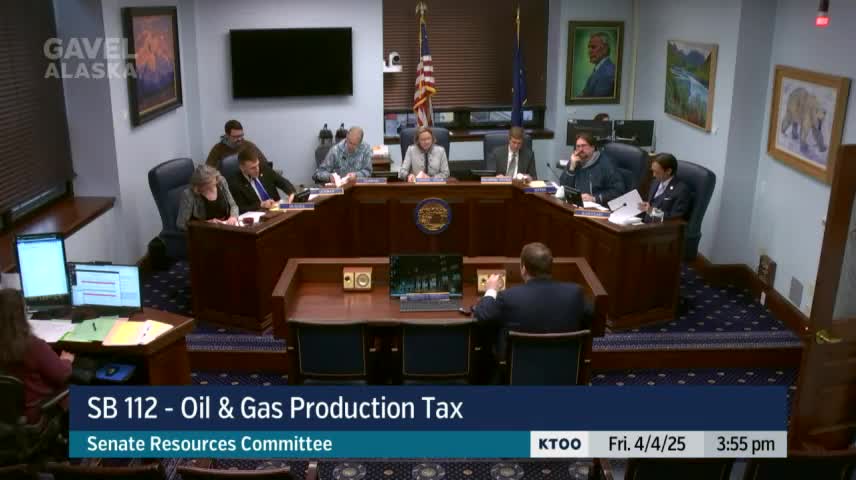
Committee hears divided public testimony on bill to trim oil per-barrel tax credit; no vote taken
Summary
Senate Bill 112 would reduce the maximum per-barrel production tax credit from $8 to $5 and add limits tied to qualified capital expenditures; committee reviewed sectional changes, took extensive public testimony both for and against, and left the measure for future consideration without a vote.
The Senate Resources Committee took up Senate Bill 112 on Feb. 4, a proposal to alter Alaska’s oil and gas production tax credits by reducing the maximum per-barrel credit and adding limits tied to qualified capital expenditures.
Hunter Lutzfeldt, staff to Sen. Wilkowski, walked the committee through the bill’s sectional changes. SB 112 would add a new subsection (k) that limits per-barrel credits a producer can claim tied to qualified capital expenditures and restricts the ability to carry forward those credits. The bill also adjusts the per-barrel sliding credit: the legislation would reduce the maximum per-barrel credit from $8 to $5 and sets an applicability and retroactivity clause applying the act to oil produced on or after Jan. 1, 2025, with immediate effective date language in the uncodified sections.
Committee members did not vote on SB 112. The committee removed an earlier objection to a committee substitute version I and then took public testimony that ran more than an hour, featuring labor, business, education and individual callers who were sharply divided.
Supporters of SB 112 argued the change is modest and would restore revenue for state services. Tim Hinterberger, calling as an individual, said the 2013 law SB 21 assumed prices above $90 and that lower realized prices have produced outsized credits; he told the committee, "Passing SB 112 would generate $190,000,000 for fiscal year 2016 and approximately $100,000,000 annually over the next decade." Several callers tied the bill to education funding; Caroline Storm, executive director of the Coalition for Education Equity, testified in favor and said, "oil companies are making an absurd profit in Alaska and I believe that they can pay a little bit more and they're actually not going to be paying more, they're just going to get less tax credits. We really, really need some revenue to support our schools." Other supporters similarly urged the committee to advance the bill to increase state revenue.
Opponents warned the changes would undermine Alaska’s investment climate and risk jobs. Kelly Droop, speaking as an individual with a family employed in the resource sector, said of SB 21 and investment: "The projects and jobs and the production forthcoming would not have happened without SB 21." Testimony from labor representatives and small-business speakers emphasized the risk to jobs, supply chains and port activity if the tax terms changed after investment commitments.
Chair Senator Giesel did not put the bill to a vote. After public testimony concluded the committee left the record open for additional testimony and indicated the measure will be revisited in later hearings. No formal votes or amendments were adopted on Feb. 4.