Get Full Government Meeting Transcripts, Videos, & Alerts Forever!
Get email alerts on the State Budget topic
No spam. Unsubscribe anytime.
Missouri House passes major FY2026 appropriations, backing K‑12 increases and new program funding
Summary
The Missouri House on April 2 approved a set of appropriations bills that make record investments in K‑12 education, transportation, higher education, public safety and health services while drawing opposition over foundation formula funding levels and a $50 million private‑school aid provision.
The Missouri House of Representatives on April 2 passed a package of appropriations bills that together fund large portions of the state's fiscal 2026 budget, including a record increase for K‑12 education, new transportation and infrastructure investments, and funding for public safety and health programs.
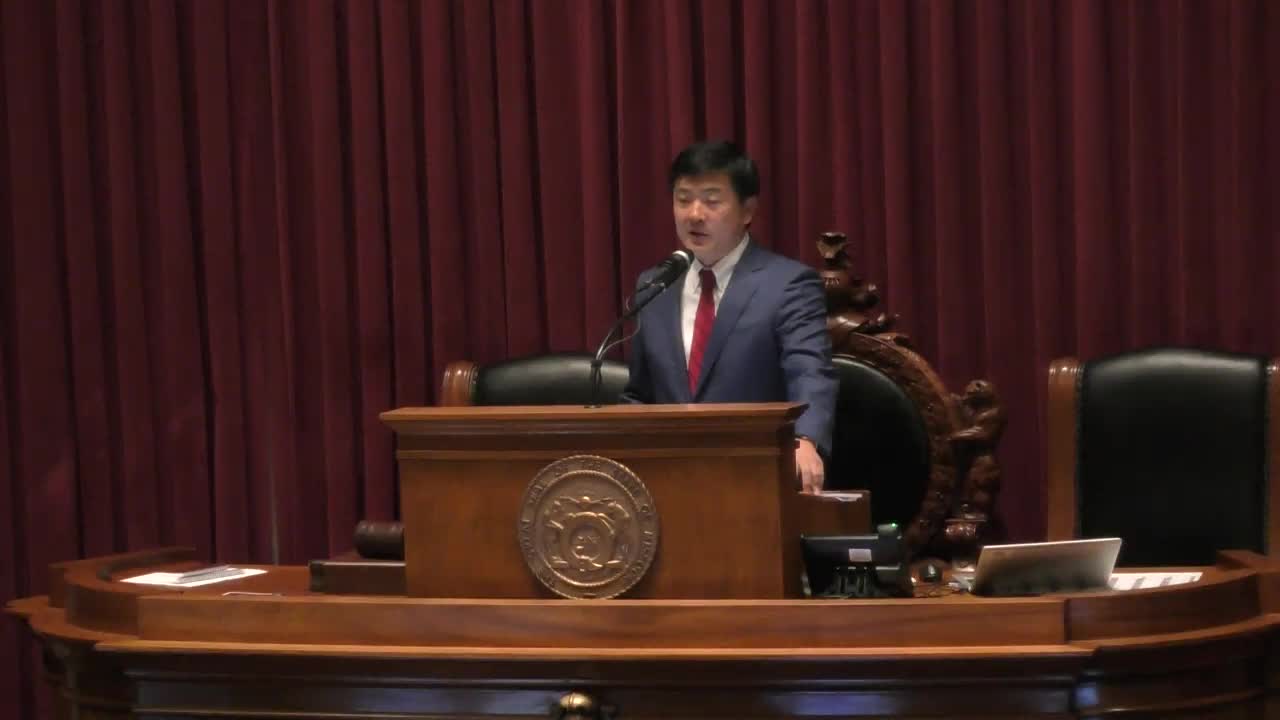
House Committee Substitute for House Bill 2, the main K‑12 appropriations bill, "includes a record amount of funding for our public schools," the budget chairman, the Gentleman from McDonald County, told the chamber. The bill passed on third reading, with the yeas being 95, the nays 34 and 25 present.
Why it matters: These bills together shape the state's operating budget for the fiscal year that begins July 1. They allocate billions for schools, colleges, transportation, public safety, veterans' care and health programs, and set policy priorities that the Senate will next consider.
What passed and key details
Votes at a glance
- House Committee Substitute for House Bill 2 (K‑12 appropriations): Passed; yeas 95, nays 34, 25 present. Sponsors said the bill provides roughly $4,000,000,000 for public education and a $47,900,000,000 operating budget total; some members said it falls short of fully funding the foundation formula.
- House Committee Substitute for House Bill 3 (Higher education and workforce): Passed; yeas 117, nays 17. Includes a 1.5% core funding increase and $27,100,000 for deferred maintenance for public colleges and universities.
- House Committee Substitute for House Bill 4 (Revenue and Transportation): Passed; yeas 147, nays 6. Sponsors highlighted $70,000,000 in new general revenue for MoDOT, $20,000,000 for rural roads and $10,000,000 for ports.
- House Committee Substitute for House Bill 5 (Office of Administration and personnel): Passed; yeas 149, nays 3. Includes employee benefit funding and adjustments to the governor's pay plan; committee said state employees will receive pay increases structured over years of service.
- House Committee Substitute for House Bill 6 (Agriculture, Natural Resources, Conservation): Passed; yeas 149, nays 3. The bill includes flood mitigation, agriculture grants and funding to support nutrient management and dairy industry initiatives.
- House Committee Substitute for House Bill 7 (Economic development, Commerce & Insurance, Labor): Passed; yeas 150, nays 4. Notable items: $10,000,000 for semiconductor reshoring efforts and $5,000,000 for a veterans employment fund.
- House Committee Substitute for House Bill 8 (Public Safety and Missouri National Guard): Passed; yeas 143, nays 2. Includes $10,000,000 for veterans homes, $10,000,000 for a "Blue Shield" law‑enforcement grant program, $4,000,000 for an eastern police training facility, and a $12,500,000 set‑aside tied to World Cup public‑safety needs.
- House Committee Substitute for House Bill 9 (Corrections): Passed; yeas 148, nays 3. Largest year‑over‑year increase was roughly $20,000,000 for offender health‑care contracts.
- House Committee Substitute for House Bill 10 (Mental Health; Health & Senior Services): Passed; yeas 138, nays 15. Includes increases for utilization, institutional and community mental‑health services; the bill reflects a roughly $25,000,000 general‑revenue FMAP impact for the Department of Mental Health.
- House Committee Substitute for House Bill 11 (Department of Social Services / MoHealthNet): Passed; yeas 130, nays 22. MoHealthNet (Medicaid) continuing costs and an FMAP adjustment produce a reported $46,000,000 pickup to general revenue; overall Medicaid spending remains the largest portion of the budget.
- House Committee Substitute for House Bill 12 (State executive, judiciary, public defender, secretary of state, treasurer, auditor, attorney general, legislature): Passed; yeas 95, nays 48. The bill contains funding for new judges, juvenile detention staff, CASA expansion and the state treasurer's "MOST Scholars" program; it also includes a $50,000,000 general‑revenue allocation intended to offset private‑school tuition (disputed on the floor).
- House Committee Substitute for House Bill 13 (Real estate/leasing for state government): Passed; yeas 146, nays 5. Provides funding for state real estate and lease needs.
- House Committee Substitute for House Bill 17 (Reappropriations): Passed; yeas 150, nays 5. Reappropriates previously approved multi‑year capital/project funding to allow ongoing projects to finish.
Debate highlights and concerns
Supporters framed the package as a bipartisan, fiscally responsible set of appropriations that increases investments across education, transportation, higher education and public safety while leaving a multi‑billion dollar reserve. "This is a balanced budget, a budget totaling $47,900,000,000," the Gentleman from McDonald County said when introducing HB 2.
Opponents objected to several choices in the bills. The Gentleman from Jackson argued that HB 2 does "not fully fund the foundation formula" and urged members to signal concern by voting no or present. Several members, including the Lady from Greene County, said the bills did not meet statutory funding minimums for the foundation formula and that childcare subsidies were not funded at desired levels.
HB 12's $50 million for private‑school tuition assistance drew sustained criticism on the floor. The Lady from Greene County described the measure as creating a precedent she could not support, saying public schools have local oversight that private schools lack, and that the change could erode public education funding. Other members argued the provision expands parental choice and represents an education investment for students who need alternatives.
Other programmatic notes
- Transportation: committee leaders emphasized rural road and port funding and said fully funding the statutory transportation reimbursement will help districts that do not benefit from the foundation formula increase.
- Veterans and public safety: bills include additional dollars for veterans' homes and a new law‑enforcement grant program; the House also approved increases targeted to Missouri State Highway Patrol pay and equipment.
- Health and social services: appropriations include autism funding, expanded utilization funding for mental‑health programs, prison nursery funding and additional addiction‑treatment resources; lawmakers repeatedly flagged federal FMAP and Medicaid uncertainty as a fiscal risk.
Ending
All passed appropriations now move to the Senate for consideration, where members may amend funding levels and program language. Lawmakers and staff on the House floor said the Senate review and final conference negotiations will determine the budget that the governor will sign into law.