Get Full Government Meeting Transcripts, Videos, & Alerts Forever!
Get email alerts on the Housing And Homelessness topic
No spam. Unsubscribe anytime.
Seattle-area housing providers warn federal cuts could put thousands at risk
Summary
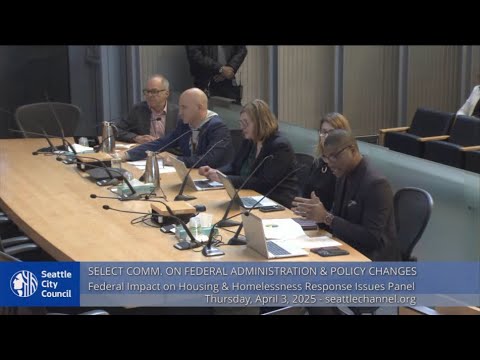
On April 3, 2025, the Seattle City Council Select Committee on Federal Administration and Policy Changes heard a briefing from local housing and homelessness providers about how proposed federal staffing and program changes, tariffs and tax-credit market shifts could reduce rental assistance, delay affordable development and put thousands of households at risk.
On April 3, 2025, the Seattle City Council’s Select Committee on Federal Administration and Policy Changes heard a briefing from local housing and homelessness providers on how federal policy and budget changes could affect services and housing production in Seattle and King County.
The presentations warned that proposed federal staffing reductions, changes to homelessness grant agreements, lower low-income housing tax credit prices and tariffs on construction materials could combine to reduce available rental assistance, delay or cancel affordable housing projects and leave thousands of vulnerable residents at risk of losing supports.
Speakers told the committee that federal funds remain a major part of the local homelessness response and affordable-housing financing stack. King County Regional Homelessness Authority, housing developers and service providers outlined immediate operational impacts, numbers of people potentially affected, and contingency planning they are undertaking with local partners.
Simon Foster, deputy CEO of the King County Regional Homelessness Authority, told the committee that the agency and partner jurisdictions depend on federal Continuum of Care and HUD funds. Foster said KCRHA “receives directly from HUD $23,000,000” and noted an additional $36,000,000 goes directly to King County, for a combined $66,000,000 in HUD-related funding in the region. He said roughly $7,000,000 of that amount flows to contracted service providers.
Foster gave a point estimate of populations at risk if renewals or reimbursements are delayed. “We’re talking about a total number of individuals of 4,490 people,” he said, and added that “over 2,000 people reside here in the city of Seattle.” Of that group, Foster said about 2,174 individuals live in private-market units and could face late fees, loss of subsidies or eviction; 2,316 are in transitional, youth or safe-haven programs that could again be pushed into homelessness; and about 241 front‑line employees are at risk if funds disappear.
Developers and investors described how federal tax and tariff policy affects the capital stack for subsidized housing. Naomi C., vice president of investor relations at Hunt Capital Partners, explained how low-income housing tax credit (LIHTC) pricing is a major input to project capitalization. She said that uncertainty about corporate tax rates and market underwriting is pushing investor pricing down by “10 to 15¢ on the dollar,” and that historically strong Seattle prices (as high as $0.95 per credit) are now sometimes in the $0.75–$0.80 range. Lower LIHTC pricing increases the subsidy gap that local gap-funders—cities, state agencies and philanthropic sources—must fill.
Naomi also highlighted the effect of tariffs on construction inputs and borrowing costs, noting that “72% of imported lumber comes from Canada, and 74% of imported gypsum comes from Mexico,” and that tariffs and higher inflation can feed into higher mortgage and construction financing costs.
Jess Blanche, senior program director at Enterprise Community Partners, summarized the changing federal budget and staffing landscape and flagged program-level impacts. Blanche said the current continuing resolution mostly funds federal programs at FY2024 levels but leaves shortfalls from fair‑market‑rent adjustments and other pressures. She noted HUD notices saying emergency housing voucher payments will be released late April with an expectation that “no additional funding from HUD will be forthcoming,” a change from prior expectations about the program’s duration.
Blanche also described the recent cancellation notices to Enterprise and LISC of HUD Section 4 capacity-building awards, which she said affected roughly $60 million nationally and more than $1.2 million of planned local grants to Washington organizations between the two intermediaries. She called Section 4 a levered federal program and urged Congress to restore funding; Enterprise is asking for $50,000,000 for FY26 to preserve capacity-building activities.
Service providers described the operational consequences. James Lovell, interim CEO of Chief Seattle Club, traced how capacity-building grants helped the organization scale from no owned units to multiple buildings and tiny-house villages, and said the Section 4 cancellations and other federal cuts have “severely hampered” the club’s ability to plan and expand. Lovell described the disproportionate impact on urban Native people and said culturally specific providers can get better housing outcomes for those populations when they have stable funding to plan and operate.
Daniel Malone, executive director of Downtown Emergency Service Center (DESC), outlined how federal funding supports clinical and housing services in his agency’s portfolio. “This year, we’re anticipating reimbursement from the Medicaid program of about 9 and a half million dollars for this set of services,” Malone said, and warned that reductions to Medicaid expansion, or work requirements, would jeopardize services and insurance coverage for many people who depend on those benefits.
Committee members asked about contingency and continuity-of-operations planning. Panelists said planning is difficult because of multiple unknowns—timing of grant renewals, pending administrative changes, tariff actions and tax-law proposals—but that partner agencies are preparing scenario plans and coordinating with King County and the city to prioritize core services. Foster said KCRHA is “working with King County and the city of Seattle to ensure that we come up with appropriate contingency plans,” but emphasized limited local fiscal capacity to replace large federal funding streams.
Council members also heard requests for local action. Panelists urged the council to consider targeted local revenue or reallocation, to preserve provider capacity and keep staffing in place at permanent supportive housing sites; to support federal advocacy on LIHTC and other programs; and to maintain flexibility on preservation and acquisition strategies if new construction pipelines slow.
For now the committee record shows the select committee received the briefing and opened follow-up conversations with city, county and regional partners. The council and partners plan continued monitoring of HUD and HHS developments and further committee discussion on next steps.