TAG recommends most 2024 UPC plumbing changes for Washington, flags backflow and condensate concerns
Loading...
Summary
At its April 3 meeting the Building Code Council's Mechanical Ventilation and Plumbing Codes TAG reviewed the 2024 Uniform Plumbing Code model changes and voted to recommend adoption of most sections while flagging several items for further research or state-specific amendment.
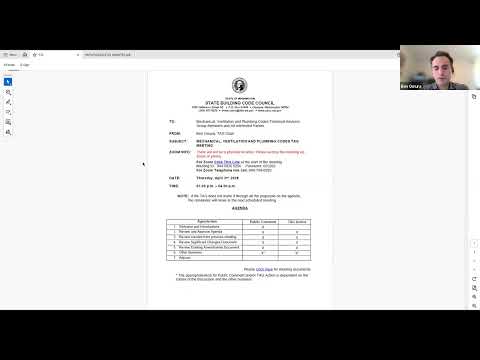
The Building Code Council Mechanical Ventilation and Plumbing Codes Technical Advisory Group (TAG) met April 3 to review model-code changes in the 2024 Uniform Plumbing Code and to recommend which changes should be adopted, amended, or held for further study in Washington state.
The TAG recommended adopting most of the UPC 2024 model changes for the sections that the state currently adopts, but it also recorded a series of exceptions and follow-ups. Key open items the TAG asked staff or members to research further include a review of electrical requirements referenced to NFPA 70 for equipment in Section 508.22, a planned code-change proposal for UPC 507.5 (water‑heater drain pan language), consultation with the Washington State Department of Health on backflow protection for carbonated beverage dispensers, and clarification of new condensate‑drain requirements in Chapter 8 that affect pumped condensate systems.
Most of the meeting covered line-by-line review of the posted “significant changes” document for UPC 2024. The TAG confirmed that several Chapter 2 definitions (for example the vented‑appliance definition) match between the UPC and the International Fuel Gas Code and recommended retaining the UPC wording where no conflict exists. In Chapter 5 the TAG recommended accepting model-code changes for sections that are adopted in the state code but noted specific subsections that the state does not adopt or that require a follow-up (notably language tied to fuel‑gas cross‑references and several subsections the state currently does not adopt). The group also identified editorial fixes (misnumbered references) to be corrected by staff prior to publication.
On Chapter 6 the TAG highlighted multiple cross-refs and existing Washington amendments affecting backflow and beverage-dispensing equipment. TAG members noted a current state amendment that requires RP assemblies for carbonated beverage dispensers while the UPC 2024 language and ASSE 1022 listing may permit alternative devices. Because the Office of Drinking Water enforces backflow protection and testability, the TAG asked staff and volunteers to consult DOH and return with a recommended alignment (either revise the state amendment or retain it). The TAG also noted a likely need to consolidate the state amendment options for irrigation backflow assemblies with the new UPC options.
Chapter 8 review produced a separate technical question: the model language on condensate connections may require individual sanitary‑waste or condensate traps/valves where multiple fan‑coils discharge to a common condensate line. TAG members worried this could have a material installation impact for pumped condensate systems and asked for further investigation. Another cross‑chapter concern was that energy‑code requirements for insulation pads under water heaters can interact awkwardly with plumbing pan and drain language, and the TAG flagged that for a code‑change proposal.
Medical‑gas language in Chapter 13 was reviewed with technical input from a TAG member experienced in NFPA 99 and medical gas installation; the TAG noted that UPC 2024 references the 2021 NFPA standard and that adopting later NFPA editions would require substantial additional amendment work, so the TAG did not propose moving forward to adopt a newer NFPA reference at this time.
Throughout the meeting the TAG moved and voted on a set of procedural and recommendation motions. Staff will prepare the formal recommendation package for the Building Code Council reflecting the TAG’s accept/reject/pending decisions, and the TAG scheduled follow‑up work (DOH consultation, NFPA 70 confirmation for electrical/backup power requirements, and a proposed code change for UPC 507.5). Staff also will correct several editorial numbering issues and verify appendix/adopted‑appendix listings before the next meeting.
Votes at a glance - Approve agenda: motion carried (voice vote). The TAG opened the meeting and adopted the posted agenda. - Approve March 27 minutes: motion carried (voice vote). - Chapter 2: recommended retaining UPC definitions reviewed (except diverter valve), motion carried. - Chapter 5: recommended adopting model-code revisions for sections adopted by the state, with exceptions for 501.1 (state amendment to remain), 507.5 (code change proposal requested), and pending review of 508.22/NFPA 70; motion carried. - Chapter 6: recommended adopting model-code revisions for sections the state adopts, with several items flagged for DOH coordination and potential state-amendment consolidation; motion carried. - Chapters 7, 8, 9, 10, 11, 13, 15, 16, 17 and Appendices A and B: TAG moved and carried separate recommendations to accept the model changes for those chapters/appendices that the state adopts, with chapter‑specific exceptions as noted in minutes (for example Chapter 8: further review of 8.14.4; Chapter 11: update state amendment language for 11.01.13.1).
Next steps and context Staff will: (1) prepare the formal recommendation packet that documents the TAG’s accept/reject/pending positions for submission to the Building Code Council; (2) correct editorial and numbering errors identified by TAG members; (3) consult the Washington State Department of Health on backflow protection for carbonated beverage dispensers and report back; and (4) draft a code‑change proposal for UPC 507.5 language flagged by the TAG. The TAG indicated it will reconvene to complete remaining amendment reviews and to consider any code‑change proposals submitted in response to today’s discussion.
Ending note The TAG met by videoconference and confirmed quorum throughout the session. Staff will circulate meeting notes, the updated significant‑changes document with editorial fixes, and the date for the next meeting.