Get Full Government Meeting Transcripts, Videos, & Alerts Forever!
Get email alerts on the Historic Preservation topic
No spam. Unsubscribe anytime.
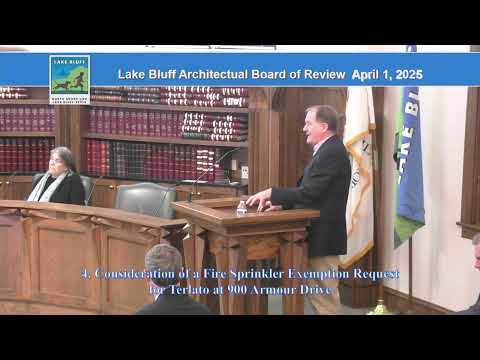
Board grants sprinkler exemption for historic Tangle Oaks manor with safety conditions
Summary
The Village of Lake Bluff Architectural Board of Review on April 1 voted 4-0 to grant a fire‑sprinkler retrofit exemption for the historic Tangle Oaks manor owned by Terlato, conditional on FSCI and staff recommendations, and a clarified requirement on exit signs and emergency lighting.
The Village of Lake Bluff Architectural Board of Review on April 1 voted 4-0 to grant a fire sprinkler retrofit exemption for the historic Tangle Oaks manor owned and occupied by Terlato, subject to Fire Safety Consultants (FSCI) recommendations and conditions from staff, including a requirement that the building remain in business use group B and that condition B be interpreted to require exit signs and emergency lighting only (not full structural rework).
The exemption matter drew a multi-person presentation from Terlato nd technical review by Fire Safety Consultants. Nick Standiford, a land‑use attorney for the applicant, described the property s a historically significant manor restored by the owners. Tom (Tom Reykjavich), the project architect, outlined the house s a 1916–1932 Tudor Gothic manor by architect Harry Lindbergh and said the structure—eatures vitrified clay tile, Ludovisi clay roof tile and many original interior finishes that would be severely disturbed by a full sprinkler retrofit. "We tried to be absolutely minimally, sort of intrusive in terms of anything we did," Reykjavich said, describing prior preservation work.
Judy Vaughn, facilities manager for the property, described fire‑safety upgrades already completed in 2022: "Everything was replaced, the fire panels, the strobes. We went from 52 smoke detectors to 105, and added an intercom system." Vaughn said detectors are inspected annually by Keith Technologies, extinguishers by Dependable Fire, boilers by the Illinois Fire Marshal every other year, and that the building maintains a lockbox for firefighter access.
Seth Sommer of Fire Safety Consultants recommended approval of an exemption after an on‑site review. Sommer said installing a sprinkler system throughout the structure would be "next to impossible," would harm the historic fabric and be highly invasive, and he noted existing compensating measures: robust detection (about 105 detectors), an alarm panel, isolated kitchen suppression for cooking equipment, large separation from neighboring structures and generally fire‑resistant masonry construction. "Short of any visitors or anything being there, there's gonna be some rare circumstances where people may not be familiar with it, and that's again our suggestion for the exit signs and emergency lighting to be considered," Sommer said.
Village staff recommended granting the exemption subject to the conditions in the FSCI report and a rollover condition that the property remain use group B (business). Staff also agreed to work with the applicant on less‑intrusive exit signage and lighting suitable for historic surfaces. At the meeting, staff clarified that the condition B modification requested by the applicant would be recorded specifically to require exit signs and emergency lighting rather than a broad rework of every egress element.
After discussion among board members and staff, Chair Hunter called for a motion. The board recorded a roll‑call vote: Member Wex — aye; Member Stradiv — aye; Member Daubman — aye; Chair Hunter — aye. The motion passed, 4–0. The board irected staff to include the applicant—hange to condition B (limited to exit signs and emergency lighting), to verify installation/operation of required alarm/detection equipment, and to require the applicant to return if the building—hanges use.
The board and FSCI emphasized the exemption is conditioned on maintaining compensating measures (alarm monitoring/inspection, exit signage/emergency lighting, door ratings and other items listed in the FSCI/staff reports). The property is listed on the National Register of Historic Places; both applicant and board cited that status as a primary reason to seek a less‑intrusive approach than a full NFPA‑13 sprinkler retrofit.
The board id not set a further deadline beyond staff follow up; staff will coordinate necessary permit reviews to document compliance with the listed conditions and to review any change of use that would void the exemption.