
Waupaca council approves updated on-call (captive) pay policy; council members debate including salaried employees
Get AI-powered insights, summaries, and transcripts
Subscribe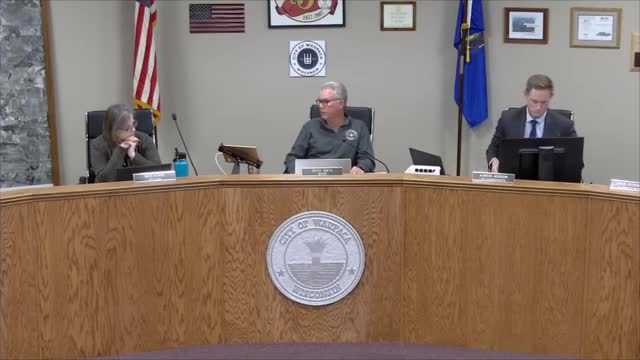
Summary
The Waupaca Common Council voted April 2 to update on-call (captive) pay policy, increasing daily stipend levels and formalizing call-in and remote response minimums after staff said current pay was low compared with peer cities.
The Waupaca Common Council voted on April 2 to update the city’s on-call (captive) pay policy, a change city staff said was intended to align Waupaca with comparable municipalities and to make on-call assignments more equitable for hourly and other staff.
City Administrator Aaron Jensen presented a draft policy developed by Public Works Director Justin Behrens and reviewed by multiple committees. Jensen said the new captive-pay proposal moves the city from an $18-per-day rate toward an average competitive level (the draft references an average of $43.50 per day in surveyed comparables) and formalizes three categories:
• Captive (on-call rotation): proposed stipend equivalent to 1.5 hours of pay per day while on call. • Call-in pay: minimum two-hour pay plus time worked (double time if on a city-observed holiday); limits on paying the two-hour minimum for repeated nuisance calls in the same day. • Remote call-in: a minimum 30-minute pay for employees responding remotely (for example, IT/Waupaca Online work) with actual pay for time worked beyond the minimum.
Jensen told the council the new policy was reviewed repeatedly by committees and that the 2025 budget already includes the amounts for a full year; sewer, water and Waupaca Online costs are budgeted in enterprise funds, not the general fund.
Council debate: Council Member Henry Velacher questioned including exempt (salaried) employees under the policy and said he had concerns about mixing hourly supplemental pay and exempt status. “I just have a real issue with including salaried employees,” Velacher said. Jensen and staff said they had checked Fair Labor Standards Act implications and that some salaried positions already receive on-call compensation in practice; staff also said that council retains budget oversight and could approve which positions receive pay during the annual budget process.
Vote and implementation: A motion by Eric Olsen, second by Scott Perchatsky, to approve the captive-pay changes (Article 3, Policy 3.5) passed by roll call, 10 ayes, 0 nays. Council members and staff said the policy is to take effect in early May (staff discussed operational start May 1–2 to allow payroll setup and scheduling changes) and will be reviewed in future budget cycles; the policy text specifies a five-year review but council retains authority to amend earlier.
Why it matters: staff said Waupaca’s prior captive-pay language was a short paragraph and that current stipends were low compared to peer cities. The change is intended to make on-call compensation competitive and to formalize minimums for call-ins and remote responses, which affects public works, sewer and water, police and IT staffing and budgets.