Get Full Government Meeting Transcripts, Videos, & Alerts Forever!
Get email alerts on the Economic Development Data Center topic
No spam. Unsubscribe anytime.
Muskogee holds first public hearing on proposed Scissor Tail Data Center; no vote taken
Summary
The Muskogee City Council on April 3 received a presentation on the proposed Scissor Tail Data Center campus, including projected jobs, investment and long-term tax incentives; council members moved to approve but the item will return for a second statutorily required hearing before any action can be taken.
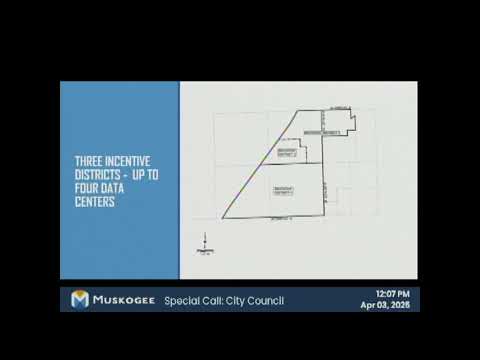
MUSKOGEE, Okla. — The Muskogee City Council held a public hearing April 3 on a proposed Scissor Tail Data Center project that would include up to four large data-center buildings and seek 25-year tax-incentive districts, but council members did not take final action pending a second required hearing.
The presentation, delivered by Lisa Harden of the Center for Economic Development Law, described the project as a potential data-center campus on roughly 419 acres in the John T. Griffin Industrial Park and said the company backing the plan is a Fortune 100 U.S.-based firm that “committed to making a private investment of at least $1,000,000,000 per phase.” Harden said each data center could be about 300,000 square feet and that Phase 1 would create at least 50 full-time jobs with an average salary of $75,000, excluding benefits.
Harden summarized the proposed incentive structure and projected public revenues. She said the company seeks three 25-year tax-incentive districts that would provide a 100% ad valorem tax exemption on new investment in the development; in exchange the company would make annual pilot (payment in lieu of tax) payments and education-focused “stimulus” payments. Harden said the first annual pilot payment for each data center is set at $1,250,000, increasing 1% per year, and that pilot payments for a single data center would exceed $35 million over 25 years; if all four centers are built the pilot payments were projected to exceed $150 million. She said stimulus payments would start at $250,000 per data center, also increasing 1% annually, with total stimulus payments for one center projected to exceed $7 million over 25 years and total stimulus payments for all four centers projected to exceed $30 million.
Harden also described a franchise-fee revenue-sharing arrangement on electricity use, saying that roughly 30% of those fees would go to the company and the remaining 70% would be shared equally among the city, the county and the port authority (Harden gave each entity 23.33% of the total). Harden said these franchise-fee shares would yield preliminary estimates of about $480,000 per year to each of those three taxing entities and “a little over $12,000,000 over a 25 year period.” Harden said the combination of pilot payments, stimulus payments and franchise-fee sharing produced projected revenues “in the order of $200,000,000 over the life of the project.”
Harden framed the incentives as necessary under state law and the Local Development Act to attract the project and said the project would not proceed without them. She noted procedural steps: a review committee unanimously recommended approval of the project plan on March 12; the Planning Commission will review conformance with the comprehensive plan on April 7; the City Council is required by statute to hold two public hearings (April 3 served as the first); and the second public hearing is scheduled for April 14. Harden said the tax-incentive agreement would then be considered by the boards of the affected taxing entities between April 15 and April 28.
A member of the public, Mike Gregg of South Robinscote, asked whether citizens could obtain the presentation packet; council staff directed requesters to the city clerk or to make an open-records request. Gregg said he had “a lot of questions about safety” but would review the materials before commenting further.
After questions, a councilmember vocalized a motion “for approval” and another councilmember seconded, but a staff member noted that “there’s no action taken by city council until after the second public hearing.” The council therefore did not adopt the project plan or the tax-incentive agreement at the April 3 meeting.
The project plan presentation and the public hearing focused on the project’s proposed scale, job estimates, the company’s pledged minimum private investment per phase, the structure and projected amounts of pilot and stimulus payments, and the proposed electricity franchise-fee sharing. Council members did not make final determinations on incentives or on any contract terms during the April 3 hearing.
The City of Muskogee will hold the statutorily required second public hearing on April 14; subsequent votes by the City Council or other affected taxing-entity boards would be required to approve any tax-incentive agreement or related contracts.