
Senate Ways and Means amends broad tax-credit repeal after industry testimony on renewable fuels and energy costs
Get AI-powered insights, summaries, and transcripts
Subscribe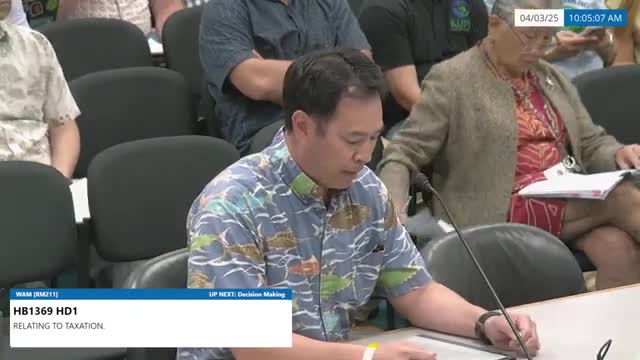
Summary
After hours of testimony, the Senate Committee on Ways and Means passed amendments to a bill that would repeal multiple tax exemptions and credits, converting many repeals into five‑year sunsets and tightening eligibility for several credits including those tied to renewable fuels and local agricultural purchases.
The Senate Committee on Ways and Means on a voice vote approved amendments to a House bill that would have repealed a large set of tax exemptions and credits, instead converting many of the proposed repeals into five‑year sunsets and adding eligibility and certification requirements for several credits.
The change follows multiple hours of testimony from industry and advocacy groups who warned that immediate repeal would raise costs for residents and hinder local renewable fuel production. Nahaalani Parsons of the Hawaii Renewable Fuels Coalition told the committee the tax credit has spurred a private investment of “over $90,000,000” at the state’s only local refinery and said the project is expected to produce “about 60,000,000 gallons” of renewable fuel when it comes online later this year. Juliandra, testifying for Hawaii Gas, said repeal would increase refining costs that “would be passed through to our customers, leading to higher energy costs for Hawaii residents and businesses.” Tom Yamachika of the Hawaii Tax Foundation summarized written comments on specific provisions, including one long‑standing sublease deduction and exemptions for federal purchases.
Why it matters: The bill, as originally drafted, would have removed multiple exemptions and credits across the tax code, producing a near‑term revenue gain the Department of Taxation estimated as $33.8 million for fiscal 2026 and $121.7 million for fiscal 2027. Committee members and agency staff said they need more industry‑specific economic analysis to understand how repeal would affect local employers, supply chains and the state’s energy and food sectors.
Key amendments and committee direction
The committee adopted a package of amendments offered by the chair that removed outright repeals for numerous Hawaii Revised Statutes sections and instead applied five‑year sunsets or revised eligibility criteria. The amendments (summary): - Replace the wholesale repeal of several exemptions and credits with a five‑year sunset for named statutory sections; - Preserve and revise certain credits by adding eligibility criteria tied to Hawaii‑made products, local feedstock usage or minimum local procurement percentages; - Require certification by the Department of Agriculture (HDOA) for agricultural procurement claims using waybill and manifest records; - Require a dollar‑for‑dollar match for entities claiming a renewable‑fuel production exemption and require certification by the state energy officer; and - Remove certain conformity amendments for consistency across the bill.
Committee members instructed DBEDT’s economic analysis division to provide industry‑level impact estimates as soon as possible. A Department of Taxation representative said the agency did not take a position but provided the revenue‑impact estimates used by staff during the hearing.
Testimony highlights and concerns
- Renewable fuels: Nahaalani Parsons (Hawaii Renewable Fuels Coalition) urged the committee to oppose repeal of the Renewable Production Tax Credit, saying the credit “is already doing what it is intended to do” by supporting local refinery investment and reducing reliance on imports. She suggested reducing the credit cap rather than repealing it if savings are required.
- Utilities and households: Juliandra (Hawaii Gas) said the company provides roughly 350 local jobs and serves about 70,000 customers across the islands; she warned repeal “would take a heavy toll on local residents and businesses who rely on gas for reliability and resilience.”
- Revenue estimates and modeling: Tom Yamachika (Hawaii Tax Foundation) and the Department of Taxation staff described modeling approaches used to estimate revenue impacts; DBEDT staff said they would supply fuller economic impact numbers for affected industries.
Committee vote and disposition
The committee approved the chair’s recommendation to pass the bill with the adopted amendments. The chair recorded an affirmative vote; several senators recorded support with reservations. The committee report will reflect the adopted amendments and that HDOA can certify certain exemptions by waybill and manifest records. One senator said she would vote no on final passage on the floor because she remained unconvinced about the full set of changes.
What the amendments leave and next steps
The amendments preserve policy levers for renewable fuels and local agricultural procurement but tighten eligibility and add certification or match requirements. The committee directed staff and agencies to provide additional economic analyses before further floor action so members can evaluate industry‑specific effects. The committee report will document the changes and the rationale for converting repeals to sunsets.
Ending note: The committee’s action delays immediate repeal of multiple tax incentives and replaces outright elimination with time‑limited reviews and revised eligibility, pending further analysis and final floor consideration.