Get Full Government Meeting Transcripts, Videos, & Alerts Forever!
Get email alerts on the Transportation Funding Package topic
No spam. Unsubscribe anytime.
House committee advances multi‑bill transportation package; transit advocates press for larger share
Summary
The House Transportation and Infrastructure Committee adopted substitutes and reported a package of transportation bills (including HB 41‑80 through HB 41‑87 and HB 42‑30). Supporters hailed the local‑roads funding but transit groups urged the Legislature to restore or increase the share for non‑road transportation services.
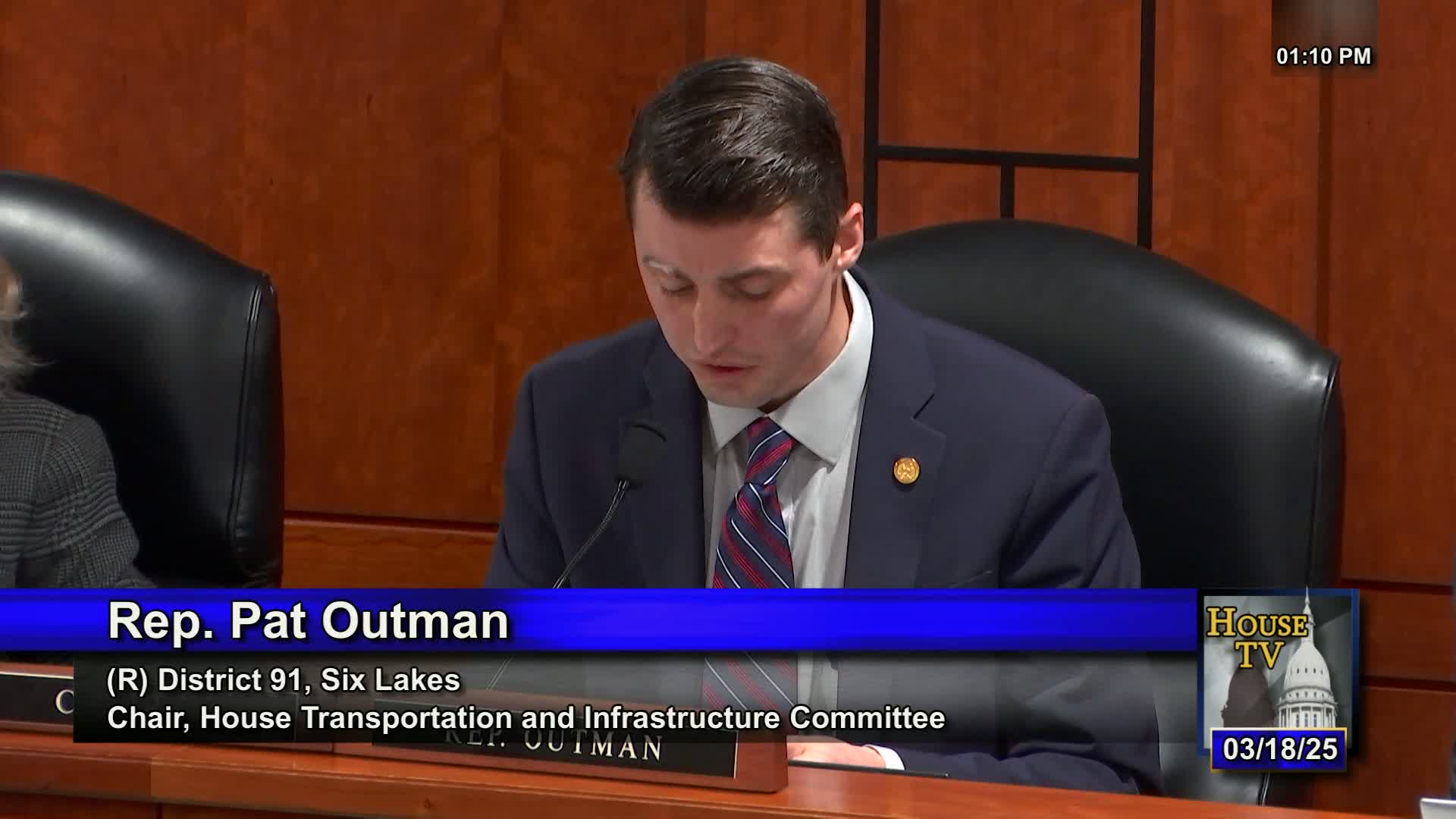
The House Transportation and Infrastructure Committee on March 11 advanced a multi‑bill transportation package that includes measures reported for further action, while transit advocates warned the package does not restore historical funding for non‑road transportation such as buses, senior rides and intercity services.
Committee members voted to adopt substitutes and report a group of bills, described in testimony as part of a broader funding package for roads and local infrastructure. Witnesses from the Michigan Municipal League, the County Road Association, the Michigan Association of Counties, engineering and labor groups supported the effort, calling it a step toward long‑term road funding. The package was described in testimony as roughly a $3.0–$3.3 billion proposal to increase local road resources.
Public transit organizations — including Transportation Riders United, the Michigan Public Transit Association and the Amalgamated Transit Union — urged lawmakers to allocate a larger and protected share of transportation dollars to non‑road services. Megan Owens, director of Transportation Riders United, said that non‑road transportation historically received about 9.5% of the Michigan Transportation Fund but that prior changes reduced that share to roughly 7–8%; she and other witnesses asked the committee to restore a 10% floor for non‑road services. John Delmas of the Michigan Public Transit Association estimated a funding shortfall of roughly $400 million to fully restore historic state support for transit.
Committee members also considered and rejected several amendments during floor action, including an amendment to preserve a $50 million Housing and Community Development Fund investment and several proposals to reallocate or earmark corporate tax distributions for transit. Those amendments did not pass on voice or roll‑call votes, and the committee proceeded to adopt substitutes and report the bills.
Votes at a glance
- House Bill 41‑80: Substitute H‑1 adopted; committee reported HB 41‑80 with recommendation as substitute H‑1. - House Bill 41‑81: Substitute H‑1 adopted; committee reported HB 41‑81 with recommendation as substitute H‑1. - House Bill 41‑82: Substitute H‑1 adopted; committee reported HB 41‑82 with recommendation as substitute H‑1. - House Bill 41‑83: Substitute H‑2 adopted; committee reported HB 41‑83 with recommendation as substitute H‑2. - House Bill 41‑84: Substitute H‑1 adopted; committee reported HB 41‑84 with recommendation as substitute H‑1. - House Bill 41‑85: Substitute H‑2 adopted; committee reported HB 41‑85 with recommendation as substitute H‑2. - House Bill 41‑86: Substitute H‑1 adopted; committee reported HB 41‑86 with recommendation as substitute H‑1. - House Bill 41‑87: Substitute H‑1 adopted; committee reported HB 41‑87 with recommendation as substitute H‑1. - House Bill 42‑30: Substitute H‑1 adopted; committee reported HB 42‑30 with recommendation as substitute H‑1.
Several roll calls were recorded in committee minutes. Some votes were unanimous on the substitute (multiple motions recorded as 16 yeas, 0 nays), while a handful of later reports recorded a mix of yeas, nays and passes for final reports. The committee record contains full roll calls and counts for each motion.
What advocates said
Transit advocates repeatedly asked the committee to direct 10% of the Michigan Transportation Fund to non‑road transportation (buses, senior rides, ferries and other services). “For decades, the non‑road transportation did receive about 9 and a half percent,” Megan Owens said during testimony, and she urged lawmakers to restore that level. John Delmas said a revenue‑neutral legislative fix (House Bill 42‑10, referenced in testimony) could add funding for transit; he and other witnesses pressed the committee to consider similar options as the package moves forward.
Other testimony touched on related topics, including: the pavement damage caused by heavy trucks and possible user‑fee approaches suggested by a City of Grand Rapids speaker; the need to coordinate road reconstruction with underground utility work; and workforce concerns raised by labor groups about a potential funding cliff for construction trades.
Next steps
Bills reported with committee recommendations will proceed through the House where further floor action and possible amendments can occur. Lawmakers and stakeholder groups told the committee they intend to continue negotiations as the package moves through both chambers and discussions with the executive branch.