
Mesa staff preview MOU with SoulTrust to finish stalled ‘Grid’ project on East Main
Get AI-powered insights, summaries, and transcripts
Subscribe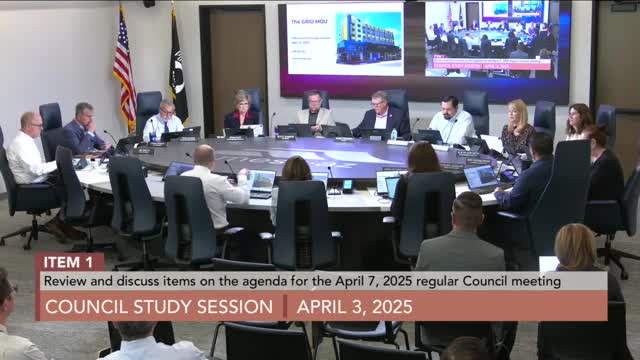
Summary
Mesa city staff on Thursday walked the City Council through a trustee-negotiated memorandum of understanding with SoulTrust Maine Q O Z B LLC that would let the developer resume work on the stalled Grid project at 233 East Main Street and lease city-owned land while completing phased construction.
Mesa city staff on Thursday walked the City Council through a trustee-negotiated memorandum of understanding with SoulTrust Maine Q O Z B LLC that would let the developer resume work on the stalled Grid project at 233 East Main Street and lease city-owned land while completing phased construction.
The presentation, given by Jeff McVay, manager of urban transformation, and Stephanie Monge, downtown transformation project manager, laid out the deal’s major terms and the bankruptcy-court steps needed before any final development or sale documents are returned to council. "This is city owned property, right next door to Benedictine University," Monge said, explaining why the city has been closely involved since the developer filed for bankruptcy last year.
Why it matters: the Grid is a high-profile, long-delayed downtown Mesa project. The MOU would let a new developer take responsibility for finishing the partially built structure and for settling claims against the bankruptcy estate; if the trustee and bankruptcy court approve the settlements, the city would enter construction-phase leases and permit the developer to purchase the property phase-by-phase after each phase receives a certificate of occupancy.
Key facts and next steps
- The property and partially built structure at 233 E. Main St. were owned by the city after earlier development problems. The city previously secured $1.7 million in escrow to restore right-of-way and complete public improvements after the prior developer failed; McVay said the city "expended all $1,700,000" to reopen Main and Pomeroy streets and finish some public work.
- The trustee in the developer’s bankruptcy ran a multi-developer selection process and, according to staff, received 11 expressions of interest and about four substantive offers before SoulTrust emerged as the selected purchaser.
- Under the proposed approach, the city would lease land to SoulTrust during construction; the developer would have an option to buy completed portions of the site within 180 days of each phase’s certificate of occupancy. Staff cited an overall appraised purchase value of $2,985,000 for the assembled property.
- Planned project scope presented Thursday: Phase 1 is described as including 76 micro units above roughly 9,000 square feet of commercial space and about 10,000 square feet of second-floor office space. Phase 2 would add 12 townhomes and related public improvements; Phase 3 would add 13 townhomes, which would wrap the north and east sides of the Pomeroy parking garage. Staff said the total site is about 3 acres.
- City and developer agreed not to build apartments on top of the Pomeroy parking garage because of structural risk; previously approved courtyard apartments would be replaced by townhomes and the city will not require the developer to complete the previously planned Gateway Park improvements as part of this arrangement. Monge said the project no longer warrants the scale of park investment previously promised.
- Parking and lease terms: the city would enter a 50-year parking license for required spaces in the Pomeroy Garage. SoulTrust requested—and staff said the MOU would include—a parking rate set at $10 per month for the first 10 years, then converting to the city’s adopted standard parking rate.
- Bankruptcy/claims: after the original developer’s bankruptcy, a trustee was appointed and worked to settle contractor and subcontractor claims. Staff advised council the city is expected to execute agreements negotiated by the trustee to resolve claims against the bankruptcy estate. McVay said the city would be waiving certain claims (staff characterized the waived city claims as roughly in the low hundreds of thousands of dollars) as part of the overall settlement and that the city intends to use sale proceeds "to make our utilities whole." Monge also told council there had been secured claims and a handful of unsecured claims in the estate; staff said one unresolved lien was originally near $6 million but had been negotiated down as part of settlements.
Council questions and staff responses
Councilmembers asked for a site plan showing the three development phases; Monge said staff would send that plan to council members. Councilmember Pillsbury asked whether the site plan covered only the building footprint or included surrounding parcels; staff clarified the phased parcels include the building lot, adjoining dirt lots behind it and narrow strips alongside the Pomeroy Garage. Councilmember Go Forth asked whether city officials expected SoulTrust to complete follow-up phases; McVay said staff reviewed SoulTrust’s pro formas and construction spending and found them financially capable and that the developer had already spent on architecture and engineering for phases 1 and 2.
Several members asked about how much the city had recovered compared with the losses from the earlier development. McVay said he could not fully quantify the original net loss dating back to 2017 but said the city would receive fair-market proceeds under the MOU while also waiving some claims against the bankruptcy estate. He also confirmed that the trustee performed more extensive financial vetting as part of the bankruptcy selection process.
Other details
- SoulTrust operates projects in Arizona and Washington and is the developer of the Forge Tower (formerly Corcorpier Towers) in downtown Mesa, staff told council. - The MOU would not remove the need for bankruptcy-court approval; staff emphasized final development and lease agreements would return to council only after the bankruptcy court approved settlements and the MOU framework.
What the council asked staff to do
Council members asked staff to: provide a site plan and parcel map before the council meeting, keep the council updated on the status of outstanding liens and settlements, and proceed with drafting the formal development agreement and lease once bankruptcy-court approval is secured. Staff said they would return with the full development and lease agreements for council consideration after the trustee and court signoffs.
Where it goes from here
The MOU and the related settlements negotiated by the bankruptcy trustee were scheduled for council consideration on the Monday, April 7 agenda; staff stressed the bankruptcy court must approve the settlements before the city will finalize a development agreement or transfer any parcels. No council action or vote was taken at the study session.
Ending note
Council members praised the fact the trustee’s process opened competition for the unfinished project and noted SoulTrust’s local experience; staff emphasized the agreement is a negotiated, court-conditioned path to finish construction and to protect city interests while settling claims arising from the Grid bankruptcy.