Get Full Government Meeting Transcripts, Videos, & Alerts Forever!
Get email alerts on the Mental Health Budget And Programs topic
No spam. Unsubscribe anytime.
Department of Mental Health asks for recurring funds to eliminate deficits, expand mandated programs and bolster community care
Summary
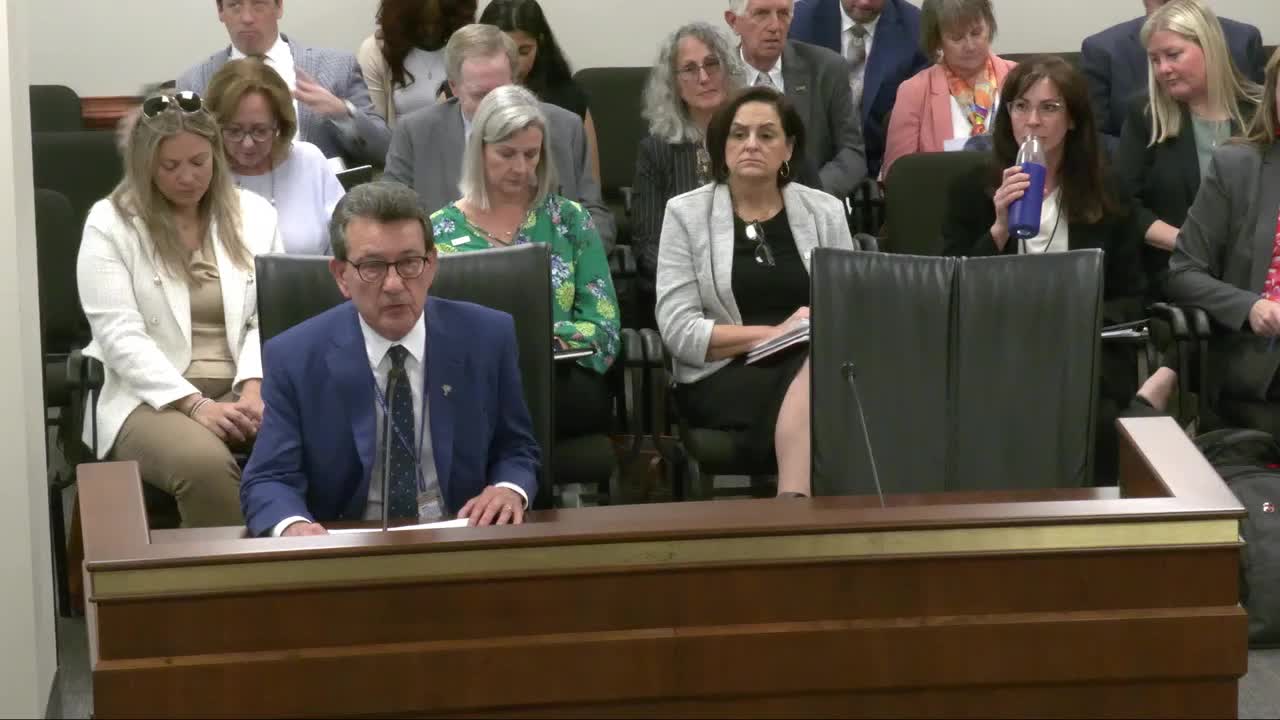
Dr. Robert Bank, interim director of the Department of Mental Health, presented the agency's FY2025–26 priorities to the Senate Finance Health and Human Services Subcommittee, asking for recurring funds to address deficits at state hospitals, expand forensic and jail-based restoration work and sustain community crisis and transportation programs.
Dr. Robert Bank, interim director of the Department of Mental Health, told the Senate Finance Committee Health and Human Services Subcommittee on March 27 that DMH is requesting multiple recurring appropriations to eliminate operating deficits, expand capacity for court-ordered forensic care and sustain community services.
Bank said the department has improved its statewide 988 call-answering performance from about 58 percent to about 88 percent of incoming calls in January and February after adding a second center and partnering with the Mental Health Association in Greenville and a new DMH-operated center in Charleston. He said fewer than 1 percent of calls required EMS or law enforcement responses.
Bank outlined the agency’s requested recurring funding by priority and provided figures during the hearing: • Forensic programming: $13,700,000 recurring. Bank said about $6,000,000 of that would cover an operational deficit at the Columbia inpatient facility; the remainder would support opening 50 additional beds and expanding jail-based restoration services to complete competency restoration in some local facilities rather than transporting patients to Columbia. Referrals for competency evaluations have risen about 40 percent in five years and the wait list exceeds 140, the presentation said. • Violent predator program: $2,000,000 recurring. The program’s census is 239 residents with capacity for about 268 before double-bunking, the agency said. • Statewide alternate transportation program: $4,500,000 recurring. The program moves psychiatrically committed patients from emergency departments to psychiatric beds by private transport rather than law enforcement, and the department said it is on track to exceed 450 transports per month. Bank said the program currently operates under a proviso and the recurring funds would allow statewide continuation. • Psychiatric residential treatment facility (PRTF): $500,000 additional operations funds to reach full census when a contracted PRTF opens later this year; the facility serves youth detained by DJJ who also have serious mental illness. • Olmstead-related community services: $3,000,000 recurring to expand community-based services, including Assertive Community Treatment teams, intended to help keep patients in the community and reduce unnecessary placements in assisted-living facilities. Bank said the U.S. Department of Justice notified the state in January 2022 of a probe alleging unnecessary institutionalization; a July 2023 DOJ report found evidence of ADA-related violations and settlement talks concluded without an agreement. • Inpatient hospital deficits: $12,400,000 recurring to eliminate operating deficits at Harris Hospital and Bryan Hospital; Bank said operational costs have risen roughly 20 to 25 percent over five years, mainly driven by staffing costs. • Community support and crisis services: $4,800,000 recurring for community mental health center supports, including funding to increase contracted community hospital bed admissions. The department noted last year’s $4,000,000 recurring allocation supported about 1,100 admissions to contracted hospitals and asked for an additional $2,000,000 to reach a projected 1,500 admissions. An eight-bed community crisis stabilization unit in Columbia is expected to open in May and would require $1,000,000 recurring for ongoing operations. • Out-of-home placements and jail-based pilots: $1,000,000 recurring for therapeutic out-of-home placements for children and recurring funds to replace prior nonrecurring dollars supporting jail-based pilots in Berkeley County and an intended expansion to Orangeburg.
Bank also emphasized continued use of telepsychiatry within DMH, saying psychiatrists and nurse practitioners are on track to provide about 100,000 telepsychiatry services this fiscal year. He noted the department moved veterans homes contracting to the Department of Veterans Affairs last July and that a solicitation for Stone Pavilion will transfer July 1.
Mark Binkley, a DMH staff member, told the committee some hospitals have been slow to use the alternate-transport program and that nonemergency ambulance and Medicaid or private insurance can offset transport costs in some cases. Senators asked for a breakdown of costs, usage and billing associated with the transportation program and for hospital-level usage data; DMH staff agreed to provide those figures.
The subcommittee did not take formal action on the DMH requests during the March 27 meeting.