Get Full Government Meeting Transcripts, Videos, & Alerts Forever!
Get email alerts on the Workforce Development topic
No spam. Unsubscribe anytime.
Workforce commission outlines consolidation, cross‑training and co‑location pilot to better match workers to jobs
Summary
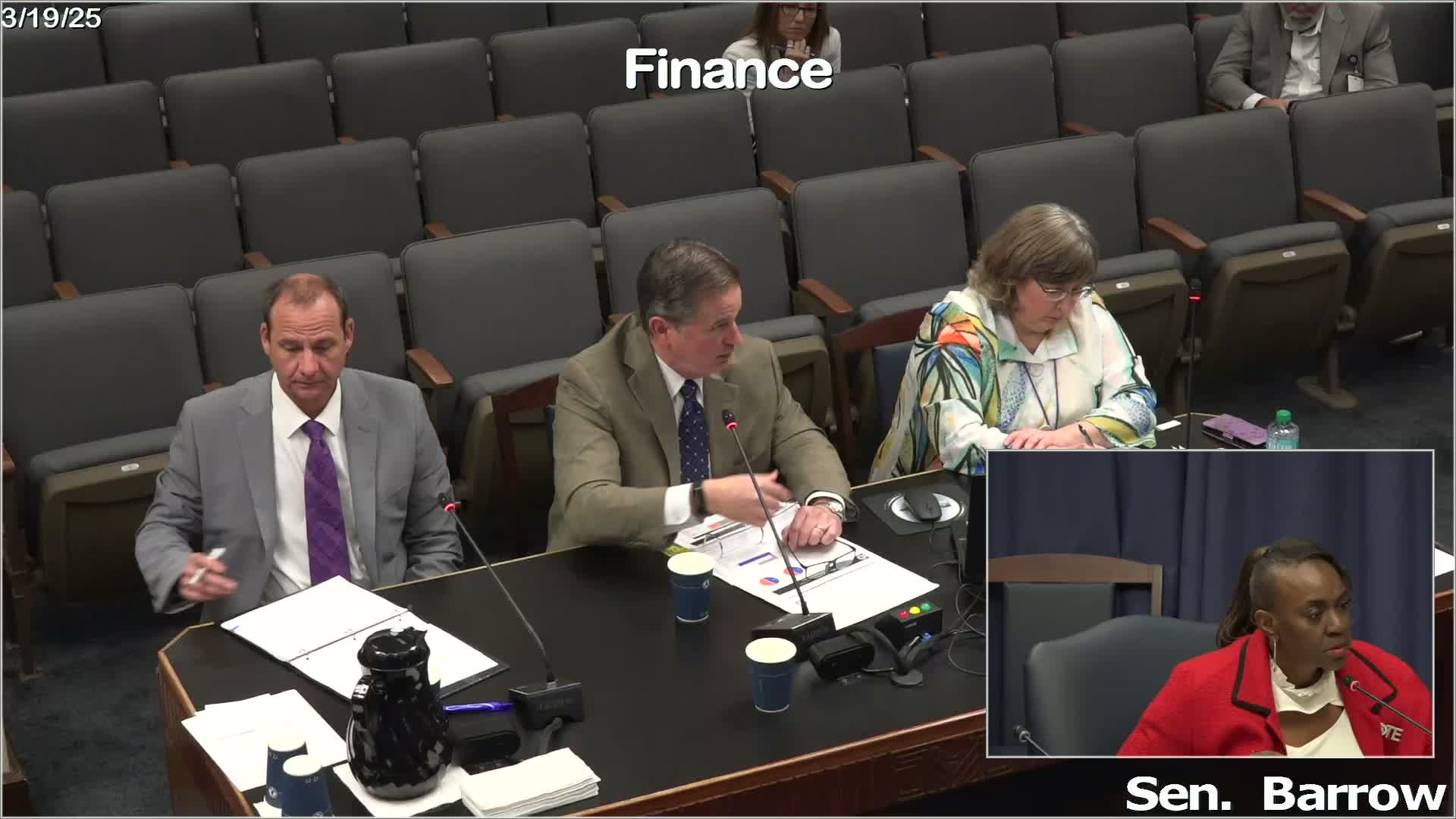
BATON ROUGE — The Louisiana Workforce Commission told the Senate Finance Committee it is consolidating several internal offices, cross‑training staff and piloting service co‑locations to broaden access to workforce services and reduce administrative costs.
BATON ROUGE — The Louisiana Workforce Commission told the Senate Finance Committee it is consolidating several internal offices, cross‑training staff and piloting service co‑locations to broaden access to workforce services and reduce administrative costs.
Mark Barnes of Senate Fiscal reviewed the commission’s FY26 recommended budget and means of finance, noting workforce receives most funding from federal sources and statutory dedications. Barnes flagged Louisiana Rehabilitation Services funding in the FY26 recommendation: roughly $30.7 million for rehabilitation services, with $8 million in state funds used to draw down federal matching dollars.
Secretary Susan Shawan (Workforce Commission) described three strategic goals: (1) provide businesses workforce solutions that support economic growth; (2) increase labor force participation to move people from dependence to employment; and (3) build talent pipelines so graduates can find jobs and remain in Louisiana.
Practical changes, Shawan said, include:
- Consolidating the Office of Workforce Development with the Occupational Information Services function that produces labor market and occupational forecasting, to reduce duplication and improve service delivery.
- Launching a co‑location pilot in the Baton Rouge workforce area that will place Department of Children and Family Services staff in workforce offices and cross‑train both staffs so clients can access a fuller set of benefits and employment services in one physical location.
- Cross‑training workforce staff for demand surges in Unemployment Insurance during disasters and moving toward common electronic application forms to reduce paperwork and match SNAP/TANF recipients to workforce programs.
- Creating an employer portal and improving online services while streamlining agency rules; Shawan said about 73 links were on the agency homepage and the office is removing unnecessary pages and documents.
On workers’ compensation, Shawan said the agency has convened a working group with the Department of Insurance and the Attorney General to identify and combat contractor and insurance fraud that drives costs.
The committee also heard that the Jobs for America’s Graduates (JAG) program is funded at $10 million in the recommendation, split across state and federal/other sources.
Why it matters: The commission framed operational changes as cost‑effective ways to increase the share of agency resources devoted to direct services and to ensure training investments align with LED and LCTCS priorities. Members asked for partnerships with legislative and local partners to expand pilots and support rural delivery.
What’s next: The commission committed to continuing the co‑location pilot and to follow up on performance and budget linkages with LED and other partners; lawmakers said they will monitor pilot outcomes as budget decisions proceed.