Get Full Government Meeting Transcripts, Videos, & Alerts Forever!
Get email alerts on the Elections topic
No spam. Unsubscribe anytime.
Secretary of State outlines closed‑party primary rollout, voter education and voting‑system timetable
Summary
Secretary Landry told senators the office will run a major voter education program ahead of the switch to closed‑party primaries, and reiterated the drive to procure a new voter system; department said a 30‑day pause follows publication of voting‑system standards this week.
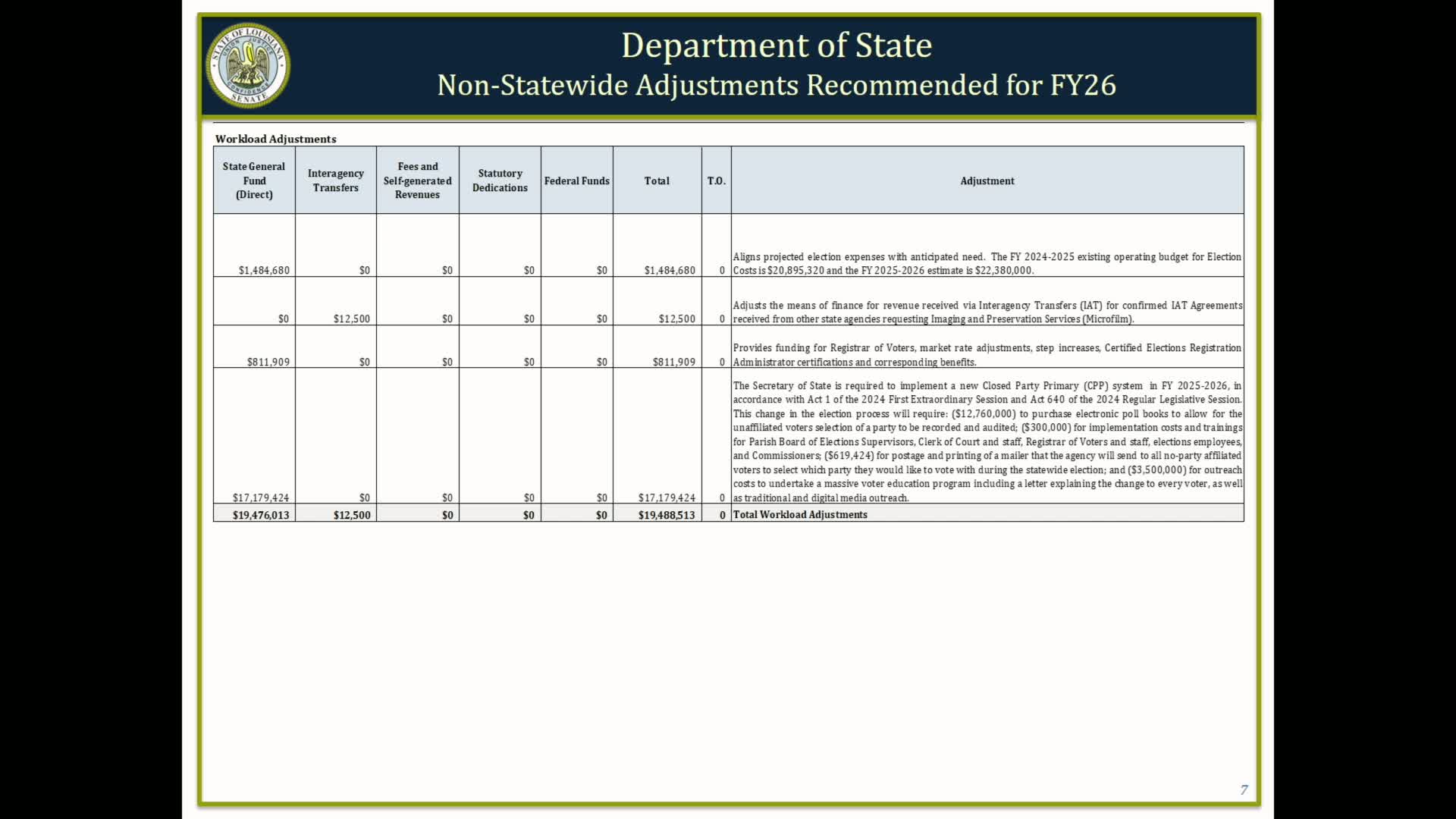
The Secretary of State briefed the committee on the FY26 budget and on implementation steps for Louisiana's change to closed‑party primaries and for voting‑system procurement.
Primary changes and public education: Secretary Nancy Landry said the office will implement the closed‑party primary system required by recent legislation and has budgeted $3.5 million for a statewide voter education program. Treasury and department staff described the outreach mix: a direct mailed notice to unaffiliated voters, television and radio ads, streaming spots and printed materials designed to explain the difference between unaffiliated (no‑party) voters and voters registered with the independent party.
Key dates and practical effects: The department told senators that a mailed notice will target unaffiliated voters (the group eligible to choose a party for the primary) and that voters can change party registration through the online portal or with their registrar. Officials said party affiliation changes will be locked for a given primary and its associated runoff; voters can change registration at other times but must meet statutory deadlines for primary ballots.
Voting system procurement: Secretary Landry said the office published state voting standards required under Act 480 (2021) and will wait the mandated 30 days before proceeding to the procurement steps defined by state law. The office said approximately $63.2 million is available in the Voting Technology Fund; the current voting equipment fleet is older than 35 years and the department wants a system that produces a paper ballot the voter can verify before final cast.
Elections costs and FY26 items: The budget includes an FY26 election line (ballot printing, poll costs) and specific funding for an electronic poll book rollout; the department described the election calendar for 2025 and the need to fund routine and one‑time election costs.
Ending: Secretary Landry reaffirmed the office's aim to procure auditable voting technology, launch an intensive voter education campaign and publish technical standards this week as the procurement clock begins.