Get Full Government Meeting Transcripts, Videos, & Alerts Forever!
Get email alerts on the Elections Omnibus topic
No spam. Unsubscribe anytime.
Secretary of State outlines omnibus election changes, new voting-system procurement and closed primary rules
Summary
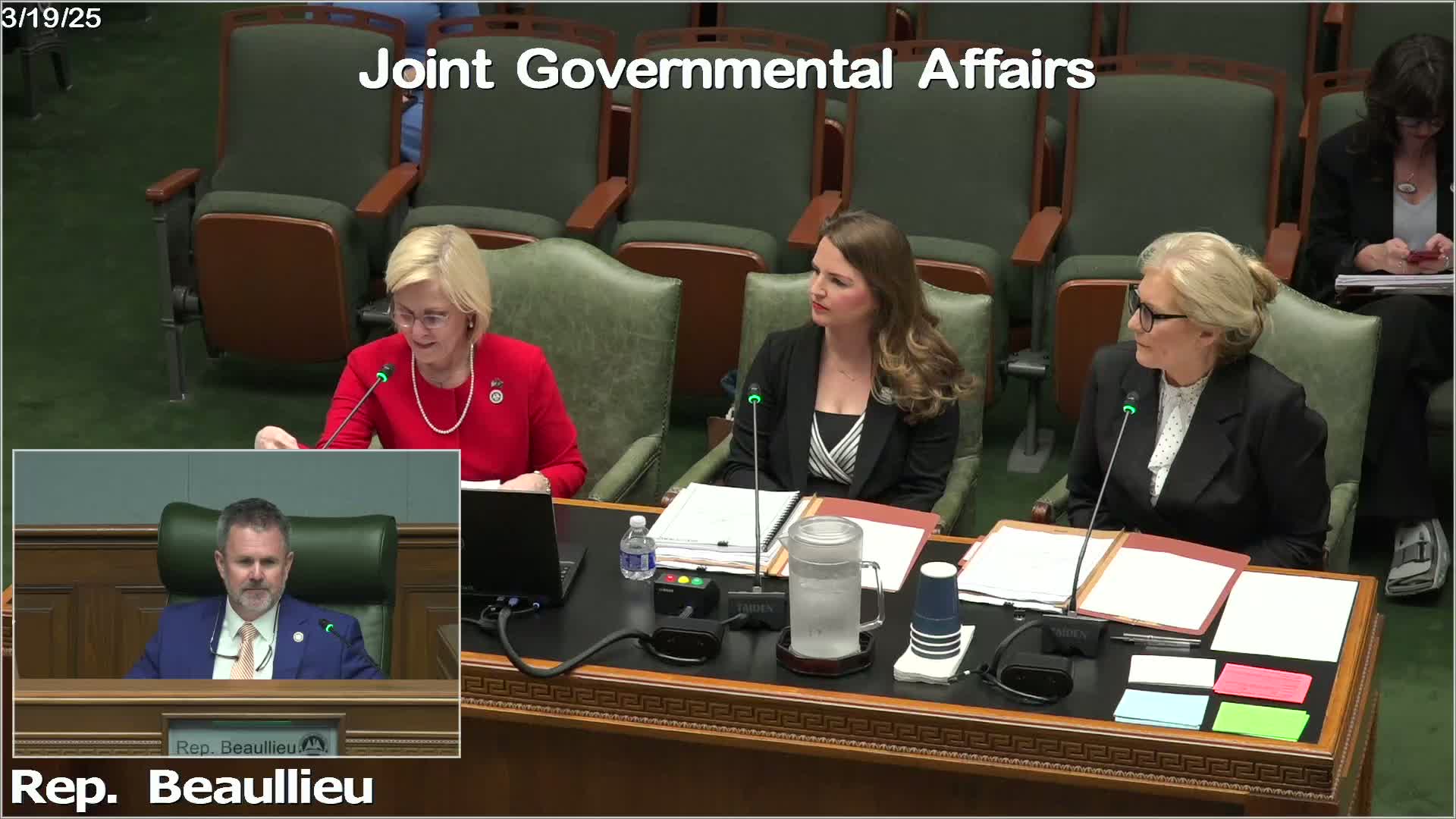
Secretary of State Nancy Landry told the Joint Committee on Governmental Affairs on March 19 that the Department will publish voting‑system standards on March 20 and, after a required 30‑day wait, begin a formal procurement; she also presented a draft omnibus bill to implement closed party primaries and multiple election‑administration updates.
Secretary of State Nancy Landry told the Joint Committee on Governmental Affairs on March 19 that the Department of State will complete step one of the voting‑system procurement process on March 20 and then must wait 30 days before issuing a request for proposals under Act 480 of 2021.
Landry said the department also plans to seek approximately $3,500,000 for voter education to prepare Louisianans for closed party primaries next year and described a draft omnibus bill with multiple technical and substantive updates to the election code.
The procurement timeline and need for a new system
Landry said the office finished drafting state system standards required under Act 480 of 2021 and will publish them March 20. "Act 480 requires that our office wait at least 30 days after the promulgation of the standards before moving on with the procurement process," she said. Landry described the current fleet of machines as "almost 35 years old," and said parts are difficult to obtain and the office sometimes must cannibalize machines for repairs. She said the new system should allow voters to confirm their selection on a paper ballot before casting it, combining technological speed and accuracy with a voter‑verifiable paper record.
Omnibus bill and closed party primary mechanics
Deputy Commissioner Laney Boyd presented a list of proposed omnibus changes the State Board of Election Supervisors recommends. Several items are explicitly written to implement closed party primaries: setting withdrawal deadlines that prevent late cancellations after in‑person voting begins; grouping closed party races together on ballots so ballots are clearer to voters; clarifying that presidential preference primaries remain closed; defining how vacancies run on closed primary dates; and updating early‑voting and absentee procedures to ensure no‑party voters who opt into a party primary receive only the ballot they are eligible for.
Boyd and other staff told legislators that no‑party voters who choose to participate in one party’s closed primary cannot then participate in the other party’s second closed primary. The proposal also allows no‑party voters to request a replacement absentee ballot if they select a party primary after initially receiving a no‑party ballot; registrars can reissue those ballots in person or by mail.
Voter list maintenance and ERIC
The omnibus would remove a hard‑coded reference to the Electronic Registration Information Center (ERIC) and replace it with language allowing the secretary of state to enter into agreements with other states or third‑party vendors that maintain address data. Deputy Commissioner Boyd and Commissioner Sherry Hatzke said the state now uses a combination of MOUs directly with bordering states and commercial vendors (transcripts cite vendors such as Experian and other third‑party contractors the Postal Service uses). Boyd said Louisiana has signed agreements with at least four states to compare data directly.
Legislators asked for greater specificity in the bill language. Representative Newell said the committee should know which vendors or vendors’ categories the office will rely on; Senator Jenkins and others pressed for clarification about how conflicting address data will be handled during the annual canvass. Boyd described the practical steps: if a voter’s address is verified through data, that address is confirmed; if multiple in‑parish addresses appear the registrar will attempt confirmation and, if necessary, send notice and allow the voter to confirm or correct their registration. Out‑of‑parish moves trigger address confirmation cards and place the voter on the inactive list but do not prevent voting.
Nursing‑home early voting changes and related questions
The draft omnibus would change the nursing‑home early‑voting program so that if a registrar’s letter to a nursing‑home participant is returned undeliverable, the registrar may remove that person from the nursing‑home program and send an address confirmation card. Legislators asked for clarity about participation: staff said the nursing‑home program is initiated by the voter (a single voter’s request will obligate a facility to participate); when the registrar conducts the nursing‑home visit staff and registrars provide assistance and may witness ballots, and being moved out of a nursing home should trigger re‑enrollment steps rather than denial of voting rights.
Machine allocations and modernization items
The recommendations include technical updates: increasing thresholds for machine allocations in large precincts, clarifying consolidation language when precincts share polling places, allowing the secretary to file affidavits instead of live testimony in certain objections to candidacy, updating form names and citations left out of recent acts, and modernizing ballot‑appearance rules for recall elections. Landry and staff also proposed that the secretary’s office be included in early‑voting machine preparation and testing and clarified qualifications for alternate commissioners and party super‑watchers.
Public comment on security, auditability and cost estimates
After the presentation, public commenter Cornelia Ullman (citizen) urged the committee to require clear standards for chain of custody, cybersecurity, and auditability in the published voting‑system standards. Ullman said the standards published in the state register emphasize usability, accessibility, durability, accuracy, efficiency and capacity but she did not see chain‑of‑custody or non‑proprietary software requirements in that version. Ullman also cited a figure discussed in Senate Finance: an estimated $12.7 million for electronic poll books statewide, a per‑parish allocation of roughly $195,000, and per‑machine estimates in the neighborhood of $9,200 (figures she attributed to testimony in finance); she urged explicit audit and software provisions in procurement specifications. "There’s no stipulation that the software shall not be proprietary," Ullman said; later she stated, "the elections are nothing more than locked spreadsheets." (Commenter text recorded in the transcript.)
Next steps and timing
Landry said the omnibus recommendations will be used to draft a bill; the department will continue briefing members and stakeholders before bill filing. The procurement schedule requires the 30‑day wait after the standards’ publication before staff may proceed to a formal RFP process; Landry said the office hopes to award a contract by the end of the year but cautioned that the 2021 statutory changes lengthened the procurement timeline.
Ending
Committee members asked for additional visual and procedural explanations during session debate—several members requested a diagram or flow chart showing how closed primaries and potential runoff mechanics will operate. The department staff encouraged members to direct follow‑up technical questions to the Secretary of State’s office before the omnibus is filed and said they will continue vetting the bill and its drafting with registrars and other stakeholders.