Get Full Government Meeting Transcripts, Videos, & Alerts Forever!
Get email alerts on the Administration Grants topic
No spam. Unsubscribe anytime.
Division of Administration frames large grant spending, ancillary appropriations and agency adjustments
Summary
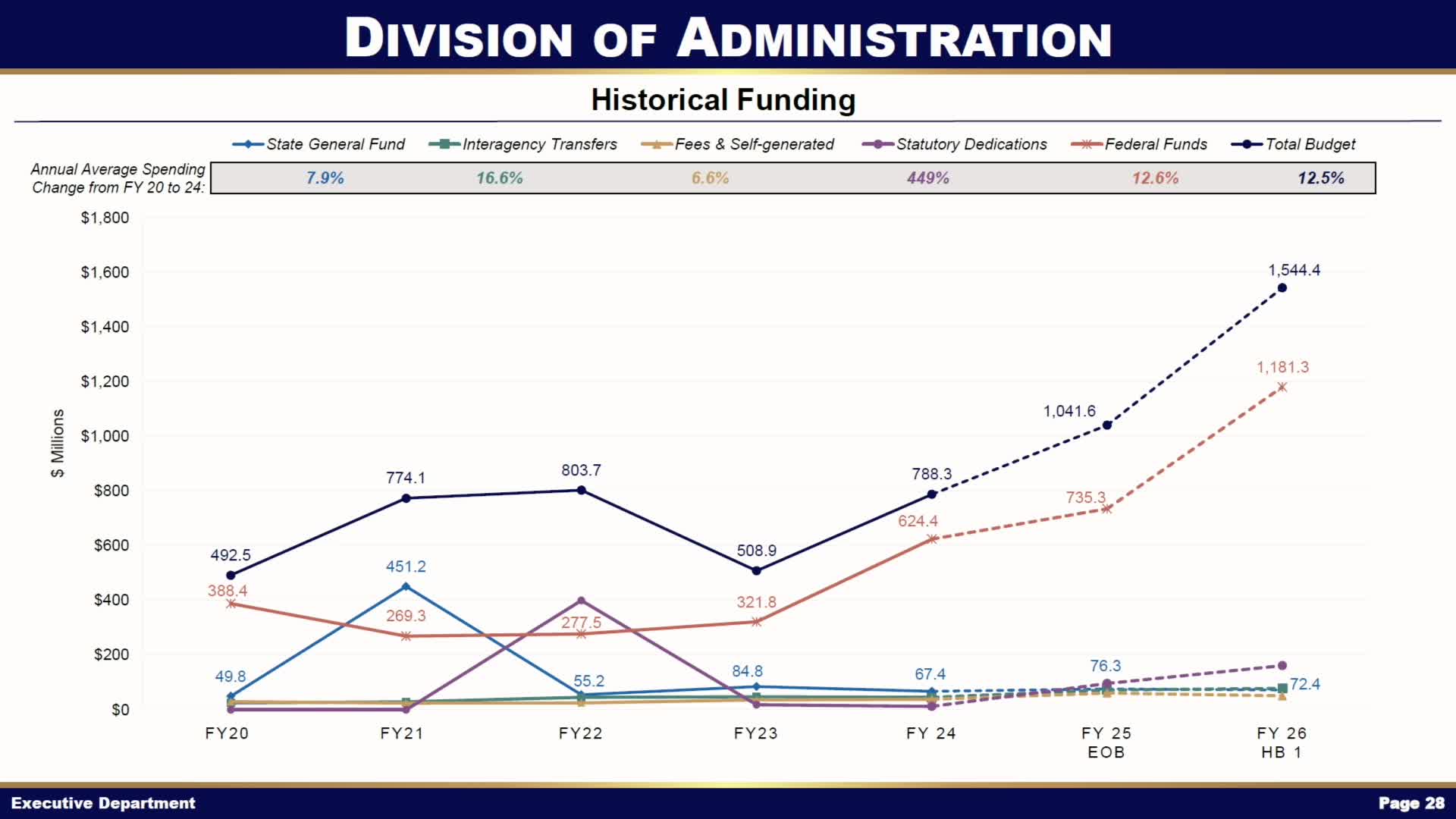
House fiscal staff told the committee the Division of Administration controls large federal and statutory grant programs — including Restore, water‑sector and housing/rental assistance grants — that drive FY26 increases in “other charges” across the executive department and ancillary appropriations.
House fiscal presenters and Division of Administration officials briefed the committee on FY26 recommendations for the Division of Administration and related ancillary appropriations. Committee members were shown that much of the Division’s FY26 increase is concentrated in “other charges” tied to large grant programs that span multiple fiscal years.
Shari Robinson summarized the executive department and said the division’s FY26 recommendation is roughly $1.5 billion, with 76.5% federal funds in that total. The presentation highlighted major federal‑funded programs administered through the Division of Administration: Restore homeowner assistance, small business loan programs, rental housing assistance, and the resilient communities infrastructure program. The fiscal slides showed roughly $700–$900 million in other‑charges grants for those programs and a notable water sector fund increase (~$65 million) tied to Phase 2 of the emergency sub‑fund for water projects.
Deputy Commissioner Patrick Goldsmith and other staff said some FY25 carryforward and one‑time funds were removed from FY26, accounting for decreases in certain statutory dedications and interagency transfers, but that the division is managing substantial increases in federal grants and workload related to litigation or disaster recovery programs. Members asked about travel management, statewide lease audits and OTS charges; officials said travel management is a statewide component housed in the division and that a multi‑strand review of leases and facility utilization is ongoing.
Ancillary appropriations tied to the division include the Office of Group Benefits (OGB), Office of Risk Management, Office of Technology Services and other statewide service agencies. The fiscal slides show OGB self‑funded prescription plans and premium passthrough authority totaling about $1.9 billion in plan estimates; committee members asked about retiree Medicare strategy as a potential cost‑savings measure and were told the agency is exploring Medicare Advantage (MA) wrap products but cannot yet validate specific savings figures.
Ending: Officials said the Office of Technology Services will return on a follow‑up day for a deeper briefing. The Division of Administration plans to continue coordinating grant program rollouts and to provide requested detail on lease audits, OGB modeling for retiree plans and timing for water‑sector investments.