Get Full Government Meeting Transcripts, Videos, & Alerts Forever!
Get email alerts on the Elections topic
No spam. Unsubscribe anytime.
Secretary of State’s office seeks $17M for closed‑primary transition, $12.7M for electronic poll books; voting system procurement advances
Summary
The Department of State told the House Appropriations Committee it needs about $17.1 million in additional state general funds to implement new statewide closed party primaries and related outreach, and it released standards for a new voting system that will require procurement and investments in e‑poll books.
The Department of State presented a FY26 budget recommendation that includes a major carryover of election‑related costs tied to the switch to statewide closed party primaries and a requested new voting system procurement.
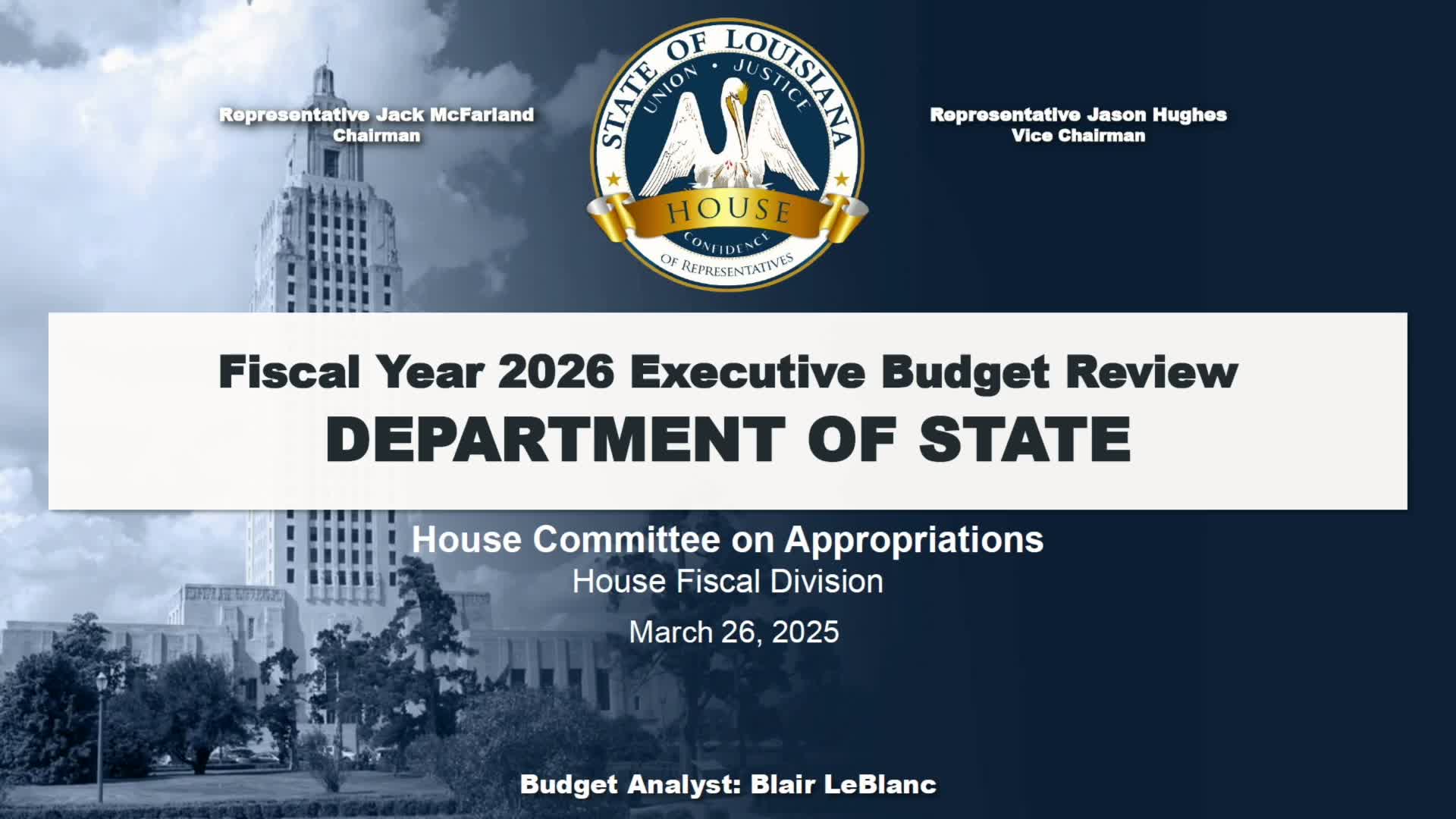
House Fiscal Division analyst Blair LeBlanc said the department’s FY26 House Bill 1 recommendation totals roughly $131.0 million, with the elections program comprising about $90.8 million (69.3 percent of the department’s funding and 151 positions). LeBlanc said REC recognized $22.9 million in state general fund for the department in the recommendation and that the FY26 request includes a net $17.1 million increase in state general fund primarily to implement a new statewide closed party primary in FY26 under recent laws.
Why it matters: The presentations link substantial one‑time and recurring election costs to statutory changes enacted in 2024. The department also emphasized the need to replace an aging voting fleet and to fund voter‑education outreach to reduce voter confusion when the closed party primary model begins.
Major budget items and procurement update
- Closed party primary funding: Department officials told lawmakers they seek about $17.1 million in additional state general fund for FY26, including $12.7 million to acquire electronic poll books statewide and $3.5 million for voter education and outreach tied to the change in primary rules.
- Voting‑system procurement: First Assistant Secretary Katherine Newsom said the voting system standards required by Act 480 (2021) were finalized and published March 20. Act 480 requires a minimum 30‑day wait after promulgation before the procurement process moves forward. Newsom reiterated the department’s policy preference for a voting system that allows voters to confirm selections on a paper ballot for auditability.
- Voting Technology Fund balance: Newsom told the committee the Voting Technology Fund held about $63,000,165 (reported in the presentation as $63,000,165.160055) and stressed urgency for replacing machines whose parts are becoming unavailable; the current fleet is roughly 35 years old.
Voter education budget breakdown
Katherine Newsom gave a detailed breakdown of the $3.5 million outreach request intended to educate voters before the first closed primaries:
- Direct mailer to every household: $1,300,000 - Television advertising: $1,000,000 - Radio: $300,000 - Streaming ads (Hulu/other): $200,000 - Video production for online use: $200,000 - Print materials/newspaper: $20,000 - Social media: $10,000 - Miscellaneous/reserve: $100,000
Operational questions from lawmakers
- Poll worker and commissioner training: Lawmakers raised concerns about poll worker availability and the potential for confusion on election day if voters misunderstand participation rules. Officials said the department will coordinate training for commissioners and local election officials and will roll out the public‑education campaign in July–August to reduce confusion ahead of 2026.
- Machine form factor and paper trail: Newsom said the procurement standards require a paper component and that the specifications were informed by a year of testimony to the Voting System Commission. The department cannot specify exact vendor hardware until procurement concludes.
- Cost timeline: Agency staff said the bulk of the added cost for FY26 is front‑loaded (e‑poll books and education). They expect lower ongoing outreach costs in subsequent years once voters and local officials are trained and systems are deployed.
What the committee learned
The Department of State framed the FY26 request as a combination of one‑time and implementation costs for a system‑level change to how party primaries operate, plus an accelerated timetable for aging voting technology replacement to meet statutory trust and auditability goals. Officials emphasized the 30‑day pause required by Act 480 before issuing procurement solicitations and the department’s stated objective to procure a paper‑based, auditable system.
Sources: Presentation by Blair LeBlanc, House Fiscal Division; remarks by Katherine Newsom, First Assistant Secretary of State; testimony and answers from Sherry Hatzke, Commissioner of Elections; Melissa Thibodeaux, Director of Accounting.