Get Full Government Meeting Transcripts, Videos, & Alerts Forever!
Get email alerts on the State Budget topic
No spam. Unsubscribe anytime.
State presents FY26 'standstill' budget as revenue forecasts flag shortfalls ahead
Summary
House and administration officials told the Joint Budget Committee the executive FY26 budget is a standstill plan that balances in the near term but relies on revenue forecasts that project multi‑year shortfalls without changes or additional revenue measures.
The executive branch presented a standstill FY26 budget to the Joint Budget Committee that the administration says balances under current revenue forecasts but that projects multi‑year revenue shortfalls if nothing changes.
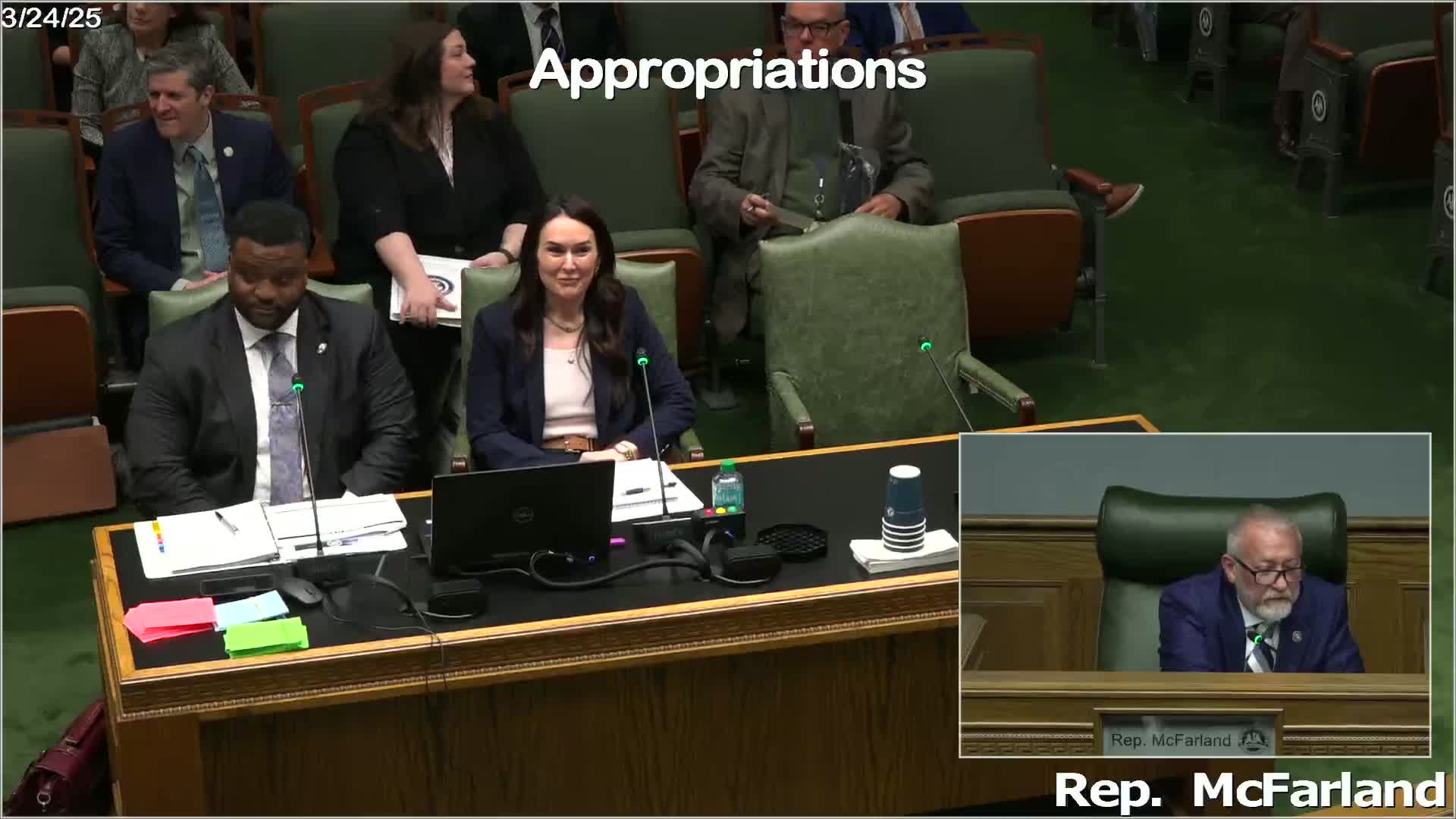
Representative Matt Mack sought a plain reading of slide 6 of the presentation, saying, “based on these current projections of revenue versus expenditures, if nothing was to change … FY 25‑26, we would be $200,000,000 approximately $200,000,000 that would [be] deficit.” Taylor Barra, Commissioner of Administration, and Patrick Goldsmith, deputy commissioner, described the FY26 package as a continuation budget that trims one‑time items and relies on current forecasts. Goldsmith told the committee none of the executive budget assumes passage of the pending constitutional amendment or future federal cuts.
Why it matters: Committee members were repeatedly warned the standstill budget leaves limited options if revenues fall short. Barra described adjustments in FY26 as “taking out all of the one‑time money” from prior budgets and noted mandatory spending and unpredictable utilization (for example, corrections and juvenile detention costs) that limit the degree to which agency budgets can be kept truly flat. Goldsmith said the executive expects policymakers to prioritize base preservation if new revenues appear, and to place new funds into one‑time or reserve uses where possible.
Officials presented figures for non‑recurring and recurring pots. House fiscal staff explained the difference between “surplus” (non‑recurring, constitutionally limited uses) and “excess” (recurring, not constitutionally limited). The presentation included a FY24 surplus figure of about $595.1 million, which, per the fiscal division split, would deposit roughly half (about $297.5 million) to the budget stabilization and the remainder across the six constitutionally allowed uses. The Revenue Estimating Conference and JLCB forecasts were cited repeatedly as the basis for the administration’s revenue outlook.
Committee members asked staff for additional detail on several slides, including month‑to‑month spending history and the data behind large apparent department increases; Representative Freiberg requested follow‑up about projected federal funding cuts given the state’s heavy dependence on federal financing (~46 percent of the budget as presented). Barra and Goldsmith both said no federal reductions had been built into the February executive budget because no official federal guidance had been issued at that time.
The presentation set up choices for lawmakers: accept the standstill continuation, enact structural changes or new revenue measures, or use one‑time balances for discrete priorities. Staff emphasized constitutional and statutory limits on the use of surplus funds.
Ending: Committee members asked for corrected slides and additional backup material (actuals and month‑by‑month spend) before agency budget hearings continue; staff said they would update and repost corrected charts.