Get Full Government Meeting Transcripts, Videos, & Alerts Forever!
Get email alerts on the Ball Obrien Infrastructure topic
No spam. Unsubscribe anytime.
Housing board awards trunk-line contract for Ball O’Brien site, advances pro forma and phased-build plan
Summary
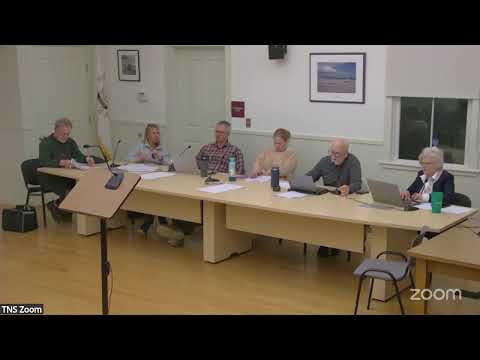
The Block Island Housing Board voted Tuesday to award the trunk-line contract for the Ball O’Brien property to A Transu Corporation and confirmed it may proceed now that the town has designated the board as a sub‑grantee of a Rhode Island Infrastructure Bank grant.
The Block Island Housing Board voted Tuesday to award the trunk-line contract for the Ball O’Brien property to A Transu Corporation and confirmed it may proceed now that the town has designated the housing board as a sub‑grantee of a Rhode Island Infrastructure Bank grant.
The decision clears a major administrative hurdle and begins the on‑site preconstruction coordination required by the Infrastructure Bank. "One of the things they wanted was to see the actual proposed work, and so I provided them the latest statement of work that Bain has provided to us," Mark Maguire, Chair of the Block Island Housing Board, said during the meeting. Maguire said the bank required an on‑site meeting with its consultants (the “beta group”), the selected contractor and the board before work begins.
Why it matters: The trunk line is infrastructure needed to bring water/sewer and other utilities to the Ball O’Brien parcel, the core of the board’s current development plan. With the town’s letter designating the board a sub‑grantee, the board can accept, monitor and manage Infrastructure Bank funds for the work.
Board discussion and contractor clearance Maguire moved to award the trunk-line contract based on the draft contract circulated to members; the motion was seconded and carried by voice vote. During discussion he described the administrative steps the board completed: the Infrastructure Bank wanted the statement of work from Bain; the town requested the grant on the board’s behalf; and the town signed a letter designating the housing board as sub‑grantee, received by the board the day before the meeting.
Maguire also noted administrative compliance items: Bain returned minority business enterprise (MBE) utilization forms that will be part of the contract. The Infrastructure Bank’s process will require Bain to submit its utilization plan and, if goals are not met, to request a waiver — a process the board’s consultant expects will be straightforward.
Omni/1 Neighborhood outreach and CapEx The agenda included updates from Omni and 1 Neighborhood. There was no substantive update from Omni; board members said they planned to connect with a company recommended by 1 Neighborhood called CapEx. Rob Grant, who identified himself as having development experience, offered to be a consistent contact with CapEx and said he would share prior correspondence and proposals with the board to help translate development terminology for the group.
Fidelity grant and pro forma review The board spent substantial time reviewing a pro forma spreadsheet prepared to support a Fidelity grant application and general financing discussions. Chris Warfel, housing board member and resident of Evans Hollow, described the spreadsheet as a working tool to test construction costs, capital sources and operating cash flow. Warfel said he populated the sheet using figures from the Rhode Island Housing application and other available estimates to test assumptions and mechanics.
Key assumptions discussed included: - a construction cost subtotal entered as $5,970,000 (populated from the Rhode Island Housing submission and prior bids, noted by the board as dated and subject to update); - an assumed town warrant or grant of $2,000,000 as a possible capital source (entered in the pro forma as an assumption for modeling purposes); - placeholder amounts for local funding sources including a Block Island Housing bond and named local funds (the board acknowledged some placeholders were optimistic and in need of confirmation); - rental and revenue assumptions such as an $800 monthly tenant rent assumption for a modeled set of units and a baseline STR tax assumption used for modeling purposes.
Board members emphasized the spreadsheet’s preliminary nature and the need to replace placeholders with updated bids and confirmed funding figures before relying on the model in a grant request. Rob Grant volunteered to help refine the pro forma and offered to produce a one‑page rental pro forma the board could use with grant reviewers.
Phased construction plan and bidder outreach Board members discussed shifting from a single large procurement to a phased build — for example, building two units at a time after completing full site utilities — to reduce upfront capital requirements and move construction forward incrementally. The group decided to ask prior bidders to update their proposals for a phased approach and to form a small subcommittee to handle outreach to bidders.
The board made a motion to form a subcommittee to contact the original bidders and seek revised proposals that reflect a phased-construction approach; the motion passed by voice vote. Maguire and other board members said the subcommittee would review existing bids and request updated pricing for building in phases (for example, 1–2 units at a time) and to reconfirm whether bidders remain interested.
What remains next Before physical work starts the Infrastructure Bank requires an on‑site coordination meeting with its consultants and the contractor; the draft contract circulated by the board includes that requirement. The pro forma requires updated line items for current construction pricing and confirmation of grant and local funding sources before the board completes a Fidelity grant submission or finalizes a financing plan.
Ending note: The board’s next steps are to sign the trunk‑line contract after the contract and on‑site meeting are finalized; to refine the pro forma using updated bids and verified funding commitments; and to pursue updated contractor pricing on a phased‑build approach through the subcommittee authorized at Tuesday’s meeting.