Get Full Government Meeting Transcripts, Videos, & Alerts Forever!
Get email alerts on the Coastal Development topic
No spam. Unsubscribe anytime.
Conservation commission gives positive advisory on Boston addition pending DEM, CRMC approvals
Summary
New Shoreham Conservation Commission voted a positive advisory for a small addition at David and Diane Boston’s oceanfront property, conditioned on engineered septic permits and Coastal Resources Management Council (CRMC) and Rhode Island Department of Environmental Management (DEM) approvals.
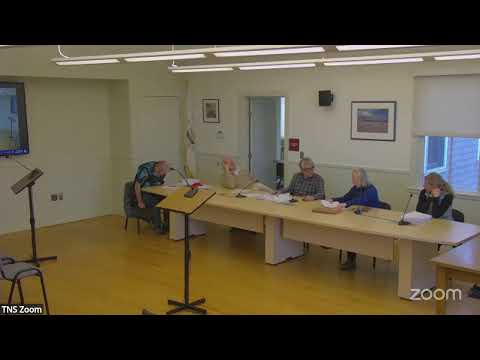
The New Shoreham Conservation Commission on March 11 advised favorably on an application by David and Diane Boston for a small house addition, conditioning its recommendation on approvals from the Rhode Island Department of Environmental Management and the Coastal Resources Management Council and on final permits for an engineered septic system.
The commission’s recommendation matters because the Boston property lies within a mapped coastal zone under town rules that normally prohibits new construction. The applicants asked the commission to review the plan so the zoning board would have the commission’s recommendation when the Bostons seek a variance from the coastal-zone restriction.
Attorney Eric Wallen, representing the Bostons, told commissioners the project would add living space to a small primary structure and that the addition’s footprint is “less probably less than 400 square feet” and would replace about 220 square feet of existing deck. Wallen said the three‑acre parcel (the application lists five acres) is constrained by a coastal feature on the oceanfront, a small stream with a DEM 100‑foot buffer and an adjacent shrub wetland with a 50‑foot buffer, leaving a tight buildable envelope.
Engineer Sergio Chirenzia (Chirenzia and Associates) said the property’s existing septic system dates to the house’s original construction in 1985 and that a leaky tank prompted earlier work. Chirenzia said the applicants already have town and DEM signoffs for a replacement conventional system from prior work but are now proposing a redesigned engineered system with denitrification sized as a five‑bedroom system to account for an optional fifth bedroom in the garage. Chirenzia said the old system will be “abandoned or removed in accordance with DEM regulations.”
Commissioners pressed for details about how the new septic pump line would cross a low point and culvert on the property. Chirenzia said DEM required the pump line to be sleeved and that the installation would be done “surgically” to limit excavation (an inch‑and‑a‑half to two‑inch pump line, with about 3–4 feet of depth for frost protection). He described sediment and erosion controls such as silt fence or straw wattles to prevent siltation into the stream and said disturbed slopes would be revegetated to restore the buffer after construction.
Commission members noted the project’s larger environmental benefit: removing or relocating the existing septic field closer to the stream would reduce wetland risk. Commissioners also discussed abandoning a mowed footpath across part of the site and restoring it to enhance the coastal buffer as a concession to CRMC.
After discussion, the commission made a motion to provide a positive advisory on the Boston addition (David and Diane Boston, Plat 19, Lot 35, buyer number 1199) with the caveats that DEM and CRMC approvals are obtained, that the engineered septic permit is approved, and that a restoration plan is completed at the end of the project. The motion was seconded and approved by voice vote; the transcript does not record a final roll‑call tally.
The commission emphasized that final approvals from DEM (septic/OWTS jurisdiction) and CRMC (coastal features and inland wetlands within their jurisdiction) are prerequisites for the town’s permits and for their advisory to be operative. Commissioners also requested that the applicant provide inspection access and follow state inspection protocols during septic installation.
The commission packet includes site plans and prior DEM correspondence; the applicants and their consultants said they had filed for a CRMC preliminary determination and were awaiting that response before returning to DEM for final septic approval. Commission members asked the applicants to provide restoration details and to avoid unnecessary disturbance to the small stream and adjacent pond areas during installation.
The commission’s advisory is nonbinding; final permission to construct in the town’s coastal zone will depend on the zoning board’s variance and the state agencies’ permit decisions.