Get Full Government Meeting Transcripts, Videos, & Alerts Forever!
Get email alerts on the Municipal Budget topic
No spam. Unsubscribe anytime.
New Shoreham council reviews proposed FY2026 budget; library, school, senior transport and dispatch needs highlighted
Summary
At its March 26 meeting the New Shoreham Town Council reviewed the proposed fiscal year 2026 budget, focusing on library staffing and state standards, the school—s request and loss of Title I funding, problems with the senior transportation program, and a new paid communications/alarm position for dispatch.
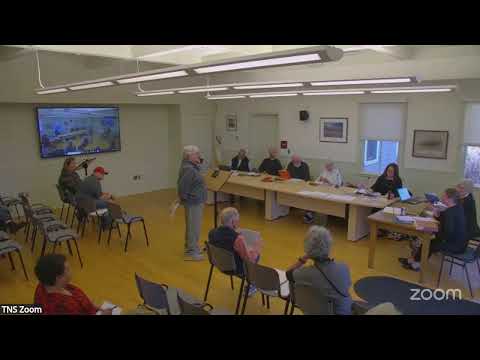
New Shoreham Town Council opened its March 26 meeting with a detailed review of the proposed fiscal year 2026 budget, hearing departmental presentations from the library, school, human services, central dispatch, planning and others and flagging several items that would require follow-up before the budget reaches final adoption.
The discussion centered on service and staffing needs across town departments and several one-time capital items. Library and school officials described mandates and construction planning that have budget consequences, human services staff detailed problems and recent changes to the island—s senior transportation program, and public-safety and communications staff urged funding to formalize long-running volunteer work.
Why it matters: the council—s review sets priorities for the town—s spending plan and identifies gaps that would affect daily services on Block Island if not funded or resolved. Council members repeatedly emphasized succession planning for small departments, clearer enforcement resources for new short-term rental rules, and better documentation and oversight where volunteers have been carrying critical functions.
Library: standards, staffing and elevator costs Bob (library director) told the council the library narrative reflects a modest overall increase and asks for an assistant director position to create a staffing pipeline and continuity when the director—s tenure ends. He said the state—s minimum standards require 35 open hours per week for libraries in New Shoreham—s population range; "Minimum standard is 35 hours, and we are currently at 34," he said. He described several other emerging requirements for professional staff that would tend to increase costs over time.
Bob and councilors also discussed building and equipment costs. The library exceeded its prior equipment-maintenance estimate in 2024 primarily because of repeated elevator repairs; the library and trustees are pursuing replacement, with installation described as scheduled for fall 2025 and partial funding pledged from trustees and a pending Champlin Foundation request (not Rhode Island Foundation, the narrative had said).
School budget and grants A school representative summarized the Block Island School—s FY2026 request: the school committee requested a 4 percent increase in its appropriation (listed in the materials as $228,286); the town manager—s recommended number shown to the council was about a 3.5 percent increase (listed in the packet as approximately $198,760). The school reports about 85 percent of its operating budget is salaries and benefits; recently settled teacher and town-employee contracts factor into next year—s figures.
The school also reported it is not receiving Title I funding because it does not meet the state threshold (the district needs either 10 students or about 2 percent of enrollment in the qualifying category). The school said the loss of Title I eligibility also affects Title IV and some related federal allocations and that the district has submitted a Stage 1 application to the Rhode Island Department of Education—s school construction program; that process will include community forums.
Human services and senior transportation Allison Carley, director of human services, described her department—s programs and several grants. She said the town received an Office of Healthy Aging (OHA) grant that provided $5,000 in total, with $2,500 used for senior transportation and $2,500 for peer-support programming. Carley told the council the island—s subsidized senior-ride program had been expanded through grant funding and that use surged; she said she has tightened eligibility and restarted an enrollment process this week so riders must reapply or reenroll.
Carley noted operational problems that emerged when the program was open without tighter controls: rides that appeared excessive and invoices that required closer oversight. She described an immediate fix requiring proof of Block Island residency and re-enrollment for the subsidized rides and said she would bring a written policy and options to the council. On services more broadly she said, "With this island, we'll never go hungry," describing continuing food and basic-needs support and a growing senior programming effort.
Dispatch, communications and alarm monitoring Council members and staff discussed creating a paid communications and alarm officer to formalize work now handled by a long-time volunteer identified in the record as Howell. The new post would fund 15—-20 hours a week to manage alarm monitoring, vendor licensing and the town—s fire-alarm head-end equipment; Howell and staff have long maintained an aging digitizer that has been struck by lightning multiple times. The town is implementing a new fire-alarm monitoring arrangement that involves Jensen Hughes at the state fire-marshal—s direction and staff said documenting the system will institutionalize knowledge now held by volunteers.
Planning, GIS and short-term rental enforcement Council and staff discussed planning and GIS contracts and a continuing gap in in-house planning capacity. The land-use office requested a 20-hour additional position in the past; for FY2026 the packet showed a narrower recommendation (10 hours) focused on short-term rental registration and enforcement. Council members said the department needs broader backfill and enforcement capacity beyond short-term rentals, and that the town should consider a longer-term staffing approach for planning and permitting.
Other items discussed - Human-resources consultant: the proposed FY2026 budget includes a $15,000 line to engage an HR consultant to standardize procedures and address recurring HR needs. - Finance: the packet lists a statistical revaluation for FY2026 at $59,000, with an anticipated state offset on the revenue side (about $25,000 noted in the materials). - Generator and equipment maintenance: the town is proposing a generator maintenance program to cover multiple public buildings and has increased several equipment-maintenance lines to reflect recent repairs and aging systems. - Police accreditation and staffing: the police chief and staff described a multi-year accreditation effort and ongoing training and staffing plans; accreditation work requires policies, some station improvements and consultant or overtime costs. - Harbormaster/harvest and public works updates: boat pump-out, abandoned-boat removal and mooring fee adjustments were discussed; state Clean Vessel Act (CVA) grants and insurance-driven salvage were described as key funding sources. - North Light (lighthouse) and Morstead/Orsted funds: North Light Commission members reported restoration work and asked the council to consider a draft funding agreement from Morstead/Orsted; the council agreed to discuss the matter in capital or a near-term agenda item.
Decisions and next steps The meeting record shows no final appropriation votes on the FY2026 budget at this session; council members asked for additional follow-up and documentation. Staff were asked to: - Provide a written policy and tighter eligibility controls for the senior transportation program and return with options; - Share updated elevator replacement cost details and the Champlin Foundation grant status for the library; - Supply clearer cost estimates for the new alarm/communications officer and the ongoing fire-alarm monitoring contract; and - Bring further detail on planning, short-term rental enforcement staffing and candidate options for the finance and HR consultant lines.
The council scheduled further budget work and a separate discussion about mitigation funding tied to the Sunrise wind/BOEM process for an upcoming meeting. The session ended with a motion to adjourn that passed by voice vote.
(Quotations in this report are taken verbatim from the council meeting transcript.)