Get Full Government Meeting Transcripts, Videos, & Alerts Forever!
Get email alerts on the Municipal Legislation Package topic
No spam. Unsubscribe anytime.
Warren council reviews Rhode Island League of Cities and Towns' 2025 legislative priorities
Summary
Council members and state legislators discussed a package of bills from the Rhode Island League of Cities and Towns covering tax caps, low-income housing tax rates, sidewalks and state road maintenance, arbitration factors, noise detection, prevailing wage thresholds, and public-safety training reimbursements.
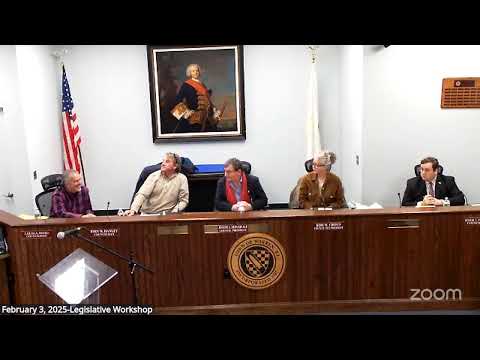
Warren’s legislative workshop on 2025 priorities opened with the Rhode Island League of Cities and Towns’ recommended bills and a request that the town endorse or adopt resolutions for items that specifically affect Warren.
The list under consideration included a proposed carve-out to the local tax levy cap, adjustments to tax treatment for qualifying low-income housing, a move to return responsibility for maintenance and remediation of sidewalks along state roads to the state, changes to factors considered in arbitration for municipal employees, authorization for automated noise-detection enforcement, a large increase in the prevailing-wage threshold for public-works contracts, and a reimbursement scheme for public-safety training when employees are hired away by other municipalities.
“The first one is regarding the maximum levy, tax levy,” said Mister Sullivan, who presented the League’s list. He summarized the levy proposal as preserving the 4% cap for general budgets while allowing a temporary increase up to 5.5% in narrowly defined cases tied to rapid housing growth or new construction that forces municipalities to provide significantly more services.
Council members asked how the existing exception process operates. Mister Rego asked, “So right now, when we go over that 4 percent, who do we send it to for permission to go over?” Mister Sullivan replied that localities currently request exceptions from the auditor general and said the League’s proposal would provide an additional statutory path to exceed the 4% cap up to 5.5% in specified circumstances.
On housing tax policy, Sullivan described an amendment to the statute governing qualifying low-income housing that would raise the municipal tax base percentage from 8% to 10% of the prior year’s gross scheduled rental income while preserving the option for towns to apply for a lower percentage. When Councilman John asked whether Warren currently had such properties, Sullivan said not at present but noted a proposed project on Connecticut Avenue could place Warren into that category.
The group spent extended time on a League proposal amending section 24-5-1 to make the Rhode Island Department of Transportation responsible for repairs and remediation of sidewalks along state highways (excluding snow and ice removal). Supporters argued shifting responsibility could reduce long-term costs by enabling the state to keep sidewalks in better repair; opponents warned the state might assume only limited duties or perform annual rather than routine maintenance. Mister Charlie urged focusing on long-term cost savings; another member cautioned that annual cleaning language should be removed if the town asks the state to accept responsibility.
Sullivan also summarized a bill that would add town charters and ordinances that establish municipal management rights to the list of factors an arbitration board may consider in police and fire arbitrations; council members pressed whether that approach would conflict with negotiated contracts.
Other items included: - An amendment to require municipalities be able to use automatic systems to detect motor-vehicle noise violations (decibel-detection systems). Presenters said the bill would authorize but not fund equipment; concerns were raised about identifying individual violators and potential budget impacts. - A proposal to permit automated speed cameras in locally designated safety zones outside school zones, with town council authority to declare such zones. - A proposal to raise the prevailing-wage trigger in public-works procurement (section 37-13-7) from roughly $1,000 to $100,000, a change Sullivan described as controversial because it shifts costs toward municipalities for work that would otherwise fall under prevailing-wage rules. - A new statute to require the hiring entity to reimburse an employee’s previous municipality for training costs if that employee is hired elsewhere within three years; Sullivan described a tiered, pro-rata reimbursement schedule tied to time served after training.
Multiple council members and the legislators in attendance—identified in the meeting as Rep. Speakman and Senator Feilat—encouraged the council to prepare a list of approvals and objections and noted that the General Assembly handles thousands of bills annually; local input, they said, helps shape legislative priorities and sponsor selection. Sullivan said the town would circulate the League’s list and that individual items would be placed on February’s meeting agenda for votes or possible resolutions.
Council members also raised local non-legislative concerns during the meeting’s open discussion: early voting funding and weekend sessions, affordable housing allocation to prioritize Rhode Island residents, and the need for clearer engineering on Market Street state-road projects. Sullivan and others said some issues hinge on state funding or agency schedules.
The workshop concluded with agreement to bring the League’s list back in February for individual consideration and possible resolutions supporting Warren-specific items.