
Everett School Committee hears FY2026 budget proposal, refers plan for committee vote after 7-0 roll call
Get AI-powered insights, summaries, and transcripts
Subscribe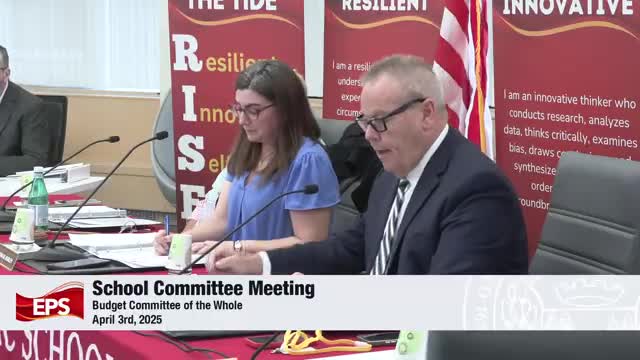
Summary
Superintendent and finance staff presented a $136.9 million operating budget ( $142.15 million including special-education transportation) for Everett Public Schools’ FY2026; the committee voted 7-0 to refer the proposal for a formal vote at the April 7 meeting and to continue city budget steps required by May 1.
Superintendent Hart and district finance staff presented the Everett Public Schools proposed fiscal year 2026 budget on April 3, outlining a $136,900,000 operating request and a total of $142,154,420 when special-education transportation is included. The School Committee voted 7-0 to refer the superintendent’s proposed budget to the full committee for action at the April 7 meeting.
The budget team framed FY2026 as a “service level” proposal that preserves existing programs and staffing while absorbing several fixed-cost increases, Superintendent Hart said. "I am indeed proud to present a budget to you this evening that puts our students, our families, and our employees first," Hart said at the start of the presentation.
Deputy Superintendent Gretchen Manning and Director of Budget Chris Schweitzer led the detailed review. Manning highlighted required investments under the Student Opportunity Act, saying the district’s year-2 obligation for that plan is "1.57 million dollars for year 2." Schweitzer said enrollment — the primary driver of state aid — was 7,347 on the official October 1 count and “as of last week, our enrollment in the district is nearly 7,500,” which the administration cited as a stabilizing factor for revenue.
Why it matters: the district said it can present a balanced operating budget without layoffs or program reductions despite rising costs in special education, health insurance and infrastructure. The committee must adopt a budget for referral to the city by the legally required May 1 timeline; the School Committee’s April 7 vote will send the request into the city budget process.
Key figures and investments - Proposed operating budget (net school spending after chargebacks): $136,900,000. Director Chris Schweitzer said this is the number his slides “back into” after accounting for required local contributions and state Chapter 70 aid. - Total request including special-education transportation: $142,154,420. Schweitzer explained special-education transportation is presented separately because it is non–net-school-spending-eligible and funded above the operating number. - Student Opportunity Act (SOA) year 2: $1,570,000 (budgeted to fund hires and programs described in the SOA plan). - Projected increase in out‑of‑district special‑education tuition: $1,200,000 (presented as a districtwide increase tied to inflation and student needs). - Projected increase in special‑education transportation (presented to the city): about $600,000, calculated from current contracts and out‑of‑district placements. - Enrollment: 7,347 (October 1 official count); administration reported nearly 7,500 current enrollment.
Staffing and program changes - The administration said the FY2026 proposal keeps current services and staff in place and absorbs the positions previously supported by ESSER grants into the operating budget without reductions. Manning said the district has "absorbed all positions that were on ESSER in FY24 into our operating budget." - Four new system‑wide positions were presented as FTE neutral: two building maintenance technicians (one with plumbing skills to reduce outsourced plumbing contracts) and two K–8 instructional coaches (to add coaching capacity). The budget team said these additions are offset by other changes and vacancies. - Paraprofessionals: the budget includes negotiated increases to raise paraprofessional pay toward a living wage as part of recently settled bargaining agreements. Manning said bargaining results are fully included in the proposal. - School administration: at three early‑childhood/K–5 sites (Adams, Webster Extension/WebEx, Webster), the administration is converting head‑teacher roles to assistant principals to reflect year‑round responsibilities; officials said the incumbents have been performing expanded duties. - Alternative and therapeutic programs: the in‑district Devon therapeutic day school was cited as saving the district more than $4,000,000 versus sending students out of district, and the evening alternative program serves 37 students ages 18–21 (14 graduates last year; the administration expects about nine graduates this year).
Budget structure and transparency - The district expanded its chart of accounts to present more granular lines (stipends, contracted services, supplies, other) to align with DESE reporting and to make school and department spending clearer. Schweitzer walked through department‑level examples such as athletics, art and CTE where previously a single line concealed contract and supply detail. - Some apparent decreases at the school or department level reflect reclassification or centralization of curriculum and professional‑development costs into system‑wide accounts, not cuts, the finance director said.
Questions and concerns raised - Committee members asked about the federal ESSER reduction reported in a memo; Manning said the district had not committed those particular federal funds and that the loss would not affect day‑to‑day services. - Members pressed for clarity on charter school (“Cherry sheet”) chargebacks and how student movement affects the assessment; staff said the assessment is calculated by the state and they would follow up with more detail on tracking and the timing of reported changes. - Committee members raised overcrowding in several schools and said principals report using all available space; district leaders acknowledged capacity pressure and said enrollment growth is driven partly by in‑migration and not only local birth rates.
Votes at a glance - Motion to invite Deputy Superintendent Gretchen Manning and Director of Budget Chris Schweitzer to present the FY2026 budget: moved and seconded; passed by voice vote (ayes). - Motion to refer the FY2026 superintendent’s proposed budget, as presented, for School Committee action at the April 7 meeting: moved by Mr. Almeda Barros; seconded by Ms. Babcock. Roll call vote 7–0 in favor (Almeda Barros — yes; Babcock — yes; Miss Barrows — yes; Cornelia — yes; Cristiano — yes; Garen — yes; Chair Hurley — yes). Outcome: passed. - Procedural votes to open and close public comment during the meeting: passed by voice votes (no speakers during public comment).
What’s next The School Committee will take formal action on the superintendent’s proposed FY2026 budget at its April 7 meeting. After the committee’s formal adoption, the proposal will be transmitted to the city as part of the city budget process required by May 1, per DESE timing referenced during the presentation.
Ending District officials emphasized the presentation’s framing as a balanced, service‑level budget that preserves staffing and program levels while addressing contractual obligations and targeted investments in special education, literacy, safety, facilities and career readiness. Committee members thanked staff for the detailed line‑item presentation and posed follow‑up questions staff said they will answer before the next meeting.