
Committee hears legal and technical outline of the Climate Superfund cost-recovery bill (H.122) and litigation risks
Get AI-powered insights, summaries, and transcripts
Subscribe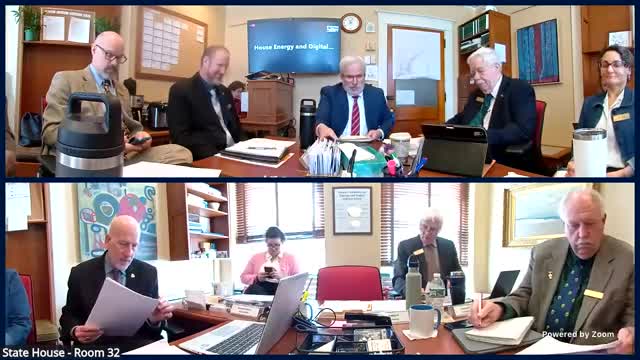
Summary
Michael Grady, counsel, briefed the House Energy and Digital Infrastructure Committee on April 4 on H.122, the Climate Superfund Act, explaining how the state would calculate costs and identify responsible parties for covered greenhouse-gas emissions from 1995'2024.
Michael Grady, identified himself as counsel, briefed the House Energy and Digital Infrastructure Committee on H.122 (branded in discussion as the Climate Superfund Act) on April 4, describing the bill's approach to cost recovery for climate-related harms and the legal and technical issues lawmakers and agencies will face.
Grady told the committee the bill is modeled on the liability approach used in hazardous-waste Superfund law (CERCLA): it would make certain entities strictly, jointly and severally liable for a portion of the cost to the state and its residents of covered greenhouse-gas emissions tied to fossil fuels they extracted or refined during a covered period (defined in the bill as Jan. 1, 1995 through Dec. 31, 2024). A responsible party is an entity whose attributable emissions during the covered period meet a very large-threshold contribution (discussion referenced a threshold of 1,000,000,000 metric tons aggregated for attribution purposes) and that has sufficient contacts with Vermont for jurisdictional purposes, Grady said.
The statute designates the Agency of Natural Resources (ANR) to administer the program and the state treasurer to calculate the total cost to Vermont and its residents of the covered emissions during the covered period. That treasurer’s calculation is intended to estimate past and projected costs — including public-health, natural-resources, agriculture and other categories — attributable to covered greenhouse-gas emissions during the covered period; that estimate is used to proportionally allocate recovery demands to responsible parties, Grady said.
How shares are calculated: the cost-recovery demand to each responsible party is the state's cost multiplied by the ratio of that party's applicable share of covered emissions to the aggregate applicable shares attributable to all responsible parties. Grady discussed a proposed technical clarification to ensure the covered greenhouse-gas quantity is tied to the entity's extraction or refining activities rather than an undifferentiated global emissions total. The treasurer and ANR must adopt a methodology and there will be an administrative rule-making process for determining shares and identifying responsible parties.
Payment mechanics and appeals: responsible parties could pay within six months, or enter a nine‑payment installment plan (20% due on the first payment, remaining 80% spread across eight payments). If a responsible party fails to pay, the unpaid balance becomes due; a buyer that assumes assets can assume installments only by agreement. The bill creates a special fund administered by ANR for climate-adaptation projects and other qualified expenditures and allows the state auditor to be reimbursed from the fund to audit program effectiveness every five years, Grady said.
Legal and practical risks: Grady described legal arguments that plaintiffs in related challenges are likely to raise, including federal preemption (Clean Air Act), due-process and interstate-commerce limits on state jurisdiction, extraterritoriality, and takings or excessive-fines arguments. He noted that multi-state litigation has been filed in other jurisdictions and that large trade associations are among the plaintiffs (he identified the U.S. Chamber of Commerce and a national petroleum trade group as parties suing in related matters). He said litigation and discovery could be lengthy and that courts could resolve different claims in stages.
Appropriations and implementation: the bill includes initial appropriations for ANR rulemaking and for the treasurer's office to hire technical support; Grady said those funds were included in past budgets but additional appropriations may be requested. He also noted a pending House amendment (H.319 language) that would adjust implementation mechanics — for example, moving the resilience strategy out of formal rulemaking into a report — and that some technical dates have been shifted in prior sessions.
Committee members asked for clarification about why distribution networks into Vermont (for example, gasoline supplied via out‑of‑state racks) create sufficient contact for jurisdictional claims and whether the program would be a one‑time cost (the covered-period calculation is one-time unless the General Assembly authorizes an expanded covered period in future action). Grady cautioned the program would be precedent-setting and could produce lengthy litigation but said states that pursue similar approaches argue they seek remediation and reimbursement for harms rather than punishment.
No formal committee vote was recorded at the April 4 briefing; the meeting was an informational presentation.