
Treasurer’s office seeks $700,000 and 12-month extension to complete Climate Superfund damage study
Get AI-powered insights, summaries, and transcripts
Subscribe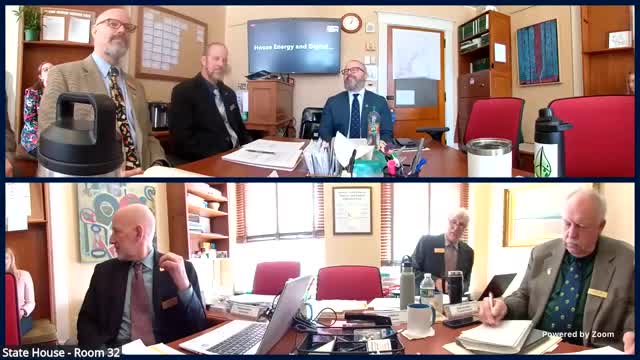
Summary
Deputy Treasurer Gavin Boyle told the House Energy and Digital Infrastructure Committee that the treasurer’s office and the Agency of Natural Resources need more funding and time to complete a scientifically defensible damages and abatement analysis under Act 122 and House Bill H.319.
Deputy Treasurer Gavin Boyle told the House Energy and Digital Infrastructure Committee on April 4, 1999, that the treasurer’s office is asking the Legislature to extend by 12 months the Jan. 15 deadline set in Act 122 and to appropriate additional funds to complete a statewide damages and abatement study tied to the so-called Climate Superfund.
The request would add $700,000 for consultants and third-party services and $125,000 for a limited-service position over three years, Boyle said, on top of $300,000 previously appropriated under Act 122 that has not yet been spent. "We got $300,000 in Act 122. One of the things that the RFI convinced us of is that that is probably not adequate," Boyle said. "Whoever we do hire needs to be someone who has testified or who has been qualified as an expert."
The treasurer’s office said it has completed a request for information, or RFI, and is close to drafting a request for proposals, or RFP, but cannot confidently issue the RFP until it has clearer funding assurances. Boyle said the office’s task is to quantify historical and forward-looking damages statewide — for example, increased flooding, heat and health impacts listed in Act 122 — and that the Agency of Natural Resources, working with its experts, would allocate those statewide damages to specific extractors and refiners.
Ashlyn (treasurer’s office policy staff) added technical context about methods and data. She said RFI responses identified different validated methodologies for discrete hazards such as fluvial erosion and heat, and cited academic and research institutions among potential contractors. "Some of these methodologies have been peer reviewed or are in the process of peer review," she said. She also noted that some datasets referenced for attribution work are publicly available, including emissions admissions databases used by climate researchers.
Committee members pressed on cost and risk. One lawmaker noted the office is already defending litigation tied to the program and questioned the prudence of additional spending with an uncertain outcome. Boyle responded that the work is required by statute and needs to be defensible in court: "We need to do the work well partly because of that litigation."
The treasurer’s office and the Agency of Natural Resources plan to run separate RFPs for their respective tasks but expect to consult with one another during evaluation. Boyle said the ANR portion — determining each responsible party’s share of the statewide figure and issuing demand letters — is a distinct phase that can proceed partly in parallel but ultimately depends on the damage estimate his office produces.
Officials also said Vermont’s geography and infrastructure — older roads, concentrated river-valley settlements and variable flood behavior from year to year — create methodological challenges that make local tailoring necessary. Boyle and Ashlyn said that while methods used in other states and academic studies are instructive, the analysis for demand letters will need Vermont-specific modeling and defensible expert testimony.
Ashlyn noted potential coordination benefits with other states: New York had announced a similar process in January, and aligning timelines could allow inter-state sharing of lessons, though the calculations must remain Vermont-specific for any demand letters.
No formal vote or committee action was recorded during the briefing. Boyle said that if the Legislature does not approve additional funds and the deadline extension, the treasurer’s office likely will be unable to complete the legislatively mandated study on the current schedule.
The treasurer’s office recommended the Legislature extend the Act 122 deadline to Jan. 15, 2027, and appropriate additional resources to allow the work to proceed with outside experts who can withstand scrutiny in litigation.