
Crime-scene investigators describe vehicle processing; eyewitness recounts encounter near San Pedro massage parlor
Get AI-powered insights, summaries, and transcripts
Subscribe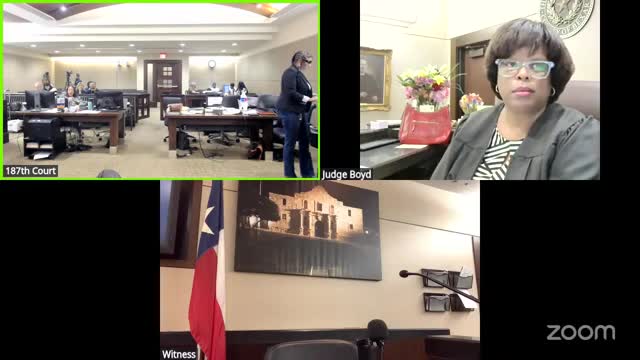
Summary
City of San Antonio crime-scene investigators testified about photographing, swabbing and cataloging items from a vehicle linked to a homicide investigation, while an eyewitness described a car with a smashed windshield and three occupants near San Pedro.
During testimony in State v. McIntyre, the court heard forensic testimony from crime-scene investigators about evidence recovered from a vehicle connected to the case, and an eyewitness described encountering occupants of that vehicle near San Pedro avenue.
City of San Antonio crime-scene investigator Lisonbee Bustamante testified that she was dispatched on April 28, 2017, to a vehicle at 7243 San Pedro that officers initially reported as an abandoned vehicle possibly involved in a homicide. Bustamante said she photographed the scene, sketched items for collection and collected multiple items, including swabs for possible biological evidence and packaged items later logged as exhibits. She testified that the investigators did not open the vehicle at the scene because they lacked a search warrant; the vehicle was sent to the impound “pound” and later brought to the department’s Ninth Street secure processing facility where a warrant allowed interior processing.
Bustamante identified and described state exhibits (photos and packaged evidence) including an empty wallet, cigarette package, beverage container, sunglasses with a missing lens, a cross pendant recovered under the vehicle, several swabs and multiple toothbrushes and electronic items recovered from the glove box and interior (including a blue iPhone). She also identified a live .380 caliber round (state exhibit 109) recovered from the vehicle interior and said empty magazines from three different manufacturers were recovered (Smith & Wesson, Taurus, Ruger). The exhibits (photos and packaged evidence) were admitted into evidence at the hearing without objection at several points in testimony (state exhibits 69–87; 88–103; 107–115 and additional numbered exhibits described by witnesses).
Crime-scene investigator Raul Hurtado, who assisted at the scene and later conducted latent-print efforts, testified that he attempted to lift prints from exterior vehicle surfaces and turned latent-print cards into the department’s identification services. Hurtado described submitting approximately 14 individual cards of developed impressions and explained that matching and analysis of those cards is handled by ID services, not by the field CSIs who collect the impressions. He also said that during his on-scene processing he focused on the exterior areas identified by Bustamante and that the cards were logged and placed into the department’s chain-of-custody process.
On cross-examination, both CSIs described the practical limits of on-scene work: exterior processing can occur without a warrant, interior processing required a warrant; items in the parking lot may be trash or unrelated but were collected because they were in close proximity to the vehicle; and some prints submitted to ID services did not develop legible, reportable prints in the field. The witnesses explained that DNA and latent-print workflows differ and that labs perform further analysis after field collection.
Eyewitness Jasmine Rios Cruz testified that on April 23, 2017, she parked near a restaurant close to a San Pedro address to visit a massage office. As she returned to her car she saw a vehicle with a shattered windshield and three occupants: a young Black male in a white T‑shirt who approached her and asked for a ride, a second taller/darker male who exited from the right rear of the vehicle, and a light-skinned female driver wearing a blonde wig who appeared shocked. Cruz said she did not give them a ride and later was contacted by police to report what she had seen.
The court also resolved objections about late discovery and the timely production of some reports; the judge overruled some objections and sustained others after bench discussion, and several evidentiary exhibits were admitted into evidence for the jury to view prior to the court’s recess.
The testimony detailed the chain-of-custody steps for physical evidence and showed the division of labor: field CSIs collect and log items and packets; latent-print development and final comparison are handled by ID services; DNA testing is performed at a separate laboratory. The court placed several witnesses on recall as necessary for trial scheduling and further testimony.