
Fairfax council introduces ADU ordinance to align local rules with new state law, adds temporary amnesty and anonymous rent reporting
Get AI-powered insights, summaries, and transcripts
Subscribe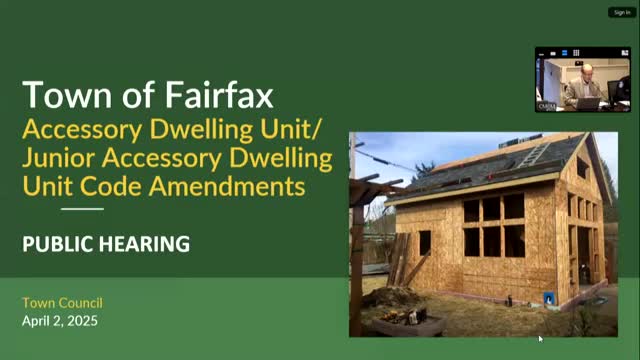
Summary
The Fairfax Town Council held a public hearing on accessory dwelling unit (ADU) rule changes required by new state law, then voted to waive first reading and introduce a local ordinance with two council amendments: extending amnesty for unpermitted ADUs and making rent‑reporting data anonymous.
The Fairfax Town Council on April 2 held a public hearing on proposed changes to local rules for accessory dwelling units and junior ADUs required by new state laws AB 2533 and SB 1211, and the council voted to waive first reading and introduce a local ordinance with two amendments.
The staff report, presented by Planning Director Jeff Beisswanger, said the state bills became effective Jan. 1, 2025, and “expand amnesty for unpermitted ADUs” and limit local review to health-and-safety standards for older, unpermitted units. Beisswanger told the council the state law also removes some local design and parking requirements and increases the number of ADUs allowed on multifamily sites, and that Fairfax may adopt limited objective design standards where state law permits.
Why it matters: the changes affect how homeowners and multifamily property owners may add units, how the town enforces unpermitted conversions, and what the town may require about replacement parking and design. Supporters at the hearing urged the council to preserve flexibility for homeowners; opponents and some residents raised concerns about parking, fire safety and how legalizing previously unpermitted units could affect the town’s housing numbers.
Key facts: staff said AB 2533 broadens amnesty for ADUs built before Jan. 1, 2020 (previously the town’s amnesty covered earlier years), requires a checklist of substandard building conditions and generally limits reviews to health-and-safety issues with a five‑year compliance window. SB 1211 clarified that local agencies cannot require replacement for uncovered off‑street parking lost to an ADU, expanded the number of detached ADUs allowed on multifamily parcels (with a cap of eight units and not to exceed the number of existing units) and constrained objective design standards that local governments may apply.
Council action: Councilmember Kohler moved — and the council seconded — to waive first reading and introduce the ordinance as recommended by staff with two amendments taken from a supplementary staff memo: (1) extend the ADU amnesty incentive program to expire Jan. 1, 2045 (rather than the earlier date in the draft), and (2) require that rent‑reporting data collected to support ADU policy be reported anonymously. Councilmember Guirangalli registered a “no” vote in debate, citing broader concerns about state mandates; the motion passed and the ordinance was introduced for further hearings and formal adoption.
Public comment and council discussion: Public commenters included homeowners, renters and parents who described local housing pressures, teacher pay concerns tied to school parcel taxes and privacy worries about rent data reporting. Several speakers asked whether ADUs legalized through amnesty would count toward the town’s RHNA (Regional Housing Needs Allocation) totals; staff said legalized ADUs can count toward housing production totals. Staff also clarified that owner‑occupancy is required for a junior ADU but not for most ADUs and that multifamily properties are subject to the new multifamily ADU rules.
What’s next: because the council introduced the ordinance, the item will return for further reading and formal adoption at a later meeting. Staff and council members noted follow‑up steps to finalize implementing details, including the town’s amnesty period language, objective standards for new detached ADUs and procedures for collecting rent data anonymously.
Ending: The council balanced implementing mandatory state changes with local safeguards — extending the amnesty period and anonymizing rent data — and scheduled the required follow‑up steps to bring the ordinance back for formal adoption.