
State dam-safety chief outlines $500,000 annual capital request and $89 million Waterbury Dam rehab
Get AI-powered insights, summaries, and transcripts
Subscribe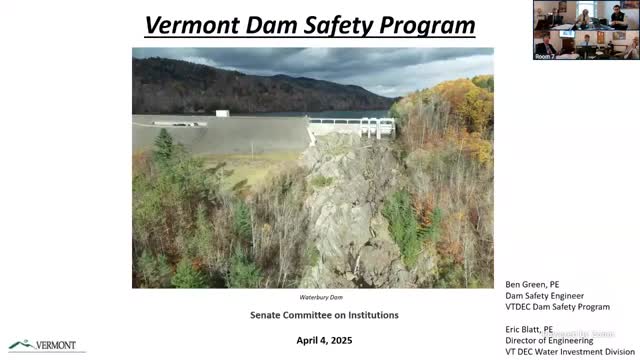
Summary
Ben Green, section chief of the Dam Safety Program at the Vermont Department of Environmental Conservation (DEC), told the Senate Committee on Institutions on April 4 that the agency is seeking $500,000 in capital construction funding for each of fiscal years 2026 and 2027 to support repairs and assessments of state-owned dams.
Ben Green, section chief of the Dam Safety Program at the Vermont Department of Environmental Conservation (DEC), told the Senate Committee on Institutions on April 4 that the agency is seeking $500,000 in capital construction funding for each of fiscal years 2026 and 2027 to support repairs and assessments of state-owned dams.
The request is part of a broader capital plan that uses leftover fiscal year 2023 funds and additional fiscal 2026–27 requests to move dams through a multi-step process of comprehensive assessment, design, permitting and construction. "We regulate about a thousand dams, statewide," Green said, and the DEC directly owns 14 dams that it manages for flood control and public safety.
Why it matters: the presentation highlighted a large, state-federal rehabilitation project at Waterbury Dam that officials say is necessary to restore the facility’s full flood-control function and reduce long-term risks to downstream communities and infrastructure.
Green told the committee that routine gate testing in February revealed jammed floodgates and concrete deterioration at Waterbury Dam. He said structural work is required to restore full functionality and that the current combined federal-state cost estimate for the Waterbury project is about $89,000,000. "The current estimate to do this project to basically restore full, flood control functionality for the stand is in the $89,000,000 range," Green said. He added that the state’s share of that cost is roughly 7.1 percent, with the remainder expected to be federally funded.
Planned work described by DEC staff includes replacing two smaller floodgates, rehabilitating the larger mid-century gate, removing and replacing a structurally deficient service bridge and lifting equipment, addressing downstream erosion with a concrete splash pad, and conducting extensive concrete repair to address alkali-silica reaction in aging concrete. Green said the project will likely require a temporary reservoir drawdown of an estimated 30 to 60 feet during a two-year construction window planned to begin in 2027, which would affect recreation and hydropower production.
The department also reviewed its inventory and project pipeline. Green described the agency’s standard sequence for rehabilitation projects—comprehensive assessment (engineering inspection, geotechnical coring, hydrologic analysis), final design and permitting, then construction—and said the DEC currently has one project in construction (Carmai Dam, as noted in agency materials), two projects moving into design (including Noyes Pond Dam and Silver Lake Dam) and about eight projects in the comprehensive assessment phase. Green said the department expects to move projects through those phases as funding becomes available.
Wrightsville study and next steps: Green outlined work needed at Wrightsville Dam near Montpelier and said the DEC has pursued assistance from the U.S. Army Corps of Engineers’ Assistance to States cost-share program (50 percent match). The Corps did not admit the study into its program last year, so Green said the department plans to hire a private consultant to advance analysis of operational alternatives and reservoir operations using about $350,000 it has identified for a 50 percent match. "We're going to hire a private consultant and go out it alone to try to at least unpack some of those issues," Green said.
Funding instruments and rulemaking: Green summarized recent legislative changes under Act 121 that expanded a revolving loan fund for privately owned unsafe dams and said the Legislature appropriated $3,000,000 for that fund. He said DEC staff are drafting rulemaking and technical standards and hope to issue a rule package in July 2026, with a statutory deadline connected to the legislation in July 2027. "Part of our hope is to roll the revolving loan fund to the same package so that when technical standards hit, the loan fund hits at the same time," Green said.
Staffing and capacity: Green reviewed recent staffing increases in the dam-safety program after legislative support last year. He said the program has hired a project manager and a technician and has additional engineering positions open; Mike Anderson was named as the new program manager who started in February (start year not specified). Green said hiring remains a recruiting challenge but that the program is building out three service areas—project management, technical services and regulatory/emergency planning—to handle the expanded workload.
Committee discussion: unnamed committee members asked about local flooding in Montpelier, the timeline for Waterbury work, the consequences of drawing down reservoirs during construction, and potential efficiencies from proceeding without full federal participation. Green cautioned that bypassing Corps processes can speed design and allow different alternatives but may complicate cost-share eligibility for later construction phases; he said the agency believes the Wrightsville study is important enough to proceed now.
Next steps: DEC staff said they will return to the committee for further discussion on related capital sections (including drinking water and clean-water matching funds) at a later meeting and will proceed with consultant hiring and rule development as described.
Ending: committee members thanked staff and deferred additional questions until the next scheduled appearance.