
Tempe explores no-cost Financial Empowerment Center; $20,000 planning grant approved
Get AI-powered insights, summaries, and transcripts
Subscribe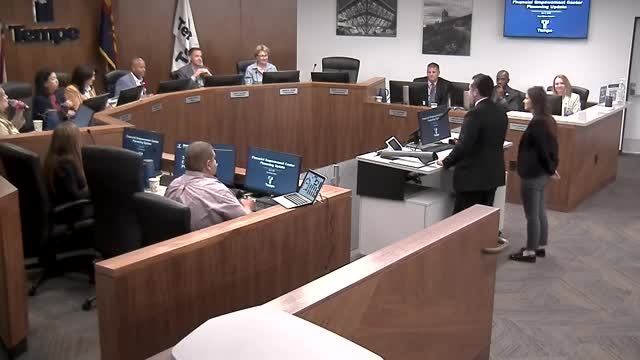
Summary
Cities for Financial Empowerment Fund briefed council on a city-run, nonprofit-delivered Financial Empowerment Center model that offers free one-on-one counseling, a $20,000 planning grant, and potential launch funding up to $150,000; city staff expect an 8–12 month planning timeline.
Tempe staff and a national nonprofit presented plans to establish a city‑led Financial Empowerment Center (FEC) that would provide no-cost, one-on-one financial counseling to residents and connect counseling to other local programs.
Tim Birch, Community Health and Human Services director, introduced Rose Harvey, manager of FEC Innovations at Cities for Financial Empowerment Fund (CFE Fund), who summarized the national model and local planning work. Harvey said the FEC is a public service typically run by local government and delivered by a contracted nonprofit that hires professionally trained counselors. The FEC model is data driven and uses a Salesforce platform provided by CFE Fund to track client-level outcomes.
Harvey told council the national network operates in 37 cities and counties, with about 20 more jurisdictions in planning. National performance figures cited by Harvey include more than 189,000 clients served, about $315 million in debt reduction and roughly $61 million in savings built across the network over the last decade. Harvey said the FEC service is open to all residents age 18 and older with no documentation or income eligibility restrictions and that counselors provide individualized, repeatable support rather than volunteer or one‑off advice.
Cities for Financial Empowerment Fund awarded Tempe a $20,000 planning grant to develop a local plan, and staff said CFE Fund can provide a one‑time launch grant of up to $150,000 and help identify matching funds. Birch and Harvey described next steps as identifying the city lead (a part‑time manager), selecting a nonprofit counseling partner through an RFP, forming community partnerships (for referrals and outreach), and designing training and marketing. Birch said the planning timeline is roughly eight to 12 months to complete community planning and an RFP for the nonprofit partner; council members asked whether that timeline could be shortened to six to eight months and staff said they would consult technical advisors while preserving program quality.
Council members raised integration and outreach questions. Council Member Chin recommended linking the FEC to existing local programs such as College Connect, Rio Salado Community College and ASU, and to Volunteer Income Tax Assistance (VITA) and workforce programs. Vice Mayor Garland and others asked whether small business owners and veterans could be served; Harvey said FEC counselors commonly advise micro‑entrepreneurs on separating personal and business finances and can refer clients to small‑business technical assistance. Council members also suggested outreach to schools, housing voucher clients, reentry programs and disability services; staff said those constituencies will be included in the planning and marketing strategy.
Harvey and Birch said the planning process will produce a detailed local plan by the end of the year, with CFE Fund technical assistance and potential launch funding to follow.