
Zoning commission recommends approval of Southland Water Resource Project, 5-3, sending it to county commissioners
Get AI-powered insights, summaries, and transcripts
Subscribe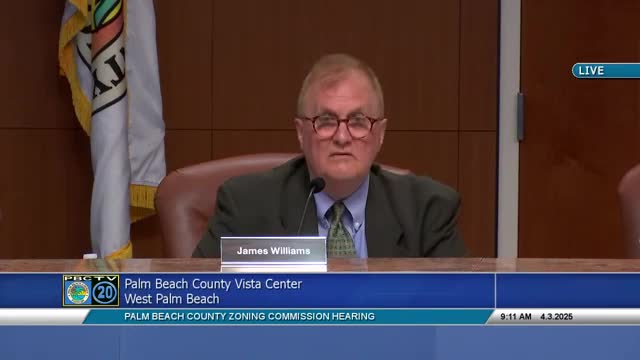
Summary
Palm Beach County zoning commissioners voted 5-3 to recommend approval of a Class A conditional use for the Southland Water Resource Project — an 8,611.52-acre excavation proposed as a shallow reservoir and aggregate operation — while opponents urged delay until state and district reviews are complete.
Palm Beach County Zoning Commission members voted 5-3 to recommend approval of CA20231791, the Southland Water Resource Project, a proposed Class A conditional use to allow a Type 3 excavation on 8,611.52 acres that the applicant says will be reclaimed as a shallow water storage reservoir and used to supply existing stormwater treatment areas.
The recommendation moves the project to the Board of County Commissioners for final local action; county staff and the applicant said the project cannot proceed with any ground disturbance until the state issues an Environmental Resource Permit (ERP) and any required agreements with the South Florida Water Management District (SFWMD) are in place.
Why it matters: Commissioners and public speakers framed the project as both a potential water-storage asset for Everglades restoration and as a commercial rock-mining operation. Supporters said the excavation would provide near-term storage capacity to hydrate Stormwater Treatment Area (STA) 56 and deliver jobs for local communities; opponents and environmental groups urged postponement until SFWMD and Florida Department of Environmental Protection (DEP) reviews are complete and legal questions about county plan language are resolved.
Applicant presentation and staff recommendation Phillips & Jordan, the applicant and design‑builder, described the Southland project as a low‑hazard, shallow reservoir adjacent to existing Everglades projects and to the Miami Canal. Matt Eidson, vice president of Phillips & Jordan, said the plan delivers an initial 20,000 acre‑feet of storage in under five years (phases 1–3) and that the excavation/reclamation approach is intended to ensure the site is developed as a water storage facility rather than an abandoned quarry. "This project will store and direct water to existing stormwater treatment areas moving south out of Lake Okeechobee," Eidson said during the presentation.
County staff advised the commission that the request is a land‑use recommendation under the county comprehensive plan and Unified Land Development Code. Eman Haddad of the zoning division summarized the request and site plan: 13 subphases with an annual excavation rate shown in the filing (the application lists an annual excavation rate of 276 acres and a phasing schedule spanning multiple decades), internal rail shown on the site plan, on‑site buildings (office, maintenance, laboratory, fueling) and limited parking. Planning staff recommended approval subject to conditions in Exhibit C that include monitoring, annual reporting and a date‑certain requirement tied to state permitting.
State and district review, permit timing, and conditions Noah Valenstein, former secretary of the Florida Department of Environmental Protection appearing as a project consultant, explained the ERP process and said DEP requires technical demonstrations (3‑D groundwater modeling, stormwater and water‑quality analyses and review of potential impacts to District works including the EAA reservoir and STAs) before issuing a construction permit. Staff and the applicant repeatedly said no excavation or removal of material could occur without an ERP from DEP.
Planning staff pointed to a December 31, 2024 letter from SFWMD that, in staff's reading, satisfied the comprehensive‑plan identification requirement. Commissioners and many public speakers disagreed about whether that letter and SFWMD’s early statements are sufficient; opponents urged the county to wait until SFWMD completes its multi‑step evaluation and any comprehensive agreement. Planning conditions require the applicant to provide a fully executed ERP demonstrating the project is for water‑resource purposes by a date certain (planning Exhibit C references a status review if a permit is not in hand by 04/30/2026), and to return to the Board of County Commissioners for compliance checks and possible revocation if required conditions are not met.
Public comment and stakeholder positions Supporters at the hearing included municipal leaders and business groups who framed the project as delivering storage, jobs and local economic benefits. Steve Wilson, mayor of Belle Glade, said the region’s agricultural communities need the jobs and water management benefits the project promises. Michael Zaff, president and CEO of the Chamber of Commerce of the Palm Beaches, said the chamber endorsed the project after review.
Opponents included environmental organizations and fishing and boating industry representatives who urged postponement. Linda Smith of the Sierra Club Loxahatchee Group said, "This project is not a water resource project. It's a rock mine." Lisa Innerlandi of the Everglades Law Center and representatives of Friends of the Everglades, Captains for Clean Water, Florida Oceanographic Society and others urged the commission to wait for SFWMD and DEP technical determinations and warned of legal and hydrologic risks to the EAA reservoir and STAs.
Commission action and next steps Commissioner Bendigo moved to recommend approval; the motion carried on a roll call vote, 5‑3. The commission's action is a recommendation to the Board of County Commissioners. If the Board approves a development order at a future meeting, the applicant must still obtain DEP's ERP and any required agreements with SFWMD or other agencies before any onsite excavation can begin. Planning conditions include annual monitoring, phase‑by‑phase reporting, and a county review with a staff recommendation to revoke the development order if the ERP or other required steps are not completed within the timeline conditions specify.
Separate, minor items A consent‑agenda item (Nash Trail) was discussed briefly; the applicant's agent said staff and the applicant are working through a specific condition and expect the item to be finalized at the Board of County Commissioners hearing later this month.
Looking ahead: The zoning commission record and the staff conditions will accompany the application to the Board of County Commissioners, which will schedule a public hearing on final county approval. The ERP application, technical permitting by DEP, and any comprehensive agreement with the South Florida Water Management District remain outstanding prerequisites to ground‑disturbing work.