Get Full Government Meeting Transcripts, Videos, & Alerts Forever!
Get email alerts on the Firearms Permit To Purchase topic
No spam. Unsubscribe anytime.
Long hearing on permit-to-purchase bill draws broad public testimony on costs, rights and enforcement
Summary
Lawmakers held extended public testimony on Engrossed Second Substitute House Bill 1163, a permit-to-purchase and concealed-carry overhaul that would require permits, new training and a State Firearms Background Check System. Supporters said permits reduce violence; opponents called it costly, unconstitutional and impractical for rural residents.
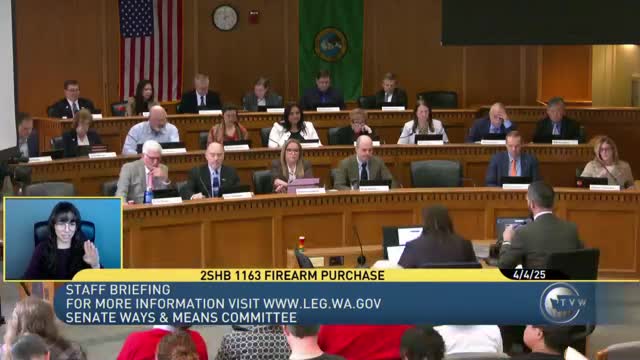
ENGROSSED SECOND SUBSTITUTE HOUSE BILL 1163, the permit-to-purchase and concealed carry overhaul, drew several hours of public testimony and detailed fiscal questioning at the Ways & Means Committee on April 4.
The bill would require buyers to obtain a permit before purchasing a firearm, authorize the Washington State Patrol (WSP) to issue or deny permits within set timeframes, require annual verification of permit holders and add proof-of-training requirements for concealed pistol licenses (CPLs). The Washington State Patrol estimated initial cash receipts of about $11.8 million beginning in FY2027 and requested a one-time general-fund transfer of $8.7 million to set up the State Firearms Background Check System, according to staff briefings presented to the committee.
Supporters — including survivors, public-health advocates and organizations that study gun violence — urged the committee to approve the measure, saying evidence and out-of-state experience show permit-to-purchase regimes can reduce firearm homicides and suicides. Elizabeth Wagner, a research analyst at the Johns Hopkins Center for Gun Violence Solutions, cited studies of Connecticut and Missouri and told the committee that Connecticut’s permanent-purchase law was associated with reductions in gun homicide and suicide.
Opponents, including firearms trade groups, shooting-range owners and individual gun owners, argued the proposal would impose heavy costs on law-abiding citizens, exacerbate race- and income-based inequities, and would be vulnerable to litigation. Multiple witnesses raised concern about the Washington State Patrol’s capacity to administer a new permitting system given existing delays in background checks. Daniel Mitchell, who testified in opposition, said the bill would “waste tens of millions of dollars” and create barriers for lawful gun owners. Several speakers called the bill a “poll tax” because of permit and training costs.
Fiscal and operational concerns dominated questioning. Committee staff relayed the WSP estimates shown in the bill’s fiscal note: a projected $11.8 million in fee revenue beginning in FY27, an $8.7 million initial general-fund transfer to cover startup costs that the patrol expects to be reimbursed by fees by mid-2028, and $13.7 million in WSP expenditures over the 2025–27 biennium for program implementation and operations. The Department of Licensing estimated a modest systems update cost of $48,000. Several testifiers — including law-enforcement commentators and county officials — told the committee they believed the patrol’s application-volume estimate (100,000 applications per year) could be low compared with the number of firearms and background checks currently processed in the state.
Public-safety and equity arguments appeared on both sides. Supporters argued that permit-to-purchase laws have been associated with reductions in firearm deaths and that annual verification and training requirements would prevent ineligible people from retaining access to firearms. Opponents, including the Washington State Rifle and Pistol Association and the National Shooting Sports Foundation, warned the bill would drive law-abiding owners off insurance panels and out of the regulated market — without deterring criminal access to illegal firearms.
Committee staff said they had not received representation from the Washington State Patrol at the policy hearing and noted the agency’s implementation questions remained central to the fiscal review.
The committee did not take a vote during the April 4 session. With broad public participation and contrasting technical estimates on staffing, systems and legal risk, lawmakers signaled additional work would be required before the Legislature could move the bill forward.
Ending: The bill remains under review; staff recommended additional technical follow-up with implementing agencies to refine cost, capacity and legal risk estimates before any final committee action.