Get Full Government Meeting Transcripts, Videos, & Alerts Forever!
Get email alerts on the Budget Fy26 topic
No spam. Unsubscribe anytime.
District projects $4.9 million FY26 shortfall under current assumptions; trustees urged belt-tightening
Summary
At a Feb. 25 board meeting, district finance staff presented initial budget assumptions showing a projected $4.9 million deficit for FY26 under current estimates, driven by declining enrollment and rising benefit costs. Trustees asked staff to seek reductions and provide regular updates.
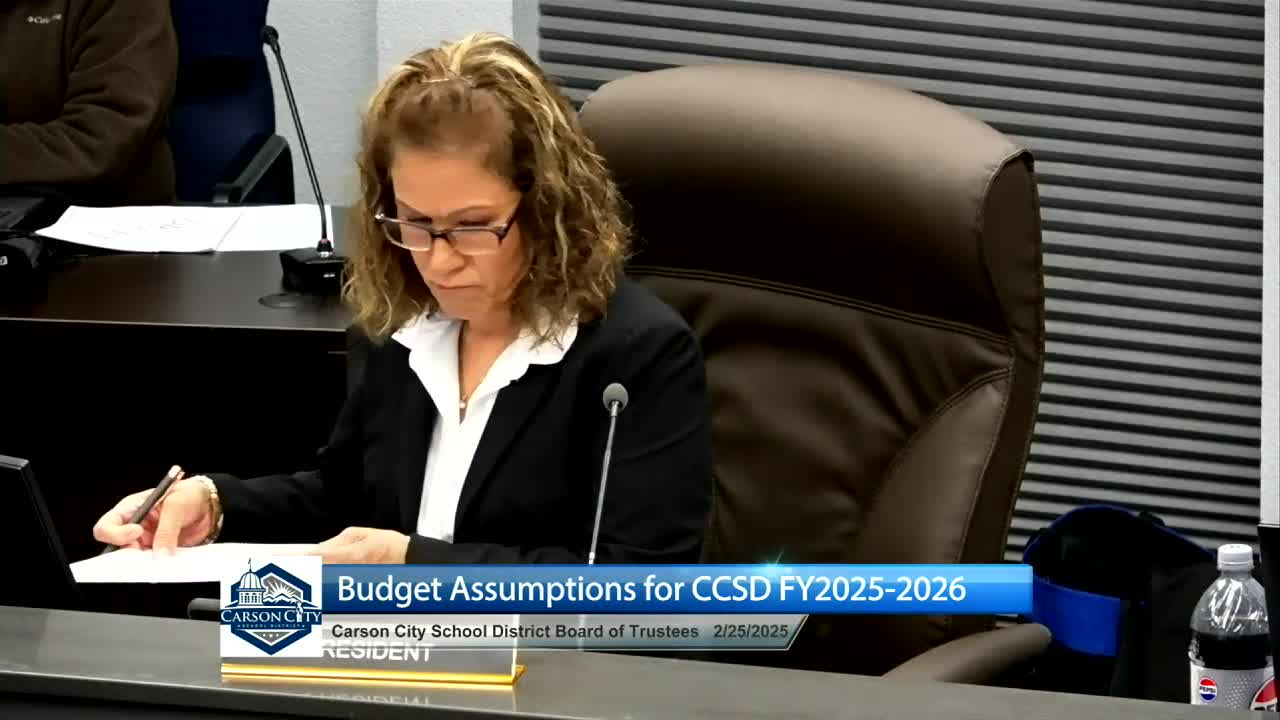
District finance staff presented a preliminary FY26 budget timeline and budget assumptions at the Feb. 25 Carson City School District Board meeting and reported a projected deficit of $4,900,000 under the assumptions available at the time.
Mr. Windward, presenting the assumptions, said the district is budgeting for 6,884 students for FY26, a decline from the 7,001 students used in the district’s December FY25 budget. State per-pupil funding in the governor’s budget was described as effectively “flat,” with an estimated $3 per pupil increase for FY26 (about $20,000 for the district) and a notional $75 per pupil in FY27 if current proposals hold.
That revenue forecast, combined with expenditure assumptions, produced a preliminary revenue estimate of roughly $80.8 million and projected expenditures of about $85.7 million, yielding the $4.9 million gap.
Staff highlighted several cost drivers: a Public Employees’ Retirement System (PERS) increase of 3.25% effective July 1, estimated to cost the district about $1.8 million; a full year of step increases estimated at $860,000; each 1% of salary increase equaling roughly $811,000; and an assumed 10% health-insurance increase equal to approximately $485,000.
Budget staff emphasized the numbers are early assumptions subject to change as the legislative session unfolds, federal and state allocations are finalized, and actual staffing vacancies and retirements take effect. The board was told NRS 354 permits post-session budget amendments within 30 days of the end of the legislative session.
Trustees pressed staff for further work to reduce the projected shortfall. Trustee Walker asked staff to review positions that had been grant-funded and consider whether vacancies could be used to reduce general-fund obligations. President Lupe Ramirez and other trustees asked for regular briefings and suggested small-group walkthroughs of the budget documents for newer trustees.
Finance staff said the district’s current fund balance (approximately $17.3 million at the end of FY24) would absorb the projected deficit and leave an estimated ending fund balance around 14% if the $4.9 million shortfall materializes — above the state-required 4% but below some internal targets.
No formal action was taken; the item was presented for discussion only and staff indicated they would return with refined estimates and options to reduce the gap.